
Newsletter 07 Oct 2024
Environment: What’s Up in GENeva | 7 – 13 October 2024
The Geneva Environment Network’s weekly newsletter includes the latest information on the global environmental agenda, main events, job vacancies, as well as other useful resources and updates. Stay tuned and follow us on X (Twitter), Facebook, LinkedIn, Instagram, and Youtube, or visit our website regularly for additional updates.
Celebrate with us and join our 25th Anniversary of the Geneva Environment Network call for video messages. To take part, record a video message (maximum 2 minutes) on how the Geneva Environment Network has been GENerating participation and engagement for increased collaboration among stakeholders for stronger environmental governance in the fight against the triple planetary crisis.
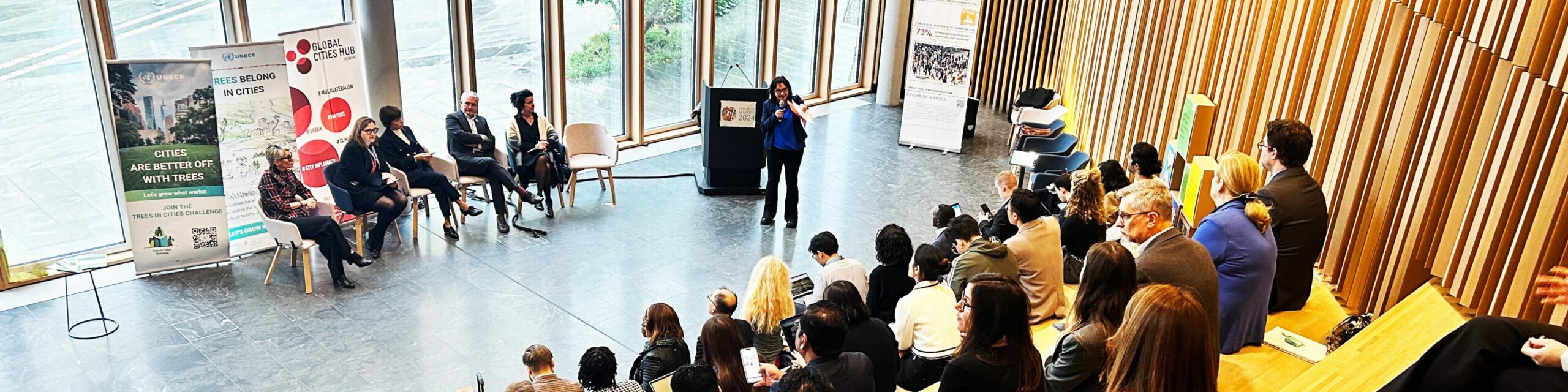
Image of the week | Co-Director of the Global Cities Hub, Kamelia Kemileva, moderating the side event to the Forum of Mayors, discussing Solutions for a Triple Planetary Crisis in Cities, on 1 October 2024, at Palais des Nations.
Informing on the Progress of Establishing a Science-Policy Panel for the Pollution Crisis | Road to OEWG 3.2 Series
The ad hoc open-ended working group (OEWG) on a science-policy panel to contribute further to the sound management of chemicals and waste and to prevent pollution is approaching a critical juncture with the upcoming negotiations at its resumed third session (OEWG 3.2). Negotiations have progressed in June 2024 in Geneva, yet the OEWG was not able to conclude its work and there are still some main areas for discussions.
In the lead up to OEWG 3.2, the OEWG Secretariat and the Geneva Environment Network are hosting “Road to OEWG 3.2 Series” of events to build bridges and promote collaboration and knowledge sharing between and among stakeholders, and to raise public awareness about the OEWG preparing proposals for the scope, shape and function of the panel. This week, a new information session on foundational document and rules of procedure will provide an opportunity for governments and other stakeholders to be informed of the process at the close of OEWG 3.1. The virtual event will indeed include a detailed presentation of the draft rules of procedure as they stand at the close of OEWG 3.1 and explanations on technical aspects of decision-making processes, quorum, and voting procedures, as well as provisions for the inclusion of non-state actors. → Register to attend on Webex on 10 October 2024 from 14:00 to 15:30 CEST.
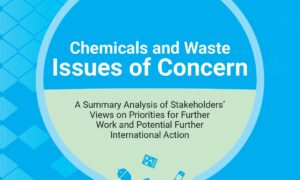
Chemicals and Waste Issues of Concern: Priorities for Further Work and International Action
At its resumed fifth session, the UN Environment Assembly (UNEA-5.2) adopted resolution 5/7 requesting the Executive Director of UNEP to seek views from Member States and other stakeholders on priorities for further work, building on existing measures and initiatives, and on potential further international action on the issues discussed in the Assessment Report on Issues of Concern. In response to this request, UNEP conducted in 2023 a consultation process on priorities for further work and potential further international action on these chemicals and waste issues of concern. A summary analysis, taking into account the views expressed, was prepared and made available in an advance version to UNEA-6 (Nairobi, 26 February to 1 March 2024).
The final version of the “Chemicals and Waste Issues of Concern: A Summary Analysis of Stakeholders’ Views on Priorities for Further Work and Potential Further International Action” will be launched this week at a virtual event co-organized by UNEP Chemicals and Health Branch and the Geneva Environment Network, which will feature an introduction by the authors of the report and offer a platform to discuss its main findings as well as the role of existing instruments and new mechanisms under negotiation in addressing these issues of concern. → Register and join us on Webex on 11 October 2024 from 13:30 to 15:00 CEST.
WTO Trade and Environment Week | Inclusive Shift to Sustainability
The fifth edition of the World Trade Organization Trade and Environment Week kicks off this Monday at the WTO’s headquarters and virtually. Complementing the regular work of the Committee on Trade and Environment (CTE), the week aims to foster exchange around trade-related environmental issues between the WTO and trade and environment stakeholders. The 2024 edition will feature a High-Level Event, 15 side events, a book talk, networking receptions, and an art exhibition. The theme of this year’s High-Level Event is “Trade for Clean Energy Transition for All” and Members’ side events focus on a diverse array of topics proposed. These include: plastic pollution, critical minerals, sustainable agriculture, SDGs, voluntary sustainability standards, calculation of embedded emissions, environmental goods and services, renewable energy, nature positive trade, and trade-related climate measures. → Discover the programme and register to attend in person.
Environment @ 57th Session of the Human Rights Council
The 57th session of the UN Human Rights Council (HRC57) is expected to conclude in Geneva on 11 October 2024. → Consult regular updates on key environmental issues at HRC57, side events, and further resources available on our dedicated HRC57 and the environment update.
Resolutions relating to the global environmental agenda tabled at this session include:
- A/HRC/57/L.9 | Promotion of a democratic and equitable international order | Cuba
A/HRC/57/L.14 | Technical assistance and capacity-building to address the human rights implications of the nuclear legacy in the Marshall Islands | Fiji, Marshall Islands, Nauru, Samoa and Vanuatu - A/HRC/57/L.19 | Right to development | Uganda on behalf of the Non-Aligned Movement Group
A/HRC/57/L.23 | Human rights to safe drinking water and sanitation | Germany and Spain - A/HRC/57/L.26 | Biodiversity and human rights | Colombia and Costa Rica
- A/HRC/57/L.29 | Human rights and Indigenous Peoples | Mexico and Guatemala
- A/HRC/57/L.31 | Mandate of the Special rapporteur on the promotion and protection of human rights in the context of climate change | Marshall Islands, Bahamas, European Union, Fiji, Panama, Paraguay, Sudan
Events of interest taking place this week include:
- Climate Change in the Context of Armed Conflict | HRC57 Side Event | 7 October 2024 | 16:00 – 17:00 CEST | Palais des Nations, Room XXV | Association Ma’onah for Human Rights and Immigration
- Indigenous Summit Just Transition | Indigenous Peoples’ Perspectives, Knowledge, and Lived Experiences | 8 – 10 October 2024 | Ibis Geneva Centre Nations | IPGCC, SIRGE Coalition, Cultural Survival, First Peoples Worldwide, Batani Foundation, Society for Threatened Peoples, IWGIA
IUCN Leaders Forum | Harnessing innovation, enabling conservation
The third edition of the IUCN Leaders Forum will be held at Palexpo Convention Center and virtually from 8 to 10 October 2024 under the theme “Harnessing innovation, enabling conservation”. Ahead of the UN summits on Biodiversity, Climate and Land — the three Rio Convention meetings of the Conference of the Parties (COPs) — later this year, the Forum will bring together government, corporate, Indigenous and youth leaders, and changemakers from around the world to discuss transformative change to achieve the global goals for nature and climate and will offer a timely platform to highlight innovative solutions to address the triple planetary crisis and prioritize nature at the nexus of energy systems, food and agriculture, and human health.
Building on past editions, the event will provide an opportunity to take stock of progress made on innovations in monitoring, regulatory frameworks and reporting directives, and disclosure and accountability tools. The Forum will explore innovative financing to accelerate change, including through scaling private sector finance, leveraging private philanthropy, repurposing subsidies and aligning climate and biodiversity funding to meet the global goals, including through emerging instruments such as biodiversity credits. → Discover the programme and register for either in-person or online participation.
Supporting African Journalists in Covering Environmental Issues
To mark the launch of a publication on the state of environmental journalism in Africa in 2024, the Geneva-based think tank Africa 21 is organizing a dialogue on the importance of access to environmental information. The event, to be held in French, will provide a general reflection on access to information, knowledge management policies and concrete examples of tools or initiatives available to journalists in international Geneva, to facilitate their work and give them access to interesting data for their day-to-day work. → Register on indico and join the event in person on Friday 11 October 2024 at 15:00 CEST at the Palais des Nations, Conference Room of the Visitors Service Room, Door E40.
The publication to be launched is based on the survey of 150 journalists from 29 African countries conducted by Africa 21 in May 2024. The results highlight that the sector is in crisis and that environmental issues are particularly badly off. There is a lack of financial resources, but also a lack of training to deal with subjects that can quickly become very complex, with 44% of the journalists questioned acknowledging a lack of technical expertise and understanding of the issues involved. → Read the press release.
Updates on Impacts of Climate Change
From melting glaciers to heating ocean temperatures and devastating extreme weather events, recent studies and news highlight the urgency to enhance climate action.
- Melting Glaciers | Recent data recorded by the Glacier Monitoring in Switzerland (GLAMOS) network demonstrate that, despite exceptionally large volumes of snow last winter, a combination of temperatures in July and August that at times reached record levels and dust from the Sahara resulted in a loss of 2.5% of the glacier volume. Overall, the glaciers also experienced melting of a striking degree in 2024. The retreat of the glacier tongues and their disintegration, a clear symptom of climate change, has caused in 2022 and 2023 a total of 10% of Swiss glacier volume to disappear, with losses in 2024 exceeding the mean value of the last decade. → Read Severe melting of glaciers despite heavy snowfall at high altitudes | Swiss Academy of Sciences (SCNAT) | 1 October 2024
- Ocean Warming | The recently released 8th issue of the EU Copernicus Ocean State Report (OSR 8), issued last week, has sounded the alarm on the record-breaking extreme events facing the ocean, including deep and intense marine heatwaves, unexpected phytoplankton blooms, as well as increased ocean warming. Among the most striking findings, the reports assess that:
- In 2023, 22% of the global ocean surface experienced at least one severe to extreme marine heatwave event.
- Higher temperatures have been recorded in uncommon depths (below 150m).
- Unprecedented sea ice loss in both poles with water temperatures rising over 4°C.
- Extreme Weather Effects | Extreme weather events such as cyclones, prolonged forest fires and hurricanes have been making headlines in the past months, providing the basis for further understanding of how climate change is changing the environment. A recent study, published in Nature, has found that South America is becoming warmer, drier, and more flammable, causing an increment in the occurrence of droughts and weather conditions associated with enhanced fire risk. Now magnified by the ongoing Hurricane Helene hitting North America, it is ever more evident that natural catastrophes are becoming more expensive and more common.
- The International Ski and Snowboard Federation and the World Meteorological Organization have announced a new partnership to raise awareness of the fact that winter sports and tourism face a bleak future because of climate change.
Updates on Ending Plastic Pollution Agenda
On the road to the fifth session of the Intergovernmental Negotiating Committee to develop an international legally binding instrument on plastic pollution (INC-5), intersessional work continues advancing the process and stakeholders and issuing studies and reports. Rewatch last Friday’s Road to Busan Geneva Beat Plastic Pollution Dialogue, with the INC Chair, H.E. Amb. Luis Vayas and leading voices, highlighting key points of convergence for a successful Plastics Treaty. → Consult our regularly updated page Road to Busan | Plastics INC-5.
Upcoming events, recent news and reports include:
- Empowering Trade to Combat Plastic Pollution: Ensuring Coherence and Leveraging Trade-related Capacity Building Efforts | As part of the 5th WTO Trade and Environment Week, the Coordinators of the Dialogue on Plastics Pollution (DDP) will host a session to highlight ongoing trade aid efforts in supporting members in aligning their trade policies with efforts to reduce plastic pollution. The session will explore potential opportunities for synergies, coherence and how to ensure aid efforts are efficient and aligned with developing members’ needs. → Join the session taking place on 7 October 2024 from 11:15 to 12:30 CEST in Room W, WTO and Youtube.
- Policy Scenarios for Eliminating Plastic Pollution by 2040 | OECD | 2 October 2024
This report provides insights into the potential environmental benefits and economic consequences of different levels of international policy ambition towards ending plastic pollution by 2040. Based on the quantification of the main drivers of plastics production and use, waste and pollution, the report provides projections of the plastics lifecycle, waste generation and treatment, as well as related leakage to the environment. Its findings can inform a critical stage of international negotiations to develop a legally binding agreement to end plastic pollution. - Structure and Elements of International Legal Instruments: Key Considerations for the Future Plastics Treaty | CIEL | 1 October 2024
This issue brief examines the three principal types of treaties: substantive (or specific), framework, and hybrid conventions, providing lessons learned from previous multilateral environmental agreements such as the Montreal Protocol and the Basel Convention. It also provides an analysis of different options for treaty design and the risks associated with each. - Final Provisions of International Legal Instruments: Key Considerations for the Future Plastics Treaty | CIEL | 1 October 2024
Final provisions — the technical provisions that help describe how a treaty will enter into force, be ratified, and undergo future revisions — are critical for a future treaty’s success. This brief provides insight and analysis into how multilateral environmental agreements, including the United Nations Framework Convention on Climate Change, Basel Convention, and Convention on Biological Diversity have addressed final provisions and it offers takeaways for negotiators working on the future plastics treaty.
- Civil Society Groups call on Plastics Treaty negotiators to agree on a text that effectively tackles plastic pollution across its lifecycle | BreakFreeFromPlastic | 1 October 2024
As plastic treaty negotiations enter a crucial phase in Nairobi, African nations, GRULAC, PSIDS & Philippines lead the charge for binding measures to cut plastic pollution, address the full lifecycle impacts, and phase out harmful plastics. - The Hard Truth About Soft Plastic | EIA | 1 October 2024
Through the use of trackers placed in Sainsbury’s and Tesco takeback schemes, investigative research and more we found that 70% of tracked soft plastic bundles that reached a final treatment waste facility were burnt, not recycled. In addition, that tracked bundles show that collected soft plastic packaging waste continues to be exported abroad, both for recovery (incineration for energy recovery) and recycling and that the majority of tracked bundles sent to recycling facilities were exported to Türkiye. - #WeAreWatching | Greenpeace and Dan Acher
Greenpeace and its global movement are collaborating with #WeAreWatching designed by Geneva-based artivist Dan Acher to demand bold action. From 25 November to 1 December, world leaders will meet in Busan, South Korea to agree on a Global Plastics Treaty. Let’s make sure it cuts plastic production and ends single-use plastic! #WeAreWatching is a monumental flag, showing an eye made up of thousands of portraits contributed from around the world. It will fly above Busan on a crane the height of a 10-story building to hold leaders accountable as they decide the future of our planet. Its message is crystal-clear: The world is watching!
Happening Abroad
Berlin Climate Security Conference | The sixth edition of the annual Berlin Climate and Security Conference, taking place on Tuesday 8 October, will explore how to secure a climate for peace. The conference will examine why climate must be integrated into the entire conflict cycle. Through taking stock of best practice examples, it will further advance concrete climate security approaches and initiatives. Various experts from International Geneva are joining the 2024 edition.
Pre-COP to the 2024 UN Climate Change Conference | UNFCCC COP 29 President outlined in July 2024 the Presidency’s vision for the 2024 UN Climate Change Conference, including key calendar moments in the lead up to the meeting. Azerbaijan announces it will host representatives of negotiating groups and Constituencies at Pre-COP in Baku on 10-11 October. A High-Level Ministerial Dialogue has been announced on the NCQG on 9 October ahead of Pre-COP.
What (Else) To Read Next?
- G20 Ministerial Declaration reaffirms commitment to tackle environmental challenges | UNEP | 4 October 2024
The G20 Environment and Climate Sustainability Working Group Ministerial Declaration both acknowledges the G20’s responsibility for the majority of greenhouse gas emissions, resource use and waste generation and reaffirms the G20’s commitment to doing something about the resulting environmental challenges.
- Why the Next Three Months Are Critical for People, Nature, and Climate | Ani Dasgupta | TESS | 2 October 2024
Decision-makers from nearly every country on the planet will attend a series of high-profile international summits between now and the end of the year. Together, they offer a unique chance to address the biggest challenges facing people, nature, and climate. - Towards Planet Positive Chemicals: WBCSD unveils Chemical Transformation Roadmap | WBCSD | 1 October 2024
The World Business Council for Sustainable Development, in collaboration with nine leading chemical companies and sustainability consultancy ERM, has issued the “Towards Planet Positive Chemicals: A Chemical Transformation Roadmap Enabled by the Circular Economy” which aims to drive transformative change across the chemical industry and downstream manufacturing value chains. - Genève, un modèle pour la diplomatie environnemental | Jean-Pierre Reymond | Tribune de Genève | 1 October 2024
Toutes les organisations internationales présentes à Genève intègrent d’ailleurs aujourd’hui, d’une manière ou d’une autre, les problématiques environnementales dans leurs travaux, contribuant ainsi au respect de notre droit à un environnement propre, sain et durable.
- Too few countries on track to restore nature by 2030, unveils new country tracker ahead of global nature conference | WWF | 30 September 2024
WWF launched new tracker of national biodiversity plans to help policymakers, businesses and civil society follow progress on key global nature framework. - G20 Governments are Spending Three Times as Much on Fossil Fuels as Renewables | IISD | 30 September 2024
In the first inventory of its kind, IISD tracked the public financial support G20 governments delivered to renewable power, grids, and storage over the past 4 years.
- Poison PR – US taxpayers funded a covert campaign to downplay the risks of pesticides and discredit environmentalists in Africa, Europe, and North America | Lighthouse Reports, the Guardian US, Africa Uncensored, Le Monde, the New Lede, The New Humanitarian, ABC News Australia, and the Wire | 27 September 2024
Lighthouse Reports – in a global collaboration with the Guardian US, Africa Uncensored, Le Monde, the New Lede, The New Humanitarian, ABC News Australia, and the Wire – delves into the underground social network bringing together the agrochemical lobby and government to weaken global environmental efforts. A year-long investigation managed to penetrate a PR operation that casts those who raise the alarm around the world, from pesticide critics to environmental scientists and UN Human Rights experts or sustainability campaigners, as an anti-science “protest industry”.
- Guidance on Mercury Releases | Minamata Convention on Mercury | September 2024
This document sets out guidance on best available techniques and best environmental practices (BAT/BEP) to control releases of mercury from relevant sources, adopted by the Conference of the Parties (COP) to the Minamata Convention on Mercury at its fifth meeting in 2023, pursuant to paragraph 7 of Article 9 of the Convention.
Events
See all
Body Meeting
57th regular session of the Human Rights Council | HRC57
09 Sep – 11 Oct 2024
Palais des Nations
HRC

Body Meeting
4th Meeting of the Small Intersessional Working group on the Strategic Framework for the Implementation of the Basel Convention | Third Part
07 – 08 Oct 2024
International Environment House II
BRS

Conference
Launch Event: WMO 2023 State of Global Water Resources Report
07 Oct 2024 | 14:00 – 15:00
Online | Zoom
WMO
Virtual
Minamata Online | Implementation of the Minamata Convention: Article 9 – Mercury Releases to Land and Water
07 Oct 2024 | 14:00 – 15:00
Online | Webex
Minamata Convention

Conference
Blue Transformation: Maximizing the contribution of Aquatic Food Systems to the 2030 Sustainable Agenda in SIDS
07 Oct 2024 | 15:30 – 16:30
Palais des Nations & Online
FAO
Workshop
Atelier La Fresque du Climat
07 Oct 2024 | 18:00 – 21:00
Espace 3DD
Association la Fresque du climat

Conference
Indigenous Summit Just Transition | Indigenous Peoples’ Perspectives, Knowledge, and Lived Experiences
08 – 10 Oct 2024
Ibis Geneva Centre Nations
Indigenous Peoples Global Coordinating Committee, SIRGE Coalition, Cultural Survival, First Peoples Worldwide, Batani Foundation, Society for Threatened Peoples, International Work Group for Indigenous Affairs
Body Meeting
Expert meeting on Best Available Techniques and Best Environmental Practices under the Stockholm Convention
08 – 10 Oct 2024
International Environment House II
BRS

Local
The beauties of an 18th-century historical herbarium of mosses: samples and engravings by Johannes Hedwig
08 Oct 2024 | 12:30
Botanical Conservatory and Garden Geneva
Geneva Botanic Garden
Virtual
Fourth Meeting of the Trees in Dry Cities Coalition
08 Oct 2024 | 14:30 – 15:30
Online
UNECE

Afterwork
Forum Transfrontalier de l’Economie Durable, Sociale et Solidaire
08 Oct 2024
Maison Communale de Plainpalais
APRÈS
Conference
Joint FAO-WFP Geneva Informal Briefing on Food Crises
08 Oct 2024 | 15:00 – 16:00
Palais des Nations | Room H-623 & Online | Zoom
FAO, WFP

Body Meeting
First Meeting of the Small Intersessional Working Group on the Improvement of the Functioning of the Prior Informed Consent Procedure under the Basel Convention | Second Part
09 – 11 Oct 2024
Palais des Nations | Room VIII
BRS

Conference
UN High Level Meeting on Antimicrobial Resistance: Are current conflicts a game changer?
09 Oct 2024 | 12:30 – 14:00
Maison de la Paix | Auditorium A2 & Online
IHEID, Geneva Global Health Platform

Virtual
What Makes Minerals and Metals ‘Critical’? Financial benefits and other key considerations for governments
23 Oct 2024 | 15:00
Online | Zoom
IGF, IISD
Conference
The important role of agrifood systems across the Rio Convention Conference of Parties to the United Nations CBD, UNFCCC, and UNCCD
09 Oct 2024 | 15:30 – 16:45
Palais des Nations | Room H-542 & Online | Zoom
FAO, FAO

Conference
Weathering the Storm: the Sectoral Economic and Inflationary Effects of Floods and the Role of Adaptation
10 Oct 2024 | 12:15 – 13:30
Maison de la Paix | Room P1-745
IHEID
Virtual
Road to OEWG 3.2 Series | Information Session on Foundational Document and Rules of Procedure
10 Oct 2024 | 14:00 – 15:30
Online | Webex
OEWG SPP CWP, GEN
Conference
Industrial Energy Efficiency: Bi-monthly open discussion forum | Enhancing Resilience and Efficiency: Circularity-by-Design
10 Oct 2024 | 14:00 – 16:00
Online | Teams
UNECE
Virtual
Fitting the Pieces of the Puzzle: Making sense of sustainability due diligence regulations across the globe
10 Oct 2024 | 15:00 – 16:30
Online | Zoom
IISD

Conference
Should I stay or should I go? Comment les plantes alpines évitent (ou pas) le clash du réchauffement climatique
10 Oct 2024 | 18:00 – 19:30
Botanical Conservatory and Garden Geneva
Geneva Botanic Garden
Virtual
Launch and Panel Discussion | Chemicals and Waste Issues of Concern: Priorities for Further Work and Potential Further International Action – A Summary Analysis of Stakeholders’ Views
11 Oct 2024 | 13:30 – 15:00
Online | Webex
UNEP Chemicals and Health Branch

Conference
Africa21 Report Launch at the Occasion of the International Day for Access to Information
11 Oct 2024 | 15:00 – 16:30
Palais des Nations | Room Philatélique (Visitor Service)
Africa 21


Jobs
See all


Professional
Project Certification Expert: Construction with Forest and Tree-based Material
10 Oct 2024
PEFC
Updates
See all

28 Sep 2026
World Migratory Bird Day

17 Sep 2026
The Water Cycle and the Role of Geneva



23 Aug 2026