Newsletter 07 Sep 2026
Environment: What’s Up in GENeva | 7 – 13 September 2026
The Geneva Environment Network’s weekly newsletter includes the latest information on the global environmental agenda, main events, job vacancies, as well as other useful resources and updates. The Geneva Environment Network is not responsible for the content of any linked site or any link contained in a linked site. Stay tuned and follow us on X (Twitter), Facebook, LinkedIn, Instagram, Bluesky, Youtube and WhatsApp, or visit our website regularly for additional updates.
This week, several organizations will be closed on Thursday 10 September, in observance of Jeûne Genevois, the traditional public holiday celebrated in the Canton of Geneva.
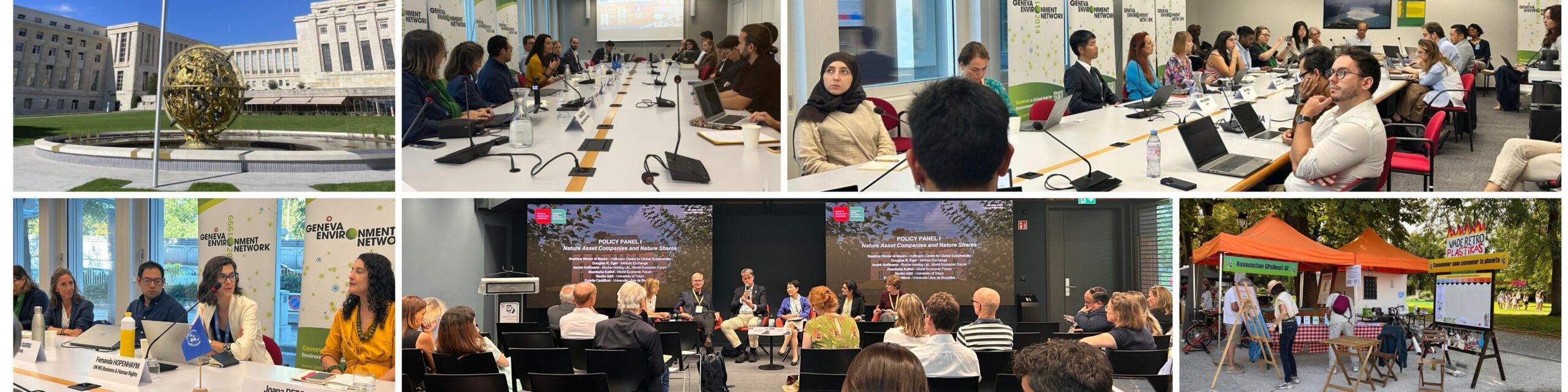
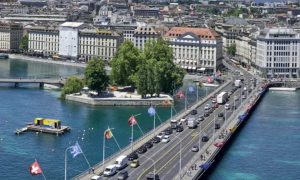
Image of the week | A non-exhaustive snapshot of events from last week at the International Environment House, Palais des Nations, Villa Barton and Parc des Bastions. © UNEP/GEN, UN Photo/Miladin Bogetic.
63rd Session of the UN Human Rights Council Kicks Off in Geneva
The UN Human Rights Council holds its 63rd session from 7 September to 7 October 2026, opening its four-and-a-half-week session in Geneva with an oral update by the High Commissioner for Human Rights, Volker Türk, on the global state of human rights. → Follow the discussion on UN Web TV.
The implications for human rights of the environmentally sound management and disposal of hazardous substances and wastes are the usual main environmental theme of the Council’s September sessions. The newly appointed UN Special Rapporteur on toxics and human rights, Bethanie Carney Almroth, will present her vision for the mandate during her first interactive dialogue with the Council, scheduled to begin on Friday 11 September 2026. She will also present the report of the previous mandate holder, Marcos Orellana, on “Forever chemicals and human rights” (A/HRC/63/27). The report examines how per- and polyfluoroalkyl substances (PFAS) impair the effective enjoyment of human rights, as they have the potential to irreversibly alter the chemical composition of life-supporting ecosystems and impair human and environmental health. With toxics and human rights high on the agenda, various side events with the Special Rapporteur will include:
- Horizon Scanning: a conversation with the Special Rapporteur on the implications for human rights of the environmentally sound management and disposal of hazardous substances and wastes on the priorities for the mandate | HRC63 Side Event | 14 September 2026 | 12:00–13:00 CEST | Palais des Nations, Concordia 1 | SR toxics
- Role of Science in Addressing Hazardous Substances and Human Rights | HRC63 Side Event | 14 September 2026 | 13:00–14:00 CEST | Palais des Nations, Room XI | Earthjustice, with support of GEN
- Corporate Influence in the Context of Health and Environmental Protection — What role for human rights and accountability? | HRC63 Side Event | 14 September 2026 | 15:00–16:00 CEST | Palais des Nations, Room XI | CIEL, FIAN, with support of GEN
- Informal Meet-and-Greet with SR toxics and human rights | 15 September 2026 | 8:30–9:45 CEST | La Pastorale, Route de Ferney 106 | Closed meeting, open to Indigenous Peoples and civil society organizations.
- Toxic Substances and Waste and Human Rights: Challenges, Responsibilities and Ways of Achieving Solutions | HRC63 Side Event | 16 September 2026 | 13:00–14:00 CEST | Palais des Nations, Concordia 1 | Côte d’Ivoire, Democratic Republic of the Congo, African Group, RADDHO and Earthjustice
Other contributions to the global environmental agenda in this session will include:
- The UN Special Rapporteur on the human rights to safe drinking water and sanitation, Pedro Arrojo Agudo, will present his report to the Council focusing on “Making the human right to sanitation a reality for all” (A/HRC/63/34). On the eve of the 2026 UN Water Conference to Accelerate the Implementation of Sustainable Development Goal 6 and the review of the 2030 Agenda for Sustainable Development, the report calls for renewed commitment to the universal realization of the human right to sanitation for all.
- The Office of the High Commissioner for Human Rights (OHCHR), following its first report on the nuclear legacy of the Marshall Islands (A/HRC/57/77), will present a second report (A/HRC/63/76) on addressing the challenges and barriers to the full realization and enjoyment of the human rights of the people of the Marshall Islands, stemming from the State’s nuclear legacy, focusing on elements of justice and accountability.
- The Working Group on the Rights of Peasants and Other People Working in Rural Areas will present its report on “Right to Seeds” (A/HRC/63/26). As seeds are foundational to food systems, biodiversity, culture and rural livelihoods, the report aims to clarify the content and scope of the right to seeds, assess challenges and good practices in its implementation, and formulate recommendations to States and other actors to ensure that seed governance frameworks are consistent with human rights, biodiversity conservation and food sovereignty.
- In line with its resolution 59/25, the Council will be presented the synthesis report by the UN Secretary-General (A/HRC/63/54) on actionable pathways in mobilizing sufficient climate financing and associated challenges and opportunities in the pursuit of the full realization of human rights for all people.
- The UN Expert Mechanism on the Right to Development is also expected to present its thematic study on “Climate finance: vulnerability and responsibility” (A/HRC/63/39) that analyzed processes and innovative practices that contribute to financing climate transition and development at various levels, identifying the conditions under which they are compatible with the right to development.
- Ahead of the fifth anniversary of the landmark recognition by the Human Rights Council of the human right to a clean, healthy and sustainable environment on 8 October 2026, a celebration is scheduled to take place in the margins of HRC63 on 24 September 2026. The celebration aims to provide an opportunity to celebrate advances and to assess the evolution of the right. It will serve both as a commemoration and a moment for renewed commitment to the implementation of the right to a healthy environment.
- The rights of Indigenous Peoples will also be addressed in this session of the Council.
- The UN Special Rapporteur on the rights of Indigenous Peoples, Albert K. Barume, will present his annual report on “Historical and contemporary forms of violations against Indigenous women and girls’ sexual and reproductive health and rights” (A/HRC/63/30), highlighting structural discrimination and environmental contamination as one of the four primary drivers.
- The Expert Mechanism will present its study on the rights of Indigenous Peoples in conflict and post-conflict situations (A/HRC/63/65), identifying key conflict dynamics and highlighting the disproportionate impact of conflict on Indigenous Peoples, including violence, displacement, environmental degradation and the erosion of cultural and governance systems, as well as pressure linked to climate change and resource competition.
- The theme of the annual half-day panel discussion on the rights of Indigenous Peoples, taking place on 23 September 2026, will be on “Convention for the Protection of the World Cultural and Natural Heritage: Indigenous Peoples’ rights and engagement”.
- The right to development will also feature in this session of the Council with the report of the UN Special Rapporteur on the right to development, Surya Deva (A/HRC/63/32) that will provide practical guidance on ensuring active, free and meaningful participation, in line with the model of “planet-centred participatory development”. The Expert Mechanism on the Right to Development will also present its thematic study (A/HRC/63/40) that focuses on artificial intelligence, cultural rights and the right to development.
Various environment-related side and parallel events are taking place in the margins of HRC63, with the week of 14 September 2026 particularly busy. Events taking place this week include:
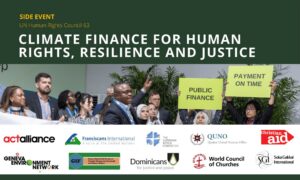
- Climate Finance for Human Rights, Resilience and Justice | HRC63 Side Event | 7 September 2026 | 14:00–15:00 CEST | Palais des Nations, Room XI & YouTube| Franciscans International, Geneva Interfaith Forum on Climate Change, Environment and Human Rights, ACT Alliance, Quaker United Nations Office, Dominicans for Justice and Peace, Soka Gakkai International, World Council of Churches, Lutheran World Federation, Christian Aid, with support of GEN
This side event will explore actionable pathways for climate finance mobilization and how this must support adaptation, address loss and damage, and strengthen resilience.
- Climate justice and human rights in contexts of foreign occupation | HRC63 Side Event | 8 September 2026 | 14:00–15:00 CEST | Palais des Nations, Concordia 1 | Mozambique
- Biennial panel discussion on the right to development | Commemoration of the fortieth anniversary of the Declaration on the Right to Development | 11 September 2026 | 10:00–12:00 CEST | Palais des Nations, Assembly Hall & Online
- Interactive Dialogue with SR right to development | 11 September 2026 | 12:00 CEST onwards | Palais des Nations, Assembly Hall & Online
- Participatory development: Why it matters and how to achieve it | HRC63 Side Event | 11 September 2026 | 14:00–15:00 CEST | Palais des Nations, Concordia 1 | India & SR right to development
- Women’s Technological Leadership in Facilitating Just Transitions in the Climate Crisis | HRC63 Side Event | 11 September 2026 | 14:00–15:00 CEST | Palais des Nations, Room XI | WOMENVAI – Women and Men in Environment and Artificial Intelligence
- Interactive Dialogue with Expert Mechanism on the right to development | 11 September 2026 | 15:45–17:00 CEST | Palais des Nations, Assembly Hall & Online
- Interactive Dialogue with SR toxics and human rights | 11 and 14 September 2026 | 17:00 CEST onwards | Palais des Nations, Assembly Hall & Online
- Informal consultations on draft resolutions that address the environment, expected to be tabled at this session of the Council, will begin this week. Draft resolutions include the renewal of the mandate of the UN Special Rapporteur on toxics and human rights, human rights to safe drinking water and sanitation, human rights and Indigenous Peoples, addressing the challenges and barriers to the full realization and enjoyment of the human rights of the people of the Marshall Islands, stemming from the State’s nuclear legacy, and human rights implications of the use and testing of nuclear weapons.
→ Regular updates on key environmental issues at HRC63, side events and further resources are available on our dedicated HRC63 and the environment update. Consult the press release on the upcoming session by the United Nations Information Service in Geneva.
Beyond 1.5°C | Acting Now to Get on an “Overshoot, Peak, and Decline” Pathway
As global temperature rise gets set to cross 1.5°C above pre-industrial levels within the next few years, climate risks and impacts will reach dangerous new heights. A new UNEP spotlight report, Limiting Overshoot: Navigating exceedance of 1.5°C and pathways towards return, finds that the goal may be achieved by acting now to get on an “overshoot, peak, and decline” pathway. The world must strive to minimize peak temperatures, return to 1.5°C or below as soon as possible, and reduce the vulnerability of societies, communities and economies to those impacts that cannot be avoided. → UNEP Press Release
Messages of the report include:
- Despite some progress on addressing climate change, global temperature rise is set to cross 1.5°C above pre-industrial levels, likely within the next few years. There are no good outcomes in remaining above 1.5°C.
- Following an ‘overshoot, peak and decline’ pathway is the best remaining option to bring temperatures to or below 1.5°C by the end of the century, which remains the goal, and adapt to unavoidable impacts.
- Rapid, collective and global action is vital: lower peak warming and shorter exceedance duration will reduce risks and impacts, make efforts to help communities cope less difficult and less expensive, and increase the chances of bringing temperatures back down.
- Equity and justice must form the core of strategies to protect the vulnerable, create a just transition and secure a liveable future for coming generations.
- Mitigation and adaptation are interconnected and mutually reinforcing. They must advance together, while being responsive to emerging risks.
- Carbon Dioxide Removal (CDR) – the process of removing carbon from the air and storing it through afforestation or other means – will be needed in addition to, not instead of, sustained reductions in greenhouse gas emissions, but these methods come with risks and trade-offs that limit their potential and need to be carefully governed.
- A return to or below 1.5°C is uncertain. Even if a return to below 1.5°C is secured, many nations and communities will face irreversible losses and permanently changed conditions. This raises issues of justice, power and political legitimacy that will require new, inclusive governance arrangements.
The release of the report on 2 September 2026 generated significant attention. Reactions from the Secretary-General, UN agencies, the IPCC, environmental organizations, research institutions, and business coalitions underscored a common message: surpassing 1.5°C is not the end of climate ambition, but a warning that urgent emissions reductions, adaptation measures, nature-based solutions and a just transition away from fossil fuels are more critical than ever. Reactions include:
- Secretary-General’s video message on the launch of the United Nations Environment Programme’s Overshoot Report | UN | 2 September 2026
- UNEP: World set to cross 1.5°C global warming, but can still limit, adapt to and return from higher temperatures | UNEP | 2 September 2026
- Overshoot explained: 5 things to understand about a world beyond 1.5°C | UNEP | 2 September 2026
- ‘Fight for humanity’: Avoiding a climate catastrophe means acting now | UN News | 2 September 2026
- What does “overshoot” mean in climate science? | Robert Vautard, IPCC Working Group I Co-Chair | 2 September 2026
- Stark findings from UNEP’s Overshoot report demand urgent, ambitious climate action | IUCN | 2 September 2026
- UN urges faster action to set world on course for ‘overshoot, peak and decline’ on climate | Red Cross Red Crescent Climate Centre | 2 September 2026
- WWF: 1.5°C overshoot is a call for urgent action | WWF | 2 September 2026
- ‘Managing’ Overshoot is Not a Strategy Approaching 1.5°C Is a Call to Double-down on Fossil Fuel Phase Out, Justice and Remedy, Not Gamble on Carbon Removal | CIEL | 2 September 2026
- We Mean Business Coalition response to UN Limiting Overshoot report | We Mean Business Coalition | 2 September 2026
- UNEP declaration of expected 1.5°C overshoot must spark urgent political response | Greenpeace International | 2 September 2026
- UNEP Report Warns World is Soon to Exceed 1.5°C ‒ but Return is Possible | World Resources Institute | 2 September 2026
- Keeping to 1.5C of warming is no longer possible – but we must still limit the overshoot | Climate Change News | 2 September 2026
- Pacific leaders demand end to fossil fuels as UNEP report warns 1.5°C overshoot threatens small island survival | Fossil Fuel Treaty | 2 September 2026
- World Has No Realistic Path to Meet 1.5ºC Warming Target, UN Declares | Health Policy Watch | 2 September 2026
- As UN Warns World Will Cross 1.5°C, Conservation International CEO Sebastian Troëng Underscores Nature’s Role as Part of the Solution | Conservation International | 2 September 2026
El Niño to Intensify into a Very Strong Event in the Coming Months
With an “exceptionally high likelihood of nearly 100%”, the World Meteorological Organization (WMO)’s El Niño/La Niña Update confirmed that El Niño will persist through to February 2027. As the world’s leading source of authoritative climate information for governments and decision-makers, the WMO describes this outlook as unprecedented in its level of certainty. This is the first time that a WMO El Niño/La Niña Update has been so unequivocal, reflecting the strong agreement within WMO’s extensive network. Fuelled by exceptionally warm ocean conditions across the tropical Pacific, El Niño is expected to strengthen further during the coming months to a very strong intensity before peaking towards the end of this year, with climate impacts continuing well into 2027.
As the strength and the severity of the effects of El Niño vary across regions and can be influenced by other climate drivers, WMO has issued a complementary Global Seasonal Climate Update. This assessment integrates information about El Niño and other major climate drivers, providing a more comprehensive picture of expected conditions. During the launch press conference, WMO Secretary-General Celeste Saulo emphasized the urgency of preparedness: “This exceptional El Niño demands exceptional preparation and response.” In response, WMO has initiated an unprecedented mobilization with National Meteorological and Hydrological Services and is strengthening collaboration with partners across the United Nations and humanitarian system to support early action and risk reduction.
Key messages from the El Niño/La Niña Update include:
- El Niño is firmly established and is expected to strengthen further.
- WMO forecasts show near 100% likelihood that it will persist through February 2027.
- Exceptionally warm tropical Pacific Ocean conditions support further intensification.
- A very strong El Niño can significantly shift rainfall and temperature patterns worldwide and fuel extreme weather.
- WMO and National Meteorological and Hydrological Services step up preparedness and early-warning efforts for an exceptional event.
The UN Secretary-General’s Special Report to the 81st Session of the UN General Assembly, “Challenges related to sea level rise and ways and approaches to address it” notes that El Niño events are associated with higher global mean sea levels, further increasing the risk of extreme sea level events. The report also highlights that rising global temperatures are influencing tropical cyclone patterns. As a result, an extreme sea level event, which would normally occur once every 100 years, is now projected under all considered scenarios to occur at least annually in more than half of all tide gauge locations by 2100.
Read more at:
- El Niño/La Niña Update | WMO | 3 September 2026
- El Niño set to become very strong, raising risks of extreme weather into 2027 | WMO | 3 September 2026
- Global Seasonal Climate Update for September-October-November 2026 | WMO | 3 September 2026
- Challenges related to sea level rise and ways and approaches to address it | Special Report of the Secretary-General
- An exceptional El Niño demands an exceptional response | WMO SG Celeste Saulo | 3 September 2026
- El Niño is surging. Months of extreme heat could follow | UN News | 3 September 2026
- US scientists: 70 per cent chance of an historic El Niño | Red Cross Red Crescent Climate Centre | 3 September 2026
- This El Niño is different. Here’s why | Conservation International | 3 September 2026
- El Niño : à quoi faut-il s’attendre ? | ONU Info Genève | 3 September 2026
- El Niño threatens more than two-thirds of children in Eastern and Southern Africa | UNICEF | 1 September 2026
Clean Air Day | Integrated Climate and Clean Air Action for Healthier Populations and Economic Prosperity
The United Nations General Assembly designated 7 September as the International Day of Clean Air for blue skies in 2019, reflecting the global community’s growing recognition of the risks posed by air pollution and the need for urgent action to protect human health and the environment. This year’s observance highlights the strong economic case for integrated climate and clean air action to support healthier populations and economic prosperity. Central to the 2026 campaign are new findings from UNEP and its Climate and Clean Air Coalition (CCAC), including the launch of a spotlight report Hidden assets: The economic and health case for climate and clean air action, which examines the economic benefits of combined air pollution and climate action, assesses the costs and benefits of 25 integrated measures, and identifies policy and financing reforms that can accelerate implementation.
Air pollution has long contributed to death and disease, undermining economic prospects and community well-being. Many sources of air pollution, such as the burning of fossil fuels and biomass, also contribute to greenhouse gas emissions, causing our planet to warm. Like climate change, air pollution affects everyone but impacts pregnant people, babies and children, older people, those living in poverty, and historically marginalized communities. The enormity and immediacy of these challenges cannot be ignored.
The day is marked by a range of events and activities, including:
- WMO Air Quality and Climate Bulletin 2026 | On the occasion of the International Day of Clean Air for Blue Skies, WMO is releasing on 7 September 2026 its Air Quality and Climate Bulletin, which reports annually on the state of air quality and links to climate. It reflects 2025 trends in the geographical distribution and levels of pollutants such as wildfire smoke and ozone.
- Businesses for Clean Air: Advancing Human Rights Through Action | The UN Special Rapporteur on the right to a healthy environment and the UN Working Group on Business and Human Rights are hosting an online event to discuss the role of businesses in tackling air pollution and recommendations and pathways for businesses to advance human rights, including clean air for all. The event will feature an address by the UN Special Rapporteur on the human right to a clean, healthy and sustainable environment, Astrid Puentes Riaño, whose report to the sixty-first session of the Human Rights Council (A/HRC/61/47) discussed “Priority actions towards breathing clean air, protecting public health and ensuring a healthy environment”. → Register to attend the event taking place on 7 September 2026 at 15:00 CEST
- International Clean Air Dialogue | Co-organized by the United Nations Economic Commission for Europe, UNEP, the Climate and Clean Air Coalition, the Forum for International Cooperation on Air Pollution and the Government of Türkiye, the International Clean Air Dialogue will bring together government representatives from different regions, international organizations, academia, research institutions and civil society to exchange solutions and strengthen global and regional cooperation for cleaner air. It will take place on 23 and 24 September 2026 in Istanbul, Türkiye.
Global Plastics Treaty Negotiations | Preparations for Upcoming Heads of Delegation Meetings
The Chair of the Intergovernmental Negotiating Committee (INC) to develop an international legally binding instrument on plastic pollution, including in the marine environment, H.E. Amb. Julio Cordano, continues to engage with Member States and observers on the way forward in the negotiations. To support transparency and facilitate preparations for future sessions, the Chair has been providing regular written updates, including letters and reflection notes to guide Member States, and outlining key developments and areas for discussion. Recent updates include:
- The fourth informal Heads of Delegations (HOD) virtual meeting on 8 and 9 September 2026. This informal virtual meeting is convened to provide a platform for exchanging views and helping to guide the next steps in the INC process.
- To facilitate participation across time zones, the meeting will be held in two alternative sessions: Session 1 on 8 September 2026 from 13:00–15:00 CEST and Session 2 on 9 September 2026 from 23:00–01:00 CEST.
- The Chair shared the Meeting Outline and Guiding Questions, which will prompt delegates to reflect on financial resources and mechanisms and capacity-building, technical assistance and technology transfer, and, if time allows, to provide general reactions to the Aid to Negotiations.
- The meeting will follow a Head of Delegation + 4 format, which includes the designated Head of Delegation or their designated representative, accompanied by up to four additional delegates.
- In a notification shared on 27 August 2026, the INC Secretariat announced a change to the format of the second informal in-person HODs meeting, scheduled for 27 to 30 September 2026, at the United Nations Conference Centre in Bangkok, Thailand. The meeting will now follow a Head of Delegation + 4 (HOD+4) format, an increase from the previously applied HOD+3 arrangement. Participation will therefore include the designated Head of Delegation, or their designated representative, accompanied by up to four additional delegates. Any additional delegates must register on Indico. An updated Note Verbale, reflecting the nomination of any additional delegate, must be uploaded at the time of registration.
Resources released recently by highly engaged stakeholders include:
- CIEL Analysis of the August 2026 Aid to Negotiations for the Global Plastics Treaty | CIEL | September 2026
- APPG on Microplastics launches new report, recommends national plan on microplastics | All-Party Parliamentary Group on Microplastics | September 2026
- Response from the Scientists’ Coalition on the Aid to Negotiations | Scientists’ Coalition for an Effective Plastics Treaty | September 2026
Latest on UN80 Initiative and Work Package 27
The United Nations is advancing a major institutional reform effort under the UN80 Initiative, aimed at strengthening the coherence, effectiveness and impact of the UN system. Recent developments include the adoption by the General Assembly of resolution A/80/L.112 endorsing the merger of the United Nations System Staff College (UNSSC) into the United Nations Institute for Training and Research (UNITAR), creating the new United Nations Institute for Capability and Learning Innovation (UNICLI) effective 1 January 2027. The reform reflects broader efforts to modernize UN learning and capacity-development functions. Geneva will remain the Headquarters of the new Institute, continuing to benefit from proximity to the Geneva-based United Nations and multilateral ecosystem. Turin, Italy, will continue to function as a learning campus and convening space, preserving its established role in United Nations system learning and leadership development. Bonn, Hiroshima, New York and Madrid will continue serving their present functions.
- General Assembly backs creation of new UN learning institute under UN80 reforms | UN News | 3 September 2026
- General Assembly Adopts Resolution Endorsing the Merger of UNSSC into UNITAR, and Establishing the new United Nations Institute for Capability and Learning Innovation | UNITAR | 3 September 2026
- The General Assembly Endorses the Creation of the new United Nations Institute for Capability and Learning Innovation through the Merger of UNSSC into UNITAR | UNSSC | 4 September 2026
- UN80 Training and Research
This week, the 13th Annual Subcommittee Meeting of the Committee of Permanent Representatives of the United Nations Environment Programme is convening in Nairobi for five consecutive days to review the implementation of the existing and the preparation of the new medium-term strategy and programme of work and budget. On the agenda of the meeting are briefings on the UN80 Initiative and Work Package 27 of its Plan of Action. In response to Action 35 of the UN80 Initiative, the Secretary-General tasked UNEP and the UNFCCC with assessing the UN environmental architecture and proposing ways to streamline support for more impactful action.
While environmental issues were not explicitly included in the UN Charter in 1945, an extensive global environmental architecture has emerged over the past decades through UNEP, multilateral environmental agreements and the work of numerous UN entities. Agenda item 7 under the Annual Subcommittee meeting includes a presentation on UN80 Work Package 27, outlining proposals to strengthen the UN system’s environmental architecture in response to growing and increasingly interconnected environmental challenges. Drawing on a review conducted with more than 27 UN entities, the assessment focuses on four areas: science, governance, coordination and implementation. It proposes elevating environmental issues across the UN system by recognizing a healthy environment as foundational to peace, development and human rights; strengthening the role of the United Nations Environment Assembly (UNEA) as the central forum for environmental action; improving the use of science through a shared UN knowledge ecosystem; and enhancing system-wide coordination through a strengthened Environment Management Group (EMG).
Correcting the Map | UN General Assembly Calls for More Equitable Global Representation
On 4 September, the UN General Assembly overwhelmingly adopted the resolution “Correct the map: rebalancing global cartographic representation and promoting equitable representation of the world’s regions, particularly Africa” (A/80/L.104), led by Togo on behalf of the African Group and endorsed by the African Union. The initiative seeks to address distortions created by the widely used Mercator projection, which significantly reduces the apparent size of Africa, the Amazon basin and other regions near the Equator, including critical ecosystems. The resolution encourages the use of equal-area map projections, such as the Equal Earth projection, in educational, institutional and media contexts to better reflect the true relative size of continents and countries.
Read more at:
- UN General Assembly Resolution A/80/L.104, Correct the Map
- UN tells the world: Stop making Africa look small | UN News | 4 September 2026
- Communiqué of the Chairperson of the African Union Commission on the Adoption of the “Correct The Map” Resolution | African Union | 4 September 2026
- Une victoire pour l’exactitude | Republic of Togo | 4 September 2026
- UN General Assembly adopts ‘Correct the Map’ resolution | digwatch | 6 September 2026
Remembering King Harald V | A Legacy of Service and Environmental Stewardship
The passing of His Majesty King Harald V of Norway on 28 August 2026 prompted tributes from national and international leaders, environmental organizations and civil society, reflecting on a reign of over three decades. Last week, the UN Flag at the United Nations Office at Geneva was lowered to half-mast in his honour. Widely respected for his commitment to public service, social inclusion, children’s welfare and environmental stewardship, King Harald was recognized both in Norway and abroad for championing sustainability and conservation issues. This week, Norway will pay its final respects at a State Funeral in Oslo on 9 September, while his son, King Haakon VIII, has succeeded to the throne, continuing a long tradition of service to the Norwegian people under the motto Alt for Norge (“All for Norway”).
The resources below highlight King Harald’s life and legacy, reactions from the United Nations and environmental organizations, and reflections on his contributions to environmental awareness and international cooperation.
- Life and Reign — HM King Harald V of Norway — Memorial Page | Norway
- Deeply Saddened by Passing of His Majesty King Harald V, Secretary-General Applauds Norwegian Monarch’s Commitment to Children’s Welfare, Environmental Issues | UNSG | 28 August 2026
- WWF in mourning over King Harald’s death | WWF Norway | 28 August 2026
- Op-Ed: The World Lost A Stealth Eco-Monarch with the Passing of King Harald V | Clean Technica | 30 August 2026
- Brazil Mourns King Harald V – A Shift in Environmental Priorities? | Foreign Policy Watch Dog | 30 August 2026
Recent Appointments
Recent appointments announced in Geneva include:
- The Intergovernmental Panel on Climate Change (IPCC) has appointed Annett Möhner as next Secretary, effective 1 November 2026. Ms Möhner, currently a Senior Manager at the UN Framework Convention on Climate Change (UNFCCC), is an international climate leader with more than two decades of experience advancing global climate action at the intersection of climate science, sustainable development and multilateral diplomacy. She has been managing the delivery and follow-up to the first-ever Global Stocktake under the Paris Agreement at the UNFCCC since early 2023. Before that, she served as Secretary to the UNFCCC’s Governing Bodies and the Adaptation Committee, helping develop it into an authoritative expert body. Ms Möhner also led engagement with the IPCC, global research community and development finance stakeholders, strengthening the science-policy nexus to enable well-informed, evidence-based policymaking.
- The United Nations Development Programme (UNDP) office in Geneva has announced that Blerta Aliko has assumed her functions in Geneva as Head of the UNDP Geneva Office and Deputy Director of the UNDP Crisis Bureau, on 24 August 2026. In this capacity, she will lead UNDP’s crisis, preparedness, resilience, response and recovery functions, and UNDP’s engagement with the humanitarian, peace and crisis management system in Geneva and globally. The former UNDP director Agi Veres will continue in Geneva in a new capacity as Director of Partnerships and External Relations, leading UNDP’s strategic partnerships and external engagement with International Geneva, development actors, organizational partners and Member States.
More Happening Around the World
81st Session of the UN General Assembly | The 81st ordinary session is opening on 8 September 2026 under the presidency of His Excellency Khalilur Rahman of Bangladesh, guided by the theme of “Restoring trust, managing transformation: A United Nations that delivers for all.” The detailed agenda of items to be tackled during the opening is available in document A/INF/81/1. The General Assembly High-level Week 2026 will take place from 18 to 28 September 2026.
Kunming dialogue on collective progress in the implementation of the Kunming-Montreal Global Biodiversity Framework in support of the global review | In its decision 16/32, the Conference of the Parties to the Convention on Biological Diversity agreed on how the global review of collective progress in the implementation of the Kunming-Montreal Global Biodiversity Framework would be conducted, highlighting that the global review would be a Party-led process and would draw upon relevant recommendations of the subsidiary bodies and working groups and the outcomes of relevant technical, subregional and regional dialogues. The Conference of the Parties also requested the Executive Secretary to facilitate an informal technical dialogue among Parties, indigenous peoples and local communities, women and youth representatives, academia, the private and financial sectors, experts and other stakeholders as part of the process leading up to the global review. In response to the above-mentioned requests, a dialogue on collective progress in the implementation of the Kunming-Montreal Global Biodiversity Framework in support of the global review is taking place in Kunming, China, from 7 to 9 September 2026.
2026 Climate Week 4 (CW4) | The 2026 Climate Weeks continue to focus on accelerating the operationalization of decisions under the intergovernmental process into action on the ground and building momentum toward COP by facilitating targeted inputs to upcoming meetings. In the format launched in 2025, the Climate Weeks bring together representatives of Parties and non-Party stakeholders in a global space that will combine several planned UNFCCC mandated meetings, as well as policy and high-impact dialogues, offering a unique opportunity to link the intergovernmental process and the discussions that will feed into COP with the real needs of implementation, while enabling the consolidation of activities to increase efficiency and impact. The Climate Weeks are held twice a year in different regions. Climate Week 4 is taking place in Baku, Azerbaijan, from 7 to 11 September 2026.
IWMI and IPCC Co-sponsored Expert Meeting to advance the science of water in climate change | The International Water Management Institute (IWMI) and the Intergovernmental Panel on Climate Change (IPCC) are bringing together experts at a co-sponsored meeting titled ‘Addressing Water Risks and Building Resilience to Climate Change: Evidence, Gaps and Policy Pathways’. The meeting is taking place at IWMI’s global headquarters in Colombo, Sri Lanka from 8 to 10 September 2026
Enjoy the Geneva Fast and the Final Weeks of a Green Summer
Celebrated every year on the Thursday following the first Sunday of September, the Jeûne genevois or Geneva Fast is a unique cantonal holiday with roots dating back to 1567. Originally observed as a day of prayer and fasting in solidarity with persecuted Protestants in Lyon, France, it gradually evolved into an important religious and civic tradition, embodying values of humility and solidarity with those in greatest need. A cherished custom is the sharing of a prune tart, which was traditionally the only meal that day and could be prepared the day before. Today, whether you are enjoying a slice of this local speciality or making the most of the day off, the weekend or even the long weekend, there are plenty of opportunities to explore Geneva and its surroundings. Find our selection of indoor and outdoor activities in our Green Summer update, including this week:
- Rencontre Calim : Démocratie alimentaire | 8 September 2026 | Calim | Maison de l’Avenir
Join Calim for an evening discussion on food democracy and citizen participation. This collective learning session will explore practical tools and methods for strengthening public participation in the food system and giving citizens a greater role in shaping how food is produced, distributed and accessed. Open to everyone and free of charge. - Escapade viticole : au cœur du terroir genevois | 8 September 2026 | Alliance Française de Genève | Domaine de la Vigne Blanche
Spend an evening discovering one of Geneva’s family-run vineyards with a guided tour of the Domaine de la Vigne Blanche. Learn about the estate’s organic winemaking, stroll through the vines, meet the animals that share the property, and enjoy a tasting of local wines paired with a selection of regional cheeses and cured meats. A relaxed way to experience the flavours and traditions of Geneva’s wine region. - PAC(O) X Vanessa Riera et Carla da Silva | From 8 to 28 September 2026 | PAC(O) | Kiosque du Rond-Point de Plainpalais
Discover Collection annuelle, an exhibition exploring the environmental and social impact of fast fashion through photography and textile art. Created by the young people of PAC(O) with artists Vanessa Riera and Carla da Silva, the project transforms discarded clothing into sculptural outfits inspired by Swiss clothing consumption figures. Presented in the style of fashion advertising, the photographs invite us to reflect on overconsumption, waste and the true weight of our everyday choices. - Extinct Plants in the Geneva Botanical Garden Herbarium | 9 September 2026 | Jardin Botanique de Genève
Discover some of the plant species that have disappeared from the wild during this guided tour of the Botanical Garden’s herbarium. Linked to the exhibition Telling Death, the visit looks at why these plants became extinct and explores how we can better protect biodiversity today. - La forêt de la princesse, entre visible et invisible Première | 9 September 2026 | Cinélux
Discover La Forêt de la Princesse, entre visible et invisible, a documentary exploring the fascinating and often hidden world of ancient forests. On 9 September, attend the premiere screening and stay for a discussion with the two directors, as they explore the importance of preserving forests for biodiversity, climate regulation and the future of our planet. - Bourse aux vélos | 9 September 2026 | Provélo | Esplanade UNIMAIL côté tram
If you are looking to give your old bike a second life or find a new one for your next ride, this event is for you. The bike sale at Uni Mail is a great opportunity to buy or sell a two-wheeler, with a repair workshop by UNICYCLE also available on site. Whether you are getting rid of a bike you no longer use or searching for your next one, come and take a look! - Entrez en matière! du grain de sable à la ville durable | From 9 September to 18 December 2026 | UNIGE | Salle d’exposition de l’UNIGE, Uni Carl-Vogt
“Entrez en matière! Du grain de sable à la ville durable” invites visitors to explore the journey of sand, from its formation and extraction to its use in the construction of our cities. The exhibition sheds light on the environmental and social consequences of intensive sand extraction, while presenting more sustainable materials and construction practices, including wood, earth, stone and reuse. It runs from 8 September to 18 December 2026 at the UNIGE Exhibition Hall, 66 bd Carl-Vogt, with free admission. - Cycle de conférence Archiclimat 2026-2027: Écologie appréhensible & architecture | 11 September 2026 | Collège des Colombières – Versoix
The Climate Alliance invites you to rethink the way we build through its new Archiclimat conference cycle, “Less, Better, Now”. Running from September 2026 to November 2027, the series will explore how architecture can respond to both the climate emergency and the housing crisis by using fewer materials and resources while creating buildings that are more sustainable and durable. The first event, “Ecology Made Tangible & Architecture”, will take place on 11 September in Versoix, opening the cycle with a discussion on how ecological principles can be better understood and integrated into architectural practices. - Journées européennes du patrimoine Suisse | From 12 to 13 September 2026 | Diverse Locations
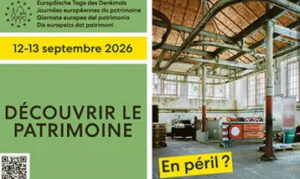
Discover Switzerland’s rich cultural heritage during the European Heritage Days, when historic sites across the country open their doors to the public. This year’s theme, “In Danger?”, explores the challenges facing our cultural heritage, from climate change and urbanization to tourism and development. With hundreds of guided tours, exhibitions, workshops and special events taking place across Switzerland, it’s a great opportunity to explore fascinating places and discover the stories behind them. - 300ᵉ anniversaire du parc des Bastions | Le Parc des Bastions: Heritage Trees and Conservation Challenges | 12 September 2026 | Ville de Genève | Parc des Bastions
Join a guided tour of Geneva’s historic Parc des Bastions to explore its remarkable trees, rich history, and the challenges of preserving this iconic green space. Led by a dendrology expert and a garden historian, the visit highlights the park’s nearly 300-year history, its exceptional arboreal heritage, and the conservation efforts being undertaken to address the impacts of climate change and increasing urban pressure. - Aliph : protéger le patrimoine en péril | 12 September 2026 | ALIPH | Cinémas du Grütli, Genève
What happens to cultural heritage when it is threatened by conflict and crisis? This event, organized by ALIPH, will explore this question through the screening of three short documentaries, followed by a roundtable discussion. Learn more about ongoing efforts to protect endangered heritage, with a particular focus on initiatives in Gaza and Ukraine. - Défendre le patrimoine : luttes, choix et renoncements à Genève | 12 September 2026 | Patrimoine suisse Genève | Vessy
For more than a century, Patrimoine Suisse Genève has worked to protect the region’s architectural and landscape heritage. This conference looks back at some of the sites that have been threatened, lost or saved over the years, while exploring the choices, challenges and debates involved in preserving heritage as a fragile common good. - Aïre : le fragile héritage de la cité-jardin | 12 September 2026 | Office du patrimoine et des sites | Société Coopérative d’Habitation Genève
Travel back to the 1920s and discover the unique history of Aïre’s garden city during a guided tour of this remarkable neighbourhood. Explore its distinctive architecture, designed around social values, individual homes and a close connection with nature, while learning more about an important chapter in the history of social housing in Geneva. - Journées européennes du patrimoine | 12 September 2026 | Pro Natura Genève | Les Berges de Vessy
This walk-workshop along the Arve invites people to discover the wildlife living around the river and to learn how to observe it. As you explore the area, you will also see how nature has adapted to a site shaped and used by people over the years. A simple way to look at the Arve from another perspective and discover the living heritage that surrounds it. The activity is free and open to children aged 6 and over when accompanied by an adult. - Et la nature dans tout cela ? | 12–13 September 2026 | Pro Natura Genève | Les Berges de Vessy
Slow down and reconnect with nature during this walk and workshop along the banks of the Arve. Discover the animals that live in and around the river, learn more about their habitats, and explore the relationship between this living environment and human activity. A refreshing outdoor experience for all ages! - Le week-end du 12 au 13 septembre 2026, c’est l’heure de VolonTerra ! | 12–13 September 2026 | Diverse Locations
VolonTerra gives young people the opportunity to turn their ideas into concrete actions for the environment. During the weekend of 12–13 September, groups across Switzerland will come together to plant, repair, build, clean and carry out their own projects, while developing new skills and making a positive contribution to their communities. A chance to take action! - Le patrimoine paysager genevois au fil du recensement icomos des jardins historiques | 12–13 September 2026 | Patrimoine suisse Genève | Jardin Icomos, Pregny-Chambésy
Hidden behind fences or woven into Geneva’s urban landscape, historic gardens are an important part of the region’s heritage. Join this guided walk through Pregny-Chambésy and the parks of the right bank to discover these often overlooked green spaces and learn why preserving them matters. - Semaine nationale contre le gaspillage alimentaire | From 12 to 20 September 2026 | Confédération Suisse
From 12 to 20 September, forces across Switzerland are joining together for the National Food Waste Prevention Week. With more than 50 organizations from the public sector, civil society and the business community taking part, the initiative aims to raise awareness about the resources, money and food lost to waste. Discover simple ways to reduce food waste in your everyday life and take action. - Bibliothèque vivante: Une Suisse impliquée, hier et aujourd’hui | 13 September 2026 | Château de Prangins
For this Living Library, the books are people. Visitors can meet historians, researchers and members of civil society and hear them talk about their personal experiences, work and ideas. Each conversation lasts 30 minutes and takes place in a small group of five to six people, making it possible to have a more direct and informal exchange. It is a chance to discover different perspectives on Switzerland and its history. - Le Jardin Botanique de Genève au Féminin | 13 September 2026 | Jardin Botanique de Genève
Meet the women who have contributed to the history of the Geneva Botanical Garden and to the development of botany. From gardeners and scientists to explorers and artists, this guided tour brings their often-overlooked work to light through the Garden’s herbarium, library and collections. A chance to explore the Botanical Garden from a different perspective and learn about the women who helped shape it. - Journées européennes du patrimoine et Journées du matrimoine au Musée Ariana | 13 September 2026 | Musée Ariana
On 13 September, Musée Ariana opens its doors and lets you discover the stories hidden behind its walls during the European Heritage and Matrimony Days. Through a series of guided visits, explore the museum’s remarkable architecture, uncover the story of Ariane de la Rive, and learn about the work and journey of ceramic artist Lucie Rie. A great opportunity to discover Geneva’s heritage while highlighting the women and stories that have shaped it. - La Bâtie – Festival de Genève 2026 | Until 13 September 2026 | Diverse Locations
Celebrating its 50th edition of La Bâtie – Festival de Genève returns with 18 days of music, dance, theatre, circus and performance across Geneva and the surrounding area. From major shows to more unexpected artistic experiences, the festival takes over around thirty venues, bringing audiences together to celebrate creativity, curiosity and 50 years of artistic exploration. - Luis Marques | Deep Blue / Intermittences | Until 13 September 2026 | Espace Kugler Gallery
Deep Blue / Intermittences presents Luis Marques’ abstract universe, where lines, textures and shades of blue come together to form imagined landscapes. Moving between deep-blue spaces and drawings created on recycled paper, the artist explores repetition, memory and the delicate balance between control and spontaneity. The exhibition offers a contemplative experience, inviting visitors to take their time and engage with drawing from a fresh perspective. - Atelier sur la faune et la flore du lac | Until 16 September 2026 | La Libellule | Bains des Pâquis
Discover the hidden life of Lake Geneva during these interactive workshops led by the association La Libellule. Taking place at the Bains des Pâquis, the sessions introduce participants to the lake’s wildlife and plant life, from fish and birds to algae, crustaceans and plankton. A fun and educational activity for anyone curious about the local environment. - Expo – Ornitho | Until 22 September | Centre nature de La Libellule
This free photography exhibition invites visitors to discover the beauty and diversity of Switzerland’s birdlife through the lens of nature photographer Damien Oberson. From the colourful hoopoe and European roller to the bearded vulture and wallcreeper, the exhibition captures these remarkable species in striking images. - Botanic Circus Exhibition | Until 30 September 2026 | Alice Izzo | Jardin des Nations
Step into a colourful world where plants, flowers, and fruit take centre stage. Created by Geneva-based artist Alice Izzo, Botanic Circus transforms the Jardin des Nations into an immersive open-air exhibition blending nature, illustration and imagination. Wander through the installations, discover playful artworks inspired by the living world, and enjoy a programme of workshops and events throughout the summer. - Exposition photographique : Les peuples autochtones face aux défis contemporains | Until 1 October 2026 | Traditions pour demain | Quai Wilson
To mark its 40th anniversary, the Geneva-based association Traditions pour demain is presenting a photographic exhibition. Created in collaboration with five partner photographers from Bolivia, Ecuador and Guatemala, the exhibition showcases the daily lives, knowledge and resilience of Latin America’s indigenous peoples in the face of the climatic, social and cultural crises of our time. Through these diverse perspectives, it invites the Geneva public to discover vibrant cultures that offer practical solutions to contemporary challenges. - Telling the story of Death | Until 4 October | Jardin Botanique de Genève
The “Telling the Story of Death” exhibition invites visitors to reflect on our relationship with death, grief and memory through six audio stories and twelve photographs. Hosted at the Geneva Botanical Garden, it also explores the disappearance of non-human life, raising questions about biodiversity, extinction and how we remember what has been lost. - Exhibition – LÉMAN ÊTRE VIVANT | Until 18 October 2026 | ASL | Espace Léman
See Lake Geneva from a completely different perspective through this immersive exhibition combining photography, films, sculptures, sound installations, and storytelling. Created by the Hydromondes collective, LÉMAN ÊTRE VIVANT invites visitors to think of the lake as a living ecosystem, connected to its rivers, forests, glaciers, wildlife, and communities. A programme of workshops and family activities complements the exhibition throughout the summer. - Hortus Botanicus Helveticus: Together for 30 years | Until 29 November 2026 | Jardin Botanique de Genève
Marking the 30th anniversary of Hortus Botanicus Helveticus, this outdoor exhibition celebrates the work of Switzerland’s 30 botanical gardens. As you walk through the Jardin Botanique de Genève, discover 30 illustrated displays, each featuring a representative plant species and highlighting the important role these gardens play in protecting biodiversity and preserving plant life for future generations. - Create Your Own Rousseau-Style Herbarium | Until 23 December 2026 | Jardin Botanique de Genève
Discover the art of herbarium making in this hands-on workshop inspired by Jean-Jacques Rousseau. Using dried flowers, plants, and traditional paper, participants can create their own herbarium sheet while learning about plant identification and the scientific techniques behind this botanical practice. The activity is free and suitable for visitors aged four and above.
What (Else) to Read Next?
- States are writing the first global rulebook for when disasters strike | Geneva Solutions | 4 September 2026
After two decades of work, a treaty could see the light of day next year, sketching out the rules for how countries help each other when disaster strikes. But they still have to overcome old divides over its implications for sovereignty and human rights. - Can sheep save the glaciers? Swiss scientists put wool to the test | Reuters | 3 September 2026
As Switzerland struggles to contain the shrinking of its glaciers, researchers are conducting an unusual experiment in the Alps to see whether one of its less valued natural resources can help: sheep’s wool. For years now, synthetic tarpaulins have been laid in summer over areas of ice and snow to reflect sunlight and reduce heat absorption as global warming melts away the ice sheets that have defined the high Alpine landscape for millennia. - Building a scalable climate coalition for heavy industry | Catherine Wolfram, Joseph Aldy, Candido Bracher et al. | Science | 3 September 2026
The important interaction between trade and climate policy has sharpened the case for a coalition of countries that commit to price industrial emissions at home and use border adjustments to apply a carbon price to imports from nonmembers. The paper proposes a coalition that initially targets four emissions-intensive industries—iron and steel, aluminum, cement, and nitrogen fertilizers (hereafter, fertilizers)—which together account for roughly 20% of global greenhouse gas (GHG) emissions.
- Loss and damage fund urged to hold crisis meeting on Nepal | Climate Home News | 2 September 2026
After last week’s catastrophic flash flooding caused hundreds of deaths and an estimated $5 billion of destruction in Nepal, some board members of the UN’s new loss and damage fund board have called for an extraordinary meeting to allocate money to help the Himalayan country.
- Almost half of the world’s farmers are poisoned by pesticides every year | Pesticide Action & Agroecology Network | 2 September 2026
A new study published in Frontiers in Public Health shows that over 400 million of the world’s farmers and farmworkers suffer from acute pesticide poisoning annually. This total excludes the 84 million children working in global agriculture who are even more vulnerable to toxic chemicals than adults, as well as rural families exposed through spray drift and environmental exposure. Action is urgently needed to remove the most poisonous pesticides from agriculture and to replace them with safer alternatives. - Turning Nuclear Ambition into Action: Q&A with Dr Jonathan Cobb, author of World Nuclear Outlook Report 2026 | World Nuclear Association | 2 September 2026
Ahead of the publication of the World Nuclear Outlook Report at World Nuclear Symposium 2026, World Nuclear Association sat down with the author, Dr Jonathan Cobb, Senior Programme Lead, Climate at World Nuclear Association for an interview. The World Nuclear Outlook Report assesses the readiness of individual countries to contribute to the goal of tripling nuclear capacity by 2050. - New Data for Africa’s Changing Climate | OECD | 1 September 2026
This report aims to fill the gap in foundational data. First, it shows how African countries and cities are exposed to major climate-related hazards, such as extreme heat, while assessing adaptation readiness of countries. Second, it describes the climate mitigation policy landscape in African countries along with key policy trends. In doing so, it breaks new ground by building on novel datasets that use robust methodologies developed by the Global Green Growth Institute (GGGI), the Organisation for Economic Co-operation and Development (OECD), the OECD Sahel and West Africa Club (SWAC) and the World Bank, covering 28 African countries that jointly account for around 73% of African GHG emissions.
- Pour promouvoir l’action climatique, l’émotion prime sur l’information | UNIGE | 1 September 2026
What are the most effective communication strategies for encouraging the public to take action on climate change? To answer this question, a team from the University of Geneva (UNIGE) reviewed a vast body of research carried out in Switzerland and abroad on the impact of various climate communication campaigns. The findings suggest that messages that appeal to emotions – such as a sense of wonder at the beauty of a landscape – are more effective than simply presenting scientific facts. - Message of His Holiness Pope Leo XIV for the 11th World Day of Prayer for the Care of Creation 2026 | The Holy See | 1 September 2026
Pope Leo XIV encourages Christians to embrace ecological conversion, transform destruction into life, and renew their commitment to caring for creation and the poor. - ISO 14002-3:2026 | Environmental management systems — Guidelines for using ISO 14001 to address environmental aspects and conditions within an environmental topic area. Part 3: Climate | ISO | September 2026
This document gives guidance to organizations on addressing climate-related environmental aspects, environmental conditions, and the associated risks and opportunities within an environmental management system (EMS) in accordance with ISO 14001 [26]. It addresses the environmental topic area of climate from both perspectives: mitigation and adaptation. - Most EU ships are being scrapped in South Asia despite sufficient domestic recycling capacity, confirms new study | NGO Shipbreaking Platform | 31 August 2026
Only 5% of EU ships’ tonnage was dismantled in Europe despite the capacity to recycle much more. The vast majority of end-of-life ships are sent for beaching in India, Pakistan, and Bangladesh under poor environmental and safety standards. - A Living Laboratory at the Top of the World: Why protecting the Everest Base Camp matters in a rapidly changing Himalaya | GEO | 31 August 2026
The massive flash flood induced by an ice-rock avalanche on the northern face of Langtang Lirung mountain on 26 August, which brought widespread destruction along the Bhotekoshi-Trishuli River corridor, is a tragic reminder of how rapidly the Himalayan cryosphere is changing. The urgent need to strengthen monitoring of the Himalayan - Permitting for Critical Minerals | IGF | August 2026
Mining permitting is increasingly important as demand for critical minerals grows to support the global energy transition. Drawing on case studies from North America, South America, Australia, Asia, and Africa, this report examines causes of permitting delays and approaches to address them. It provides practical “Do” and “Don’t” tools across three areas: internal process tools for planning, coordinating, resourcing, and auditing; regulatory framework tools to define timelines and processes that are risk-based and streamlined, and external process tools to meet the needs of proponents and communities. Governments can analyze their mine-permitting system and choose the tools most relevant to their challenges, goals, and available resources. - We stand with humanity: A scientist statement to confront climate destruction | International scientists, academics and healthcare professionals
This letter by international scientists, academics and healthcare professionals raises the alarm on the immense danger of our current climate state and trajectory. Their goal is to declare our firm professional commitment to serve our societies as a whole, on climate knowledge and action, in order to protect health and lives, resisting political cooptation and manipulation. They invite their colleagues to engage in this urgent interdisciplinary effort which requires both mitigation (halting climate-changing emissions) and adaptation (reduction of climate impact harms).
Events
See all

Body Meeting
63rd session of the Human Rights Council | HRC63
07 Sep – 07 Oct 2026
Palais des Nations | Assembly Hall
HRC
Body Meeting
Eighth meeting of the Implementation and Compliance Committee
07 – 08 Sep 2026
Online
Minamata Convention
Conference
Climate Finance for Human Rights, Resilience and Justice | HRC63 Side Event
07 Sep 2026 | 14:00 – 15:00
Palais des Nations, Room XI
Franciscans International, Geneva Interfaith Forum on Climate Change, Environment and Human Rights, ACT Alliance, QUNO, Dominicans for Justice and Peace, Soka Gakkai International, WCC, LWF, Christian Aid
Conference
Towards Effective Action for the Right to a Clean, Healthy and Sustainable Environment
07 Sep 2026 | 14:00 – 16:00
Online | Zoom
IPU
Conference
Outer Space Security Conference 2026
08 – 09 Sep 2026
Palais des Nations | Room VIII & Online
UNIDIR
Virtual
Taking Responsibility – Navigating the New Era of Ongoing Emissions
08 Sep 2026 | 11:00 – 11:40
Online | Teams
Gold Standard Foundation
Conference
Commemorative Event | 20th anniversary of the Central Asian Nuclear-Weapon-Free Zone
08 Sep 2026 | 13:15 – 14:45
Palais des Nations | Room VII
Kazakhstan, Kyrgyzstan, Tajikistan, Turkmenistan, Uzbekistan, UNODA, ICAN

Conference
Hoffmann Centre High Level Lecture with Ruben Durante | Hijacking Credibility: The Capture of Trusted Digital Platforms by Autocrats
08 Sep 2026 | 17:15 – 19:30
Maison de la paix, Room A2
IHEID
Conference
9th International Network on Digital Labor Conference (INDL-9): AI Supply Chains
09 – 11 Sep 2026
ILO
ILO, IHEID

Virtual
Fourth meeting of the Small Group on Mine Tailings Safety of the 2025-2026 Biennium
09 Sep 2026
Online
UNECE Convention on the Transboundary Effects of Industrial Accidents

Virtual
Advancing Sustainable Agriculture: How Retailers, Food Brands and Certification Bodies are Rethinking Standards, Sourcing and Communication on Agrochemicals
09 Sep 2026 | 14:00 – 15:30
Online | Zoom
GEF, UNEP, UNDP, UNIDO, GGKP
Virtual
Interactive Workshop on Managing and Reporting on Nature
09 Sep 2026 | 15:00 – 18:30
Online | Zoom
UNCTAD, UNEP FI, UN Global Compact, UNDP
Virtual
Circular Solutions to Achieve Nature Targets in Banking
10 Sep 2026 | 14:00 – 15:00
Online | BrightTalk
UNEP FI
Virtual
Becoming a Member of the Global Alliance on Highly Hazardous Pesticides
11 Sep 2026 | 08:00 – 09:00
Online | Zoom
FAO, UNDP, UNEP, WHO
Afterwork
Journées européennes du patrimoine Suisse
12 – 13 Sep 2026
Various Locations
Réseau suisse pour le patrimoine culturel
Jobs
See all
Professional
Young Professional Officer (Small Island Developing States – SIDS) – P1
07 Sep 2026
FAO
Updates
See all
Experts
See all