Newsletter 21 Sep 2026
Environment: What’s Up in GENeva | 21 – 27 September 2026
The Geneva Environment Network’s weekly newsletter includes the latest information on the global environmental agenda, main events, job vacancies, as well as other useful resources and updates. The Geneva Environment Network is not responsible for the content of any linked site or any link contained in a linked site. Stay tuned and follow us on X (Twitter), Facebook, LinkedIn, Instagram, Bluesky, Youtube, and WhatsApp, or visit our website regularly for additional updates.
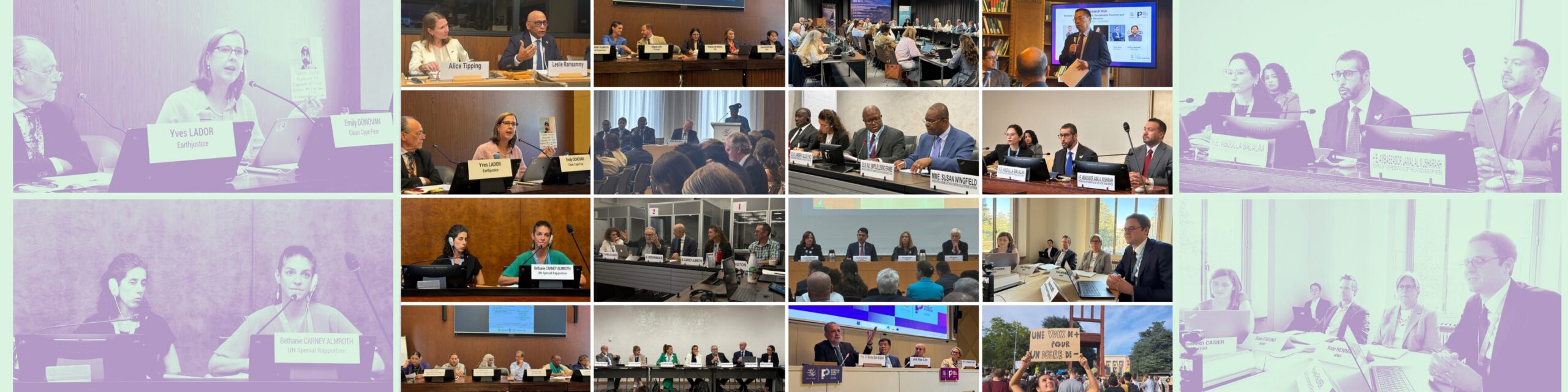
Image of the week | A non-exhaustive snapshot of events from last week at Palais des Nations, the World Trade Organization, Maison de la Paix and on Place des Nations, highlighting ongoing efforts to advance the global environmental governance agenda. © UNEP/GEN & Roger Deneys.
Human Rights Council Spotlight | Five Years of the Right to a Healthy Environment & Other Key Moments
The 63rd session of the UN Human Rights Council (HRC63) continues this week, featuring numerous environment-related side events. Highlights include discussions on Indigenous Peoples’ rights and free, prior and informed consent, environmental justice and women human rights defenders, the human right to a clean, healthy and sustainable environment, and climate-related challenges facing coastal communities. These events underscore the growing recognition of environmental protection as a fundamental human rights issue.
Celebrating Five Years of the Recognition of the Right to a Healthy Environment | On 8 October 2021, the UN Human Rights Council adopted resolution 48/13 recognizing that a clean, healthy and sustainable environment is a human right, placing it at the forefront of the human rights agenda.
Ahead of the fifth anniversary of this recognition, a celebration is scheduled to take place at this session of the Council. The celebration aims to provide an opportunity to celebrate advances and to assess the evolution of the right. The fifth anniversary of the milestone will serve both as a commemoration and a moment for renewed commitment to the implementation of the right to a healthy environment. → Join the celebration taking place in Palais des Nations, Concordia 1 on 24 September 2026 from 12:00 to 13:00 CEST. A reception on this occasion is taking place at Palais des Nations from 17:30 to 19:00 CEST.
Climate Change and Human Rights | Last Thursday, during the General Debate on Agenda Item 3, Peru, on behalf of a group of countries (Dominica, Bosnia and Herzegovina, Ecuador, Cyprus, Singapore, Panama, Uruguay, Costa Rica, Chile, Vanuatu, Andorra, Sovereign Order of Malta, Belgium, Vietnam, Nepal, Albania, Philippines, Germany, Morocco, Mauritius, Cambodia, Egypt, Finland, Bangladesh, Indonesia, Kiribati, Colombia, Portugal, Netherlands, Malaysia, Georgia, Switzerland, Barbados, Slovenia, Ireland, Spain, Maldives, Dominican Republic, Mexico), delivered a joint statement on “Human Rights and the Impacts of El Niño”, which highlights how climate change adversely affects the enjoyment of human rights across all regions and climate phenomena, such as El Niño, are becoming increasingly severe, exacerbating existing vulnerabilities, placing additional pressure on ecosystems and biodiversity, and generating new hazards that threaten the enjoyment of human rights and sustainable development in societies around the world. The joint statement stresses the importance of ensuring that climate finance is accessible, predictable, transparent and responsive to national circumstances, and that it supports integrated approaches capable of simultaneously strengthening climate resilience, protecting ecosystems and biodiversity, and advancing the enjoyment of human rights. → Consult the joint statement on the HRC63 Portal and on UN Web TV.
Relevant side events taking place this week include:
- Coastal Cities Towns & Settlements on the Front Line: Protecting People from Sea-Level Rise – Towards a human rights agenda for liveable, inclusive and resilient cities | HRC63 Side Event | 25 September 2026 | 12:00–13:00 CEST | Palais des Nations, Concordia 1 & Youtube | Dominican Republic, The Bahamas, Cabo Verde, Cyprus, Ecuador, Maldives, Malta
To promote a policy-oriented and practical dialogue on how to protect the rights, dignity and livelihoods of people living in coastal cities and settlements exposed to sea-level rise, this side event will explore possible elements for a future Human Rights Council initiative on sea-level rise and human rights focused on urban and local action. The event will follow the High-level meeting to address the existential threats posed by sea level rise at the UN General Assembly.
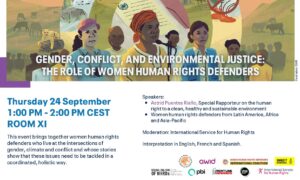
- Gender, conflict, and environmental justice: The role of women human rights defenders | HRC63 Side Event | 24 September 2026 | 13:00–14:00 CEST | Palais des Nations, Room XI | Amnesty International, Front Line Defenders, ISHR, WHRD MENA Coalition, WHRDIC, PBI, AWID, UAF and APWLD
This event brings together women human rights defenders who live at the intersections of gender, climate and conflict and whose stories show that these issues need to be tackled in a coordinated, holistic way.
World Heritage and the Rights of Indigenous Peoples | This week, the annual half-day panel discussion on the rights of Indigenous Peoples focused on the “Convention for the Protection of the World Cultural and Natural Heritage: Indigenous Peoples’ rights and engagement” will take place on 23 September 2026. The panel discussion will aim to examine the impact of the World Heritage Convention on the human rights of Indigenous Peoples, focusing on issues related to lands, territories and resources. The panel will aim facilitate the sharing of experiences regarding the recognition of Indigenous Peoples’ cultural values and rights and identify good practices and challenges in the engagement and inclusion of Indigenous Peoples in the identification, nomination, declaration, management, and protection of World Heritage sites and the implementation of the World Heritage Convention.
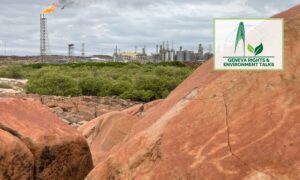
In the margins of the Council, a Geneva Rights and Environment Talk, “Indigenous World Heritage in Danger: 50,000 years of cultural legacy to be erased in Murujuga?” will provide a space to discuss the situation of Murujuga, an Indigenous World Heritage located in Pilbara region in Western Australia, that was listed as a UNESCO World Heritage Site in July 2025. Three months later, the Federal Environment Minister approved a 40-year extension to Woodside’s North West Shelf gas processing facility. In light of this decision, a complaint is expected to be lodged in October at the United Nations Human Rights Committee. This event will hold a discussion with Raelene Cooper, a Mardudhunera lore woman, Indigenous elder and traditional custodian, on how to protect such world heritage site and the related cultural and environmental rights. → Register on Indico to join the discussion in person taking place at Palais des Nations, Room S-29 or online via Webex, on 25 September 2026, from 10:00 to 11:00 CEST.
Other events taking place this week include:
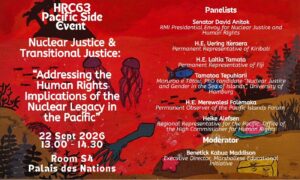
- Nuclear Justice and Transitional Justice: Addressing the Human Rights Implications of the Nuclear Legacy in the Pacific | HRC63 Side Event | 22 September 2026 | 13:00–14:30 CEST | Palais des Nations, Room S4 | Marshall Islands, Australia, Fiji, Kiribati, Micronesia, Nauru, New Zealand, Papua New Guinea, Samoa, Vanuatu, Pacific Islands Forum, OHCHR, ICAN, Marshallese Education Initiative, WCC
- Guidance on the right of Indigenous Peoples to free, prior and informed consent in the context of business activities | HRC63 Side Event | 22 September 2026 | 13:00–14:00 CEST | Palais des Nations, H-207-208-209 | WG on Business and Human Rights, IPRI, ISHR, BHRC
- Interactive Dialogue with SR on rights of Indigenous Peoples | 23 September 2026 | 12:00 CEST onwards | Palais des Nations, Assembly Hall & Online
- Interactive Dialogue with Expert Mechanism on the rights of Indigenous Peoples | 23 September 2026 | 15:45–17:15 CEST | Palais des Nations, Assembly Hall & Online
- Advancing Indigenous Peoples’ Rights – From Recognition to an Effective Roadmap | HRC63 Side Event | 24 September 2026 | 13:00–14:00 CEST | Palais des Nations, Concordia 1 | Botswana
- Right to Free, Prior and Informed Consent | HRC63 Side Event | 25 September 2026 | 12:00–13:00 CEST | Palais des Nations, Room XI | Conselho Indigenista Missionário CIMI
- Implementation of the rights of Indigenous Peoples: experiences and good practices on participation, consultation, and free, prior and informed consent | HRC63 Side Event | 25 September 2026 | 14:00–15:00 CEST | Palais des Nations, Room XI | Guatemala and Mexico
- Commemorating 80 years since the first nuclear weapons test in Marshall Islands | Concert by MARK Harmony | 25 September 2026 | TBC CEST | Salle des Pas Perdus | Marshall Islands
→ Regular updates on key environmental issues at HRC63, side events, and further resources are available on our dedicated HRC63 and the environment update. Consult the press release on the upcoming session by the United Nations Information Service in Geneva.
Read more at:
- Highly persistent toxic waste threatens ‘many, if not all, human rights’ | UN News | 14 September 2026
- UN expert on toxic chemicals: ‘We shouldn’t allow exposure of entire populations and the planet before acting’ | Michelle Langrand, Geneva Solutions | 16 September 2026
- Human rights defenders in the Marshall Islands engaged in collective pursuit of justice and human rights across generations: UN expert | HRC Special Procedures | 17 September 2026
Digital Innovation and MEAs | Knowledge Platforms and AI in Practice
Multilateral environmental agreements (MEAs) generate and manage growing volumes of information, from decisions and national reports to scientific and technical data, guidance, project information and implementation experiences. The challenge is increasingly not only to make this information available, but also to ensure that it is structured, accessible, interoperable and reusable. Digital transformation therefore offers important opportunities to strengthen institutional knowledge, improve access to information and support more effective implementation of environmental commitments.
Following the UN Digital Cooperation Day 2026, organized by the United Nations Office for Digital and Emerging Technologies during the High-Level Week of the 81st session of the UN General Assembly, the Minamata Convention on Mercury and the Geneva Environment Network are organizing the session “Digital Innovation for MEAs: Knowledge Platforms and AI”. It will bring together representatives from MEA secretariats, InforMEA and governments to share practical experiences with digital platforms, knowledge tools and emerging technologies. The discussion will explore what MEAs can learn from each other; how interoperability, shared standards and digital cooperation can improve access to and use of environmental information; and where responsible applications of AI could add value. It will also consider opportunities for greater collaboration, with the aim of identifying approaches and lessons that can be transferred across MEAs while avoiding duplication and keeping digital solutions focused on the needs of Parties and users. → Register on Indico to join in person at the International Environment House I, Room 2 or on Webex to join the event online taking place on 22 September 2026 from 11:00 to 12:00 CEST.
Climate Action in Focus
While global attention this week is focused on the UN General Assembly High-Level Week and Climate Week NYC, with numerous experts from International Geneva contributing to discussions in New York, climate change remains high on the agenda in Geneva. Discussions range from the launch of global recommendations on nationality and statelessness in the context of climate change to an Office of the UN High Commissioner for Refugees (UNHCR) briefing on climate action readiness, and discussions on climate action readiness, early warning systems, and the evolution of climate science.
This momentum comes as the international community continues to assess the escalating risks associated with climate change. Released on 15 September 2026, the United Nations Global Risk Report 2026 finds that, despite growing geopolitical tensions, climate change inaction remains the single most significant global risk identified by respondents, ahead of 27 other risks. The report highlights climate change as a major driver of social instability, forced displacement and rising inequalities, while emphasizing that global preparedness remains stronger in identifying risks than in reducing them. Against this backdrop, public mobilization is growing. In Switzerland, under the banner “Pas d’étés à 50 degrés!” (“No 50°C Summers!”), a coalition of more than 50 organizations has been organizing demonstrations across the country to raise awareness of the dangers of extreme heat and climate inaction, including a march in Geneva last Saturday that drew more than 3,000 participants according to the police, 7,000 according to the organizers.
Climate discussions in Geneva are also taking place as preparations intensify for the UN Climate Change Conference COP31 in Antalya, Türkiye, under the leadership of COP31 President-Designate Murat Kurum, Türkiye’s Minister of Environment, Urbanization and Climate Change. Speaking in Geneva last week, Minister Kurum emphasized the critical role of multilateral cooperation and science-based climate action, highlighting the strengthening of observation, forecasting and early warning systems as a key element of COP31’s implementation agenda. → Read more in WMO article COP31 President-Designate addresses WMO.
Against this backdrop, several climate-related events are taking place across Geneva this week:
- While the yearly negotiations of the UNHCR Omnibus resolution are taking place in Geneva this week, various events will address climate change in that space, including:
- Launch of the Global Recommendations on Nationality and Statelessness in the Context of Climate Change | UNHCR | 22 September 2026, 11:30–12:30 CEST | UNHCR Headquarters, Room MBT-04 & Online
This event will launch new global recommendations addressing the growing risks of nationality loss and statelessness linked to climate change impacts, displacement and changing environmental conditions. The Global Recommendations document will be made publicly available at the time of the launch. - Virtual Briefing on the Readiness Assessment of UNHCR’s Focus Area Strategic Plan for Climate Action | UNHCR | 22 September 2026, 15:00–16:30 CEST | Online [Open only to Member States]
UNHCR will present findings from its readiness assessment examining the implementation of its Climate Action Strategic Plan and discuss priorities for strengthening climate resilience and response within humanitarian operations.
- Launch of the Global Recommendations on Nationality and Statelessness in the Context of Climate Change | UNHCR | 22 September 2026, 11:30–12:30 CEST | UNHCR Headquarters, Room MBT-04 & Online
- In the context of the ongoing session of the Human Rights Council, as announced above, various events addressing climate change are also taking place this week.
- Other events will examine how science and technology can support climate action and resilience:
- Making Temperature Global: The Untold History of an Emperor Indicator | UNIGE | 22 September 2026, 17:15 CEST | University of Geneva, Boulevard Carl-Vogt 66, Room E712
This academic lecture explores the historical development of temperature as a global climate indicator and its role in shaping contemporary climate science and policy. - Revolutionizing Weather Predictions with AI: AI for Multi-Hazard Early Warning Systems | UNDRR | 23 September 2026, 12:00–13:00 CEST | Online
This hands-on masterclass examines how artificial intelligence can improve weather forecasting, disaster risk reduction, and early warning systems, helping communities better prepare for climate-related hazards. - Better Predicting Weather and Climate Extremes | European Meteorological Society Award 2026 Reception | WMO and Austria | 25 September 2026, 18:15–20:00 CEST | WMO Atrium
The reception will highlight advances in meteorology and climate science that are improving understanding and prediction of extreme weather and climate events.
- Making Temperature Global: The Untold History of an Emperor Indicator | UNIGE | 22 September 2026, 17:15 CEST | University of Geneva, Boulevard Carl-Vogt 66, Room E712
Additional recent climate news includes:
- Rapid Warming in the Himalaya Exacerbates Geohazard Cascades Beyond Adaptation Limits | World Weather Attribution | 17 September 2026
- OECD and Türkiye’s COP31 Presidency Launch Strategic Partnership to Accelerate Climate Action | OECD | 17 September 2026
State of Global Water Resources | The Water Cycle Becomes More Erratic and Unpredictable
The World Meteorological Organization (WMO) released the State of Global Water Resources 2025 on 17 September 2026. This comprehensive science-based annual assessment of the hydrological cycle and extreme events shows that the water cycle is becoming more erratic and unpredictable, swinging between severe shortages and excess of water. In the past seven years, the proportion of rivers with “normal” flows since 1991 has reached its lowest level. While the overall picture is concerning, signs of improvement have been observed in water storage in South America and in the water levels in Central and Southern Africa. Key areas of concern highlighted in the report include:
- 2025 was one of the driest years for river discharge globally in 35 years, with below-normal flows over 36 per cent of global river basin area.
- For the seventh year in a row, the number of river basins experiencing “normal” conditions was in a clear minority: accounting for only 34–38 per cent of basins, compared with the 1991–2020 average of 46%.
- Terrestrial water storage – the total amount of water stored in groundwater, lakes and rivers, soil moisture, vegetation and ice and snow – has been declining since the mid-2010s, raising concerns about long-term water security.
- 2025 marked the fourth consecutive year with widespread glacier loss across all regions, leading to short-term hazards such as flooding and long-term water insecurity threat.
- Record-breaking floods and droughts have been reported every year of the the past five years by National Meteorological and Hydrological Services worldwide. In various regions, communities have had little or no time to recover from one extreme event before facing another.
Read more at:
- State of Global Water Resources 2025 | WMO | 17 September 2026
- WMO: Recent water trends have serious future implications | WMO | 17 September 2026
- What WMO’s State of Global Water Resources 2025 report tells us about our depleting water reserves | Celeste Saulo, WMO Secretary-General | 17 September 2026
- As freshwater reserves shrink, countries must prepare for a new water reality | UN News | 17 September 2026
- WMO State of the Global Water Resources 2025 Report shows river temperatures above the historical average in most areas around the globe
- Rewatch the press conference
As preparations intensify for the 2026 United Nations Water Conference, co-hosted by the United Arab Emirates and Senegal in Abu Dhabi from 8 to 10 December 2026, the Permanent Mission of the United Arab Emirates in Geneva convened a High-Level Briefing on the Conference. With key information on the preparations shared by H.E. Abdulla Balalaa, UAE Assistant Minister of Foreign Affairs for Energy and Sustainability, the UN Special Rapporteur on the rights to water and sanitation, Pedro Arrojo-Agudo, and the highly engaged Member State representatives and Geneva-based organizations, discussions underscored the importance of institutionalizing the UN Water Conference to bring water back to the top of the international agenda. → Consult the highlights
Preparations Intensify for the Next Round of Global Plastics Treaty Negotiation
The process towards the fourth part of the fifth session of the Intergovernmental Negotiating Committee to develop an international legally binding instrument on plastic pollution, including in the marine environment (INC-5.4), continues to progress, with a key milestone taking place this week as delegates are convening in Bangkok, Thailand, for the Second Informal in-person Heads of Delegation (HODs) meeting from 27 to 30 September 2026, following a day of regional consultations on 26 September 2026.
- The meeting will follow a Head of Delegation + 4 (HOD+4) format, an increase from the previously applied HOD+3 arrangement. Participation will include the designated Head of Delegation, or their designated representative, accompanied by up to four additional delegates. → Consult the meeting schedule
- To support the delegates’ preparations, the INC Chair, H.E. Amb. Julio Cordano, shared a document containing Guiding Questions, which are intended to support delegations in preparing for the Cluster discussions and seek to encourage continued exchanges, identify interlinkages and explore possible landing zones to inform the development of the second iteration of the “Aid to Negotiations”.
- The Chair of the INC issued an invitation requesting accredited observer organizations to provide written views on the guiding questions circulated in advance of the second informal in-person HODs meeting through the dedicated form. The deadline for receipt of Observer written views is Wednesday 23 September 2026. Written views already available to Members of the Committee in advance of the meeting are published on a rolling basis on the INC website.
- Useful documents for the session include: Note by the Chair (20 August 2026), Guiding questions by the Chair (9 September 2026), Aid to Negotiations (8 August 2026), Possible elements for draft resolutions for consideration by the diplomatic conference of plenipotentiaries (25 August 2026).
Observers participating in the process have continued to contribute to discussions by sharing position papers and analytical inputs. Recent contributions include:
- Tipping Point. How Coordinated Markets can Transform Global Plastic Value Chains Towards a Treaty to End Plastic Pollution | WWF | September 2026
The report will be discussed at a webinar “Treaty Tipping Points: How Early Action Can Build Global Momentum” organized by WWF on 21 September 2026, 14:00–15:00 CEST. - The INC Chair’s “Aid to Negotiations” document for the Global Plastics Treaty – IUCN Legal Analysis | IUCN | 15 September 2026
- A treaty of the willing: Consensus, critical mass and pathways to an effective plastics treaty | Norwegian Academy of International Law | 11 September 2026
- This is how much microplastic enters soils and water bodies from the air | EMPA | 10 September 2026
- The world doesn’t need a Paris Agreement for plastics | Amy Youngman (EIA), Climate Change News | 9 September 2026
- Tackling the global plastic pollution crisis | Guibing Zhu, Changchao Li, Peng Wang et al. | National Science Review | 8 September 2026
- GAIA Response to the Aid to Negotiations | GAIA | 8 September 2026
- ‘Plastic pollution hotspots’ spawn a public health crisis across Latin America | Mongabay | 8 September 2026
Protecting the Caspian Sea | Regional Cooperation under the Tehran Convention
The Caspian Sea, the world’s largest enclosed body of water, is bordered by five littoral States: Azerbaijan, Iran, Kazakhstan, the Russian Federation and Turkmenistan. In recent decades, its unique and ecologically significant marine environment has come under increasing pressure from pollution, biodiversity loss, unsustainable resource use and the impacts of climate change. To address these challenges, the Framework Convention for the Protection of the Marine Environment of the Caspian Sea, commonly known as the Tehran Convention, was adopted in 2003 by all five Caspian States. As the first legally binding regional agreement dedicated to the protection of the Caspian Sea, it establishes the overarching legal framework and institutional mechanisms for environmental cooperation and sustainable management of the region’s shared marine ecosystem.
At the Baku Climate Action Week, earlier this month, officials warned that the decline in the Caspian Sea’s water level is no longer a future risk but an ongoing reality, with significant consequences for coastal communities, infrastructure, biodiversity and economic activities. The falling water level is causing shoreline retreat and habitat loss, threatening species such as the Caspian seal and sturgeon, while experts stressed the need for stronger regional cooperation and adaptation measures to address the transboundary impacts of climate change and human activities.
The ongoing Seventh Meeting of the Conference of the Parties to the Tehran Convention (COP7), taking place in Tehran from 20 to 23 September 2026, provides an important platform for regional cooperation on environmental challenges affecting the Caspian Sea, including marine pollution, biodiversity conservation, and climate change adaptation.
Montevideo Programme | Advancing Environmental Law
Since 1982, UNEP has conducted its environmental law activities on the basis of the Montevideo Programme for the Development and Periodic Review of Environmental Law (Montevideo Programme). Now in its fifth iteration, the Montevideo Programme promotes the development and implementation of environmental rule of law, strengthens related capacities in countries and contributes to the environmental dimension of the 2030 Agenda.
This week, UNEP is convening consultations under the Montevideo Programme. The discussions will help shape collaborative approaches to addressing emerging environmental challenges and advancing the effective implementation of environmental law at all levels. This consultation will provide an opportunity to discuss progress in implementing the Montevideo Programme V, identify opportunities to enhance partner and stakeholder engagement, and exchange views on current and emerging issues in environmental law and governance. The outcomes of the consultation will help inform discussions and strategic priorities for the Third Global Meeting of National Focal Points. → Register for the online consultation taking place on 22 September 2026, from 13:00 to 15:00 CEST.
Later this autumn, an upcoming Briefing on the Montevideo Programme V: A Decade of Action on Environmental Law organized within the framework of the Geneva Environment Network on 3 November, as part of UNEP Environmental Law Week, taking place from 3 to 6 November 2026, and ahead of the Third Global Meeting of National Focal Points for the Montevideo Programme V, will bring together the Member States and stakeholders to raise awareness about the Montevideo Programme V, explore opportunities to engage in its implementation and discuss expectations for the upcoming Third Global Meeting. → Save the date and register on Indico to attend the event in person at the International Environment House 1 or online via Webex on 3 November 2026, from 9:30 to 11:00 CEST.
International Geneva at the UN General Assembly
Every September, world leaders, diplomats, and advocates, including heads of agencies and experts from Geneva, gather in New York for the High-Level Week of the United Nations General Assembly — one of the most important moments on the global diplomatic calendar. This year, the 81st session of the United Nations General Assembly is held under the theme “Restoring trust, managing transformation: a United Nations that delivers for all”. Key moments include:
- Climate Week NYC | From 20 to 27 September with hundreds of events, ranging from high-level policy dialogues and industry forums to community-led initiatives and cultural exhibitions. Experts from Geneva and from the broader environmental community will be actively engaged in numerous sessions, including:
- Unlocking Climate Innovation: From Global Commitments to Local Green Technology Deployment | WIPO Green | 21 September 2026
- Sustainable Investment Forum | 22 September 2026 | Fordham Gabelli School of Business & UNEP-FI
- 2026 Plastics and Human Health Symposium | 22 and 23 September 2026 | NYU Langone Health Center for the Investigation of Environmental Hazards & Food Packaging Forum
- A Changing Global Health Architecture and the Governance of Climate-Health | 22 September 2026 | Health Diplomacy Alliance
- Find additional events where Geneva organizations and actors will be active in:
- General debate | From 22 to 26 September and 28 September 2026
H.E. Khalilur Rahman of Bangladesh will preside over the UN General Assembly’s 81st session. → Watch on UN Web TV - UN Global Compact Leaders Summit | 22–24 September 2026
- High-level meeting to commemorate the fortieth anniversary of the Declaration on the Right to Development | 23 September 2026 | A/RES/80/207
For the past four decades, the Declaration has provided a framework for advancing inclusive, sustainable, and participatory development at all levels, while shaping related laws and policies. → Watch on UN Web TV - Climate Summit 2026 | High-level meeting on climate action and the just transition | 23 September 2026
Ten years after the Paris Agreement, the climate crisis has entered a new phase in which overshoot is now inevitable, while the energy transition accelerates. → Watch on UN Web TV - High-level meeting to address the existential threats posed by sea level rise | 24 September 2026 | A/78/L.101
This meeting will focus on building common understanding, mobilizing political leadership, and promoting multisectoral and multi-stakeholder collaboration and international cooperation towards the objective of “addressing the threats posed by sea-level rise”. → Watch on UN Web TV and read more at The Ocean at UNGA81 - High-level meeting on pandemic prevention, preparedness and response | 25 September 2026 | A/RES/79/333
Guided by the theme, “Fostering a multilateral and intergenerational approach to prevent, prepare for and respond to pandemics and public health emergencies, through the principles of equity and solidarity,” the meeting will culminate in the approval of a concise, action-oriented political declaration agreed upon by consensus through intergovernmental negotiations. → Watch on UN Web TV
International Geneva at UNGA:
- Digital@UNGA | ITU
- WHO at the United Nations General Assembly 2026
- ILO at the 81st Session of the UN General Assembly
- IOM at the 81st Session of the UN General Assembly
- IUCN at UNGA81
- Health Diplomacy Alliance at UNGA81
Read more at:
- UNGA81: Restoring trust will require more than climate promises | Greenpeace | 17 September 2026
- AI, climate and conflicts top Guterres’s agenda ahead of General Assembly | UN News | 16 September 2026
- The world comes to New York: What’s at stake at UN General Assembly high-level week | UN News | 16 September 2026
More Happening Abroad
More events moving forward the global environmental agenda taking place this week in other duty stations include:
- 22nd meeting of the Persistent Organic Pollutants Review Committee (POPRC.22) | POPRC.22 is taking place from 21 to 25 September 2026, back-to-back with the 22nd meeting of the Chemical Review Committee of the Rotterdam Convention, in Rome, Italy. At POPRC.22, the Committee will consider the revised draft risk profile for polybrominated dibenzo-p-dioxins and dibenzofurans and mixed polybrominated/chlorinated dibenzo-p-dioxins and dibenzofurans, developed by the intersessional working group established at its twenty-first meeting. The Committee deferred its decision on this matter at that meeting and invited Parties and observers to submit Annex E information, in particular on the linkages between long-range environmental transport and adverse effects on human health. → Follow the live coverage by the Earth Negotiations Bulletin.
- International Clean Air Dialogue | Organized within the framework of the UNECE Convention on Long-range Transboundary Air Pollution, and in cooperation with the Convention’s Task Force for International Cooperation on Air Pollution, UNEP, CCAC and the Government of Türkiye, with financial support from the European Union, Türkiye, the United Kingdom and the United Nations Development Account, the dialogue is taking place on 23 and 24 September 2026 in Istanbul, Türkiye. The Dialogue provides a platform for exchanging knowledge and experiences on air quality, building on recent global discussions and initiatives. It will foster dialogue among policymakers, experts and stakeholders from different regions and enhance understanding of effective approaches to air pollution management and climate co-benefits. → Register to participate online.
- 2026 Global Forum on ASGM | The planetGOLD Global Forum on Artisanal and Small-Scale Gold Mining (ASGM) is scheduled to take place from 22 to 24 September 2026. This flagship event organized by the planetGOLD programme aims to bring together a wide range of stakeholders — including miner representatives, government officials, international agencies, policy and technical experts and members of the private sector — to inform, educate, and exchange best practices for improving and professionalizing the ASGM sector.
- WOAH 32nd Conference of the Regional Commission for Europe | The 32nd Conference of the Regional Commission for Europe of the World Organization for Animal Health (WOAH) is taking place from 20 to 25 September 2026 in Riga, Latvia. The environment will feature prominently during the conference, including a session on One Health, where the Regional Director and Representative of the UN Environment Programme in Europe, Arnold Kreilhuber, will deliver a video message.
- Nature and Climate Risks Shaping Investment Decisions | In partnership with Swiss Sustainable Finance and in association with Building Bridges, the Swiss Finance Institute is hosting the sixth edition of its renowned conference on current sustainable finance issues. This year’s theme is “Nature and Climate Risks Shaping Investment Decisions”. The conference takes place in Zurich on Thursday 24 September 2026.
Internship Opportunity at the GENeva Environment Network
The Geneva Environment Network is seeking a motivated and dynamic intern to support its outreach, communications, and stakeholder engagement activities. The internship offers a unique opportunity to gain hands-on experience at the interface of environmental governance and multilateral cooperation in Geneva. The selected candidate will contribute to communications and publicity efforts, support the organization of events and webinars, monitor environmental developments, and assist in strengthening engagement with environmental stakeholders across the Geneva ecosystem. → Apply through the UN Careers portal by 25 September 2026.
The Start of a Green Autumn in Geneva
Autumn officially begins on 23 September 2026 at 2:05 am CEST, when the Sun crosses the celestial equator southward, marking the autumnal equinox in the Northern Hemisphere. As the season arrives in Geneva, the city offers a wide range of opportunities for engagement, reflection and learning. Through cultural events, exhibitions, outdoor walks, forums, nature activities and other community initiatives, the season provides a timely occasion to explore sustainability, strengthen connections with nature and celebrate the changing landscape. Our highlights for this week include:
- Visite du quartier naturel du cimetière de Châtelaine | 22 September 2026 | Pro Infirmis | Cimetière de Châtelaine
This guided visit offers the chance to discover the natural area of Châtelaine Cemetery and learn more about greener and more nature-friendly approaches to funerals. The tour will also include an information session on more ecological funeral practices, in collaboration with the City of Geneva’s Funeral Services, Cemeteries and Crematorium Department. The activity is free of charge and is aimed at seniors. - Vernissage de “Station 505” au Parc des Bastions, une œuvre d’art temporaire d’Andreas Kressig | 23 September 2026 | FMAC | Promenade des Bastions
Come and discover this temporary artwork, a pavilion sculpture created by Andreas Kressig in the heart of Parc des Bastions. The sculpture offers a unique experience, both from the outside and from the inside, and invites visitors to reflect on the relationship between public and private spaces. - Atelier du Management Durable : Global Impact Projects, entrepreneuriat à impact et Genève, Capitale de l’Impact | 24 September 2026 | Maison de l’Avenir
The Geneva Forum’s autumn workshop focuses on Global Impact Projects, impact entrepreneurship and the initiative to position Geneva as a Capital of Impact. The day will bring together organizations and professionals interested in developing practical projects and partnerships for sustainable development. - Repas Challenge 2026 | Until 25 September 2026 | City of Geneva
From 14 to 25 September, take part in the REPAS Challenge and explore simple ways to make your everyday diet more local, balanced and sustainable. Through fun challenges, quizzes and practical tips, discover how small changes can help reduce food waste and make a positive difference. You can take part on your own, with friends, family or colleagues! - Genève – Stand « Le Zéro Déchet, on s’y met ! » | 25 and 26 September 2026 | Zero Waste Switzerland | Marché de Plainpalais, Genève
Discover simple and creative ways to reduce waste at the “Le Zéro Déchet, on s’y met !” stand at Plainpalais Market from 25 to 26 September. Take part in an interactive workshop, make your own personalized Bee’s Wrap, and pick up practical tips to make your everyday habits more sustainable. - Photomarathon WWF 2026 | 25 and 26 September 2026 | WWF Switzerland | Bains des Pâquis
The WWF Photomarathon invites participants to spend 24 hours photographing the nature and biodiversity found across Geneva or Lausanne. Open to photographers of all ages and levels, the challenge encourages participants to capture the urban wildlife and natural spaces they value, while supporting WWF projects to protect biodiversity in French-speaking Switzerland. Selected photographs will be exhibited locally, with prizes of up to CHF 500. - La Ville est à Vous – Pâquis | From 25 to 27 September 2026 | Pâquis
From 25 to 27 September, the Pâquis will host the 32nd edition of La Ville est à Vous, a free neighbourhood festival supported by the City of Geneva. The three-day programme features concerts, children’s and teenagers’ activities, street art, a flea market, world food stands, association stalls and mapping shows. The festival brings residents and visitors together while turning the neighbourhood’s streets into a lively space for community activities. - 78th Fête des Vendanges de Lutry | From 25 to 27 September 2026 | Lutry
The 78th edition of the Fête des Vendanges de Lutry will take place from 25 to 27 September! The three-day celebration will bring the town to life with concerts, DJ sets, fanfares, Guggenmusik, parades and activities for children. It will be a weekend full of activities, from the student parade to circus activities, rallies and live music. There will be fun for everyone. - Escapade gourmande : visite de la ferme et dégustation de produits locaux | 26 September 2026 | Alliance Française de Genève | Ferme GRAF
This visit to Ferme Graf introduces participants to a family-run farm that has been producing local, quality products for three generations. The afternoon includes a tour of the farm, with the opportunity to see the animals and learn about the milk processing facilities, followed by a tasting of products made on site. It offers a relaxed way to learn more about local agriculture and enjoy some regional specialities. - CaféFil: coudre et upcycler | From 26 September to 7 November 2026 | Salles du Rondeau, Carouge
CaféFil invites participants to give new life to damaged or unwanted clothes through sewing and upcycling. The free workshop offers an opportunity for people of all ages to learn how to transform old garments into unique pieces, encouraging creativity while promoting more sustainable ways of using and repairing clothing. - Écrire le vivant 14 – Échos écoféministes | 26 September 2026 | Bibliothèque de Saint-Jean
For this writing workshop led by Anne Pitteloud, the figure of the witch will serve as a starting point for exploring the relationship between women and the natural world. Through writing, participants will reflect on forests, plants, the body, care and the idea of nature as a place of refuge or resistance. The session will also look at the links between ecological and feminist questions, leaving room to question both the possibilities and limits of these connections. - Traces et indices en forêt | 26 September 2026 | Pro Natura | Centre Nature du Vallon de l’Allondon
Curious about what lies beyond the trees? Spend an afternoon exploring the forest and learning to read the signs left behind by its wildlife. From footprints to hidden clues, discover the animals that inhabit this fascinating ecosystem and sharpen your skills as a young nature detective! - Les Beaux Jours au Jardin – 2026 | Until 27 September 2026 | Jardin des Moraines, Carouge
As summer comes to an end, the Jardin des Moraines keeps the good vibes going with two special events in September. On 19 September, celebrate the start of the new season with an evening of live music, from acoustic soul and disco to reggae. Then, on 27 September, get involved in preparing the garden for its winter hibernation during a hands-on collective workshop. - Telling Death: Un podcast pour raconter la mort | 27 September 2026 | Jardin Botanique de Genève
Do you want to learn what happens to our relationship with death across generations? This free event invites you to listen to an episode of the “Telling Death” podcast, which brings together stories and conversations recorded in different parts of French-speaking Switzerland. The discussion will explore subjects such as funeral practices, rituals, burial, mourning and remembrance, followed by a conversation with researchers Veronica Pagnamenta and Marc-Antoine Berthod. - Victoria hall en fête | Ciné-concert | 27 September 2026 | Victoria Hall
The Victoria Hall will open its doors for a special day celebrating the history, architecture and artistic life of this iconic Geneva venue. From 9:00 CEST, visitors can enjoy a breakfast before exploring the concert hall and its backstage spaces, discovering its renowned organ, and taking part in musical and creative activities. The programme includes a vocal and piano recital, historical dance workshops, a miniature organ-making workshop and a cine-concert featuring films by René Clair and Buster Keaton. - PAC(O) X Vanessa Riera et Carla da Silva | Until 28 September 2026 | Rond-Point de Plainpalais, Genève
Discover Collection annuelle, an exhibition exploring the environmental and social impact of fast fashion through photography and textile art. Created by the young people of PAC(O) with artists Vanessa Riera and Carla da Silva, the project transforms discarded clothing into sculptural outfits inspired by Swiss clothing consumption figures. Presented in the style of fashion advertising, the photographs invite us to reflect on overconsumption, waste and the true weight of our everyday choices. - Botanic Circus Exhibition | Until 30 September 2026 | Alice Izzo | Jardin des Nations
Step into a colourful world where plants, flowers, and fruit take centre stage. Created by Geneva-based artist Alice Izzo, Botanic Circus transforms the Jardin des Nations into an immersive open-air exhibition blending nature, illustration and imagination. - Exposition photographique : Les peuples autochtones face aux défis contemporains | Until 1 October 2026 | Traditions pour demain | Quai Wilson
To mark its 40th anniversary, the Geneva-based association Traditions pour demain is presenting a photographic exhibition. Created in collaboration with five partner photographers from Bolivia, Ecuador and Guatemala, the exhibition showcases the daily lives, knowledge and resilience of Latin America’s indigenous peoples in the face of the climatic, social and cultural crises of our time. - Telling the story of Death | Until 4 October | Jardin Botanique de Genève
The “Telling the Story of Death” exhibition invites visitors to reflect on our relationship with death, grief and memory through six audio stories and twelve photographs. Hosted at the Geneva Botanical Garden, it also explores the disappearance of non-human life, raising questions about biodiversity, extinction and how we remember what has been lost. - Leurs cultures, nos racines – portraits de femmes en terre genevoise | Until 16 October 2026 | Promenade de l’Observatoire Saint-Antoine
This exhibition highlights the women who contribute to Geneva’s agricultural heritage, from farmers and winegrowers to livestock breeders and horticultural workers. Through a series of portraits by photographer Bertrand Carlier, discover their stories, professions and essential role in shaping the present and future of local agriculture. The exhibition also celebrates the International Year of the Woman Farmer 2026. - Exhibition – LÉMAN ÊTRE VIVANT | Until 18 October 2026 | ASL | Espace Léman
See Lake Geneva from a completely different perspective through this immersive exhibition combining photography, films, sculptures, sound installations, and storytelling. Created by the Hydromondes collective, LÉMAN ÊTRE VIVANT invites visitors to think of the lake as a living ecosystem, connected to its rivers, forests, glaciers, wildlife, and communities. A programme of workshops and family activities complements the exhibition throughout the summer. - Hortus Botanicus Helveticus: Together for 30 years | Until 29 November 2026 | Jardin Botanique de Genève
Marking the 30th anniversary of Hortus Botanicus Helveticus, this outdoor exhibition celebrates the work of Switzerland’s 30 botanical gardens. As you walk through the Jardin Botanique de Genève, discover 30 illustrated displays, each featuring a representative plant species and highlighting the important role these gardens play in protecting biodiversity and preserving plant life for future generations. - Du Grand Cinéma pour les Petit·e | Until 19 December 2026 | Various locations
This autumn, young children are invited to discover the wisdom behind four popular proverbs through specially selected animated short films. Each month features a new programme exploring themes such as difference, perseverance, respect for nature and helping others, using humour, poetry and imagination to engage young audiences. In September, “L’habit ne fait pas le moine” encourages children to look beyond appearances and reflect on prejudice, exclusion and the value of differences. - Create Your Own Rousseau-Style Herbarium | Until 23 December 2026 | Jardin Botanique de Genève
Discover the art of herbarium making in this hands-on workshop inspired by Jean-Jacques Rousseau. Using dried flowers, plants, and traditional paper, participants can create their own herbarium sheet while learning about plant identification and the scientific techniques behind this botanical practice. The activity is free and suitable for visitors aged four and above.
What (Else) to Read Next?
- UNECE experts shape the future of clean air policies | UNECE | 18 September 2026
Air pollution remains a major environmental challenge, impacting everything from human health and natural ecosystems to the stability of our climate. To tackle this invisible threat, scientists and environmental experts recently gathered in Geneva for the twelfth joint session of the Steering Body to the Cooperative Programme for Monitoring and Evaluation of the Long-range Transmission of Air Pollutants in Europe and the Working Group on Effects. - The Earthshot Prize Announces 2026 Finalists | Earthshot Prize | 18 September 2026
The global environmental award launched by Prince William to identify, celebrate and back solutions to repair the planet, announced its sixth cohort of Finalists. For the first time the science of positive tipping points has been applied to Earthshot Finalist selection criteria to identify solutions capable of unlocking wider environmental transformation. Five Winners will be announced at The Earthshot Prize Awards Night in Mumbai on 17 November. - Cool Leaders, a roadmap and nature for cooling: Global Cooling Pledge acts on heat | UNEP | 17 September 2026
As extreme heat becomes one of the deadliest and fastest-growing climate risks worldwide, governments, cities, industry leaders and philanthropic foundations today announced a package of new measures to accelerate action on sustainable cooling and heat resilience; among these measures are the inaugural Cool Leaders award, a global Heat Resilience Roadmap, and a Nature for Cooling Challenge.
- Boosting action on climate and nature in focus | UNEP ED Inger Andersen | 16 September 2026
The thirteenth Annual Subcommittee meeting, held last week, helped to clarify the direction we must take to strengthen UNEP. But she said at the closing, there were three clear takeaways: we need continued reform and improvement at UNEP and the UN, we need a financially strong UNEP, we need a data-driven UNEP that delivers strong science and impact. - What can space teach us about the circular economy? | ILO | 17 September 2026
In this episode of the ILO’s Future of Work podcast, Canadian astronaut David Saint-Jacques and Casper Edmonds, the ILO’s expert on the circular economy and the world of work, explore how circular approaches are already shaping millions of jobs. They discuss the opportunities and risks for workers, why more than half of those working in the circular economy are in informal employment, and how social dialogue, skills and decent work can help ensure that the transition delivers both environmental and social benefits. - WMO bulletin shows successes and challenges in ozone layer recovery | WMO | 16 September 2026
The Antarctic ozone hole in 2025 was one of the smallest in decades – testimony to the continuing success of international action to protect the Earth’s ozone layer which shields us against the sun’s harmful ultraviolet rays, according to the WMO Ozone Bulletin. - Collective power. The struggle for protection for land and environmental defenders | Global Witness | 16 September 2026
At least 124 land and environmental defenders were killed in 2025 for standing up to protect their lands and livelihoods from destruction. This figure brings the total number of killings and disappearances documented by Global Witness since we began this work in 2012 to 2,375. Every one of these deaths represents an attempt, in the most brutal fashion, to impose a chilling effect on movements that resist environmental and human right abuses. We remember the families, friends and communities who have been left devastated by each attack. - Ice loss on Konkordiaplatz, Great Aletsch Glacier, during summer 2026 | Matthias Huss, GLAMOS | 16 September 2026
A layer of almost 6 metres of ice is gone. In the center of the biggest glacier of the Alps. It is hard to grasp even for glaciologists. Just back down in the valley after a long and sunny day out from the top to the bottom of this still (…) incredibly beautiful ice stream.
- Observation prometteuse sur l’Arve: Genève au cœur du retour naturel de la loutre | République et Canton de Genève | 15 September 2026
A wonderful surprise for biodiversity: after a long absence of the species, an otter was spotted this summer in Geneva. The animal was filmed in a wooded section of the local Arve River. This native species, emblematic of healthy, fish-rich waterways, had completely disappeared from Switzerland by the end of the last century. - Beyond GDP: Closing the data gap to measure real progress | UN Trade & Development | 15 September 2026
By shifting the focus from what is produced to what is sustained and shared, the new dashboard marks a fundamental change in how the world defines progress. While per-person emissions have stabilized in many countries, total emissions continue to climb due to economic and population growth. Staying within planetary boundaries requires far more ambitious action. - Why Geneva Matters Now ! | Building Bridges | 15 September 2026
Several new features for Building Bridges 2026 were announced including a new Solutions Stage concept, a stronger focus on leadership from Asia, and greater attention to investment opportunities in Africa. New speakers include Dr Ma Jun of the Hong Kong Green Finance Association and Carine Smith Ihenacho of Norges Bank. He also confirmed the return of keynote speakers John Kerry and Rhian-Mari Thomas to continue discussions that started at last year’s Summit. Building Bridges will host the Geneva Premiere of How to Live on Earth.
- From Environmental Jurisprudence to the Right to a Healthy Environment: The Need for a Standalone Convention in Europe | Sumeyra Arslan and Malgorzata Kwiedacz-Palosz, ECHR Blog | 10 September 2026
The European Convention on Human Rights (ECHR, the Convention) does not explicitly recognize the right to a healthy environment. Nevertheless, environmental protection has featured prominently in the case law of the European Court of Human Rights (the Court), which has ruled on more than 300 cases concerning air, water and noise pollution, as well as environmental degradation. Despite this growing body of jurisprudence, the absence of an explicit legal basis for environmental protection under the Convention has resulted in limited, often indirect, protection of the environment. - The Coming AI Waste Wave – Part 1 | Basel Action Network | September 2026
This new four-part white paper series examines an overlooked environmental consequence of the global artificial intelligence boom: the vast amount of electronic equipment that will become e-waste as AI infrastructure expands dramatically and rapidly becomes obsolete.
Events
See all
Body Meeting
63rd session of the Human Rights Council | HRC63
07 Sep – 07 Oct 2026
Palais des Nations | Assembly Hall
HRC

Body Meeting
Fish Week | Negotiating Group on Rules | Fisheries Subsidies
21 – 25 Sep 2026
WTO | Room W, S1 & D
WTO
Body Meeting
45th session of the Working Group on the Issue of Human Rights and Transnational Corporations and other Business Enterprises
21 – 25 Sep 2026
Palais des Nations
Special Procedures of the UN Human Rights Council

Body Meeting
Second Meeting of the Small Intersessional Working Group on Improving the Functioning of the Prior Informed Consent Procedure under the Basel Convention
21 – 22 Sep 2026
International Environment House II | Room Rhin, Aare and Rhone,
BRS
Conference
Strengthening Cooperation Against Crimes that Affect the Environment and UNTOC
21 Sep 2026 | 13:00 – 14:15
GI-TOC Office | Avenue de France 23
Peru, The Royal Foundation
Virtual
Treaty Tipping Points: How Early Action Can Build Global Momentum
21 Sep 2026 | 14:00 – 15:00
Online | Teams
WWF

Conference
Digital Innovation for MEAs: Knowledge Platforms and AI | Minamata Online
22 Sep 2026 | 11:00 – 12:00
International Environment House 1 | Room 2 & Online | Webex
Minamata Convention, GEN
Conference
Launch of the Global Recommendations on Nationality and Statelessness in the Context of Climate Change
22 Sep 2026 | 11:30 – 12:30
UNHCR Headquarters, MBT-04 & Online
UNHCR
Virtual
Intellectual Property and Traditional Medicine: Rethinking Access, Benefit Sharing and Data Governance
22 Sep 2026 | 13:00 – 15:00
WIPO | Room B & Online
WHO, WIPO
Conference
Nuclear Justice and Transitional Justice: Addressing the Human Rights Implications of the Nuclear Legacy in the Pacific | HRC63 Side Event
22 Sep 2026 | 13:00 – 14:30
Palais des Nations | Room S4
Republic of the Marshall Islands, Australia, Fiji, Kiribati, Micronesia, Nauru, New Zealand, Papua New Guinea, Samoa, Vanuatu, Pacific Islands Forum, OHCHR, ICAN, WCC, MEI
Conference
Guidance on the right of Indigenous Peoples to free, prior and informed consent in the context of business activities | HRC63 Side Event
22 Sep 2026 | 13:00 – 14:00
Palais des Nations | H-207-208-209 & Online
Special Procedures of the UN Human Rights Council, IPRI, ISHR, Business and Human Rights Centre
Virtual
Virtual briefing on the readiness assessment of UNHCR’s Focus Area Strategic Plan for Climate Action [Open only to Member States]
22 Sep 2026 | 15:00 – 16:30
Online | Teams
UNHCR
Conference
Making Temperature Global. The Untold History of an Emperor Indicator
22 Sep 2026 | 17:15
Bvd Carl-Vogt 66, E712
UNIGE

Body Meeting
5th Meeting of the Expert Working Group on the E-Waste Technical Guidelines
23 – 25 Sep 2026
International Environment House
BRS
Body Meeting
39th Session of the Working Party on Transport Trends and Economics
23 – 25 Sep 2026
Palais des Nations | Room V
UNECE
Virtual
Implementing the Global Framework on Chemicals Through Safe and Sustainable Innovation | Green and Sustainable Chemistry in the Global Framework on Chemicals
23 Sep 2026 | 13:00
Online | Zoom
GFC, UNITAR, IOMC

Virtual
Revolutionizing Weather Predictions with AI | AI for Multi-Hazard Early Warning Systems: A Hands-On Guide to Strengthening Early Warning and Response
23 Sep 2026 | 12:00 – 13:00
Online | Zoom
UNDRR
Workshop
Atelier du Management Durable : Global Impact Projects, entrepreneuriat à impact et Genève, Capitale de l’Impact
24 Sep 2026 | 10:00 – 17:00
Maison de l'Avenir
OSI
Conference
A Celebration and Stocktaking: Five years since the recognition of the human right to a clean, healthy and sustainable environment | HRC63 Side Event
24 Sep 2026 | 12:00 – 13:00
Palais des Nations | Concordia 1
Special Procedures of the UN Human Rights Council, Costa Rica, Maldives, Morocco, Slovenia, Monaco, France, OHCHR, UNEP, COE, LabJAC, International Commission of Jurists, International Indian Treaty Council, ISHR, FIAN International, Franciscans International, CIEL, GEN
Conference
Gender, Conflict, and Environmental Justice: The role of women human rights defenders | HRC63 Side Event
24 Sep 2026 | 13:00 – 14:00
Palais des Nations | Room XI
Amnesty International, Front Line Defenders, ISHR, WHRD MENA Coalition, WHRDIC, Peace Brigades International, AWID, APWLD
Conference
Strategic Dialogue on the Future Outputs of the Informal Task Force on Electric Mobility | 39th Session Working Party on Transport Trends and Economics
24 Sep 2026 | 16:15 – 18:00
Palais des Nations | Room V
UNECE
Conference
Indigenous World Heritage in Danger: 50,000 years of cultural legacy to be erased in Murujuga? | Geneva Rights and Environment Talks 2026
25 Sep 2026 | 10:00 – 11:00
Palais des Nations | Room S-29 & Online | Webex
Earthjustice, GEN
Conference
Coastal Cities Towns & Settlements on the Front Line: Protecting People from Sea-Level Rise – A human rights agenda for liveable, inclusive and resilient cities | HRC63 Side Event
25 Sep 2026 | 12:00 – 13:00
Palais des Nations | Concordia 1
Dominican Republic, The Bahamas, Cabo Verde, Cyprus, Ecuador, Maldives, Sovereign Order of Malta, OHCHR, UN-Habitat, Global Cities Hub - Geneva
Afterwork
Better Predicting Weather and Climate Extremes | European Meteorological Society Award 2026 Reception
25 Sep 2026 | 18:15 – 20:00
WMO Atrium
WMO, Austria
Body Meeting
7th Meeting of the Expert Working Group on the Review of Annexes to the Basel Convention (Part II)
27 – 30 Sep 2026
International Environment House II | Room Rhin, Aare and Rhone,
BRS
Jobs
See all