Newsletter 28 Aug 2023
Environment: What’s Up in GENeva | 28 August – 3 September 2023
The Geneva Environment Network’s weekly newsletter includes the latest information on the global environmental agenda, main events, job vacancies, learning opportunities, as well as other useful resources and updates. Stay tuned and follow us also on Twitter, Facebook, LinkedIn, and Youtube, or visit our website regularly for additional updates.
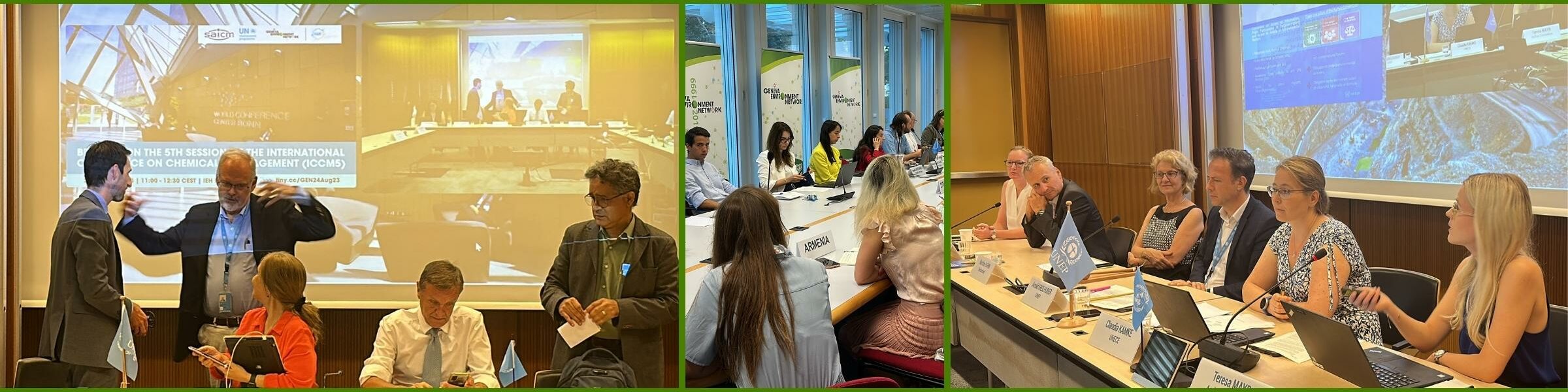
Image of the week | With the start of the new scholar year for public schools in Geneva last week, the Geneva Environment Network organized various events in preparation for upcoming negotiations. On 22 August, Human Rights and the Environment: Meeting on Activities Related to 54th Session of the Human Rights Council, to be held from 11 September to 13 October in Geneva. On 23 August, Briefing on the Global Intergovernmental Meeting on Minerals and Metals, to be held on 7 and 8 September in Geneva. On 24 August, Briefing on the 5th session of the International Conference on Chemicals Management (ICCM5), to be held from 25 to 29 September in Bonn, Germany.
Advancing the Global Water Agenda
The 2023 edition of the World Water Week convened last week in Stockholm, Sweden, to explore solutions to water-related challenges that reshape water management and ensure future sustainability. Numerous experts from international Geneva joined this annual event, where discussions followed up on the UN 2023 Water Conference, tackled preparations for international processes — such as the SDG Summit in September and the climate meeting COP28 — and analyzed progress on the Water Action Agenda. Outcomes and relevant updates surrounding World Water Week 2023 include:
- The UN Environment Programme has launched the report “Wastewater – Turning Problem to Solution“, which reports on and seeks to address significant amounts of wastewater that are still being released untreated into the environment with negative repercussions for the environment and human livelihood.
- The topic for World Water Day 2024 and the UN World Water Development Report: ‘Leveraging Water for Peace’ was introduced in a side event organized by UN-Water, UN Educational, Scientific and Cultural Organization, and UN Economic Commission for Europe.
- With over 15,000 participants in-person and online and 300 events over 4 days, key messages that came out of the conference include: that interconnectivity is crucial, the importance of rethinking what innovation means, and the need to learn from Indigenous Peoples.
The global water agenda continues to advance this week with a Briefing in Preparation for the 10th World Water Forum in 2024. Ahead of the World Water Forum’s 2nd Stakeholder Consultation meeting taking place in Bali, Indonesia from 12 to 13 October 2023, this event organized by the Permanent Mission of Indonesia to the UN in Geneva within the framework of the Geneva Environment Network will provide updates on the outcomes of the UN Water Conference that took place in March 2023, and stakeholders’ perspectives on the way forward to the Forum. It will also address the water-related outcomes of the 27th UN Climate Change Conference. → Register to attend in person or watch online on 30 August 2023 from 11:00 to 12:30 CEST.
In Geneva, water is discussed in various fora (human rights, humanitarian, health, meteorology, disaster prevention, nature conservation, economy, peace, pollution, etc.) and numerous organizations (UN, intergovernmental organizations, NGOs, business organizations, academic) focus on water issues, making this region a strategic hub for global water governance. → As water continues to be under extreme threat from water resource mismanagement, increasing demands of agriculture and industry, and the worsening impacts of climate change, learn more about how International Geneva is taking action on water.
Mobilizing Stakeholders for the Global Meeting on Resources Management
In preparation of the Global Intergovernmental Meeting on Minerals and Metals Management that will tale place next week, on 7 and 8 September 2023 in Geneva, the Geneva Environment Network, in partnership with the process’ co-chairs, Switzerland and Pakistan, hosted two preparatory events. A first briefing, organized in February, ahead of the regional consultations, focused on the Implementation of UNEA Resolution 5/12 on Environmental Aspects of Minerals and Metals Management. At the second briefing, organized last week, the conveners and stakeholders engaged in the process made a point on the latest stages of preparations for the global consultation. → Rewatch the session and access documents and presentations. Additional efforts and engagements of Geneva actors in resource management are listed on our regularly updated page.
The UN Environment Management Group (EMG) will host an online EMG Nexus Dialogue on the topic, on 30 August from 15:00 to 16:30 CEST. The event will follow up on the outcomes of the 2020 Nexus Dialogue on Mineral Resource Governance, inform on preparations, and address the UN system’s synergetic efforts, including the UN Secretary General’s Working Group on Extractives’ Industries.
To participate in the Global Consultation in person (for UNEP-accredited stakeholders) or online, register until 1 September 2023 through Indico.
UN Treaty to End Plastic Pollution: Kicking Off INC-3 Preparations
The third session of the Intergovernmental Negotiating Committee to develop an international legally binding instrument on plastic pollution, including in the marine environment (INC-3), is scheduled to take place in Nairobi, Kenya, from 13 to 19 November 2023. Preparations started taking speed on 22 August with the kick-off of a series of technical webinars organized by the INC Secretariat discussing topics of interest expressed by Members of the Committee. The INC Chair, Ambassador Gustavo Meza-Cuadra, sent an invitation to observers offering the opportunity to present their written submissions in one of two webinars on 29 August and 5 September 2023. → To remain informed about upcoming preparatory events and news ahead INC-3, consult our regularly updated page.
Highly engaged in the process, stakeholders from International Geneva have provided written submissions on (a) elements not discussed at INC-2, such as principles and scope of the instrument: CIEL | IATA | ILO | ISO | ITUC | IUCN | OHCHR | UNDRR | WBCSD | Business Coalition for a Global Plastics Treaty | Scientists Coalition for an Effective Plastics Treaty ; and (b) any potential areas for inter-sessional work compiled by the cofacilitators of the two contact groups, to inform the work of INC-3: Secretariat of the Basel, Rotterdam and Stockholm Conventions| CIEL | Forum on Trade, Environment & the SDGs (TESS) | Geneva Cities Hub | ISO | IUCN | UNITAR | Business Coalition for a Global Plastics Treaty | Scientists’ Coalition for an Effective Plastics Treaty (Scientists’ Coalition).
Other recent news on plastics include:
- Résidus d’abrasion des pneus, source la plus importante de microplastiques | Conseil fédéral Suisse | 23 August 2023
At the 23 August 2023 meeting, the Swiss Federal Council approved a report recognizing tire residues as the main source of microplastics and relative measures for reduction. - A preliminary study about the potential risks of the UV-weathered microplastic: The proteome-level changes in the brain in response to polystyrene derived weathered microplastics | Hee-Yeon Kim, Janbolat Ashim, Song Park, et al. | Environmental Research | September 2023
A study found that weathered microplastics (WMPs) are a more profound inflammatory factor than virgin microplastics (VMPs). These can have potential risks to biological systems and even humans in the ecosystem.
Summer Heatwave | Impacts on Alps and Glaciers
With less than 100 days until the Climate COP28, the summer of globally recorded extremes has sent clear messages on the need to act swiftly to curb the increasingly threatening impacts of climate change.
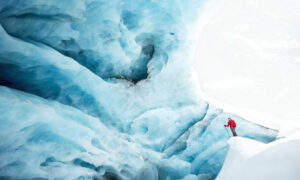
The past week’s heat dome continued to batter various European countries, scoring new records on Swiss peaks. On the night between 20 and 21 August 2023, the MétéoSuisse weather balloon above Payerne registered the zero-degree line – the altitude at which the temperature falls below freezing – at 5,298 meters. The elevated temperatures had also visible impacts on the Alps and various Swiss glaciers. On 23 August, ten to twenty cubic meters of rock detached from the north face of the Aiguille du Midi in Haute-Savoie, France, while the conspicuous ice loss witnessed on various Swiss glaciers brought experts to mourn the death of the St. Annafirn glacier. According to Matthias Huss, head of Glacier Monitoring Switzerland (GLAMOS), high temperatures at high altitudes increase the speed of glaciers melting, aggravating the already poor state they are in. MétéoSuisse recently published a glacier history through photos, showing their past fluctuations, which offer essential scientific information on current and future climate. Recent observations also raised the warning about Indonesia’s “eternity glaciers”, as two of the world’s few tropical glaciers might be melting and vanishing by 2026.
As these changes are practically irreversible, a recent study published in the journal Nature highlighted how “by 2100, the decline of all glaciers outside the Antarctic and Greenland ice sheets may produce new terrestrial, marine and freshwater ecosystems over an area ranging from the size of Nepal to that of Finland.” According to the researchers, “in deglaciated areas, the emerging ecosystems will be characterized by extreme to mild ecological conditions, offering refuge for cold-adapted species or favoring primary productivity and generalist species.” → Learn more about Unprecedented Rates of Mountain Glacier Melting and the Role of Geneva
This summer has also been characterized by record-breaking wildfires, with an unprecedented wildfire season in the Boreal Region and wildfires burning in Greece found to be the largest recorded in the European Union in years. → For a collection of the latest science and evidence of climate change impacts on weather and extreme events, visit our update.
Launch of the Global Biodiversity Framework Fund
The Global Biodiversity Framework Fund (GBFF), which was launched last week at the Seventh Global Environmental Facility (GEF) Assembly in Vancouver, Canada, will support the implementation of the Kunming-Montreal Global Biodiversity Framework, adopted last December, which aims to halt and reverse biodiversity loss by 2030 and guide nature towards recovery by 2050. The new GBFF has been designed to mobilize and accelerate investment in the conservation and sustainability of wild species and ecosystems, whose health is under threat from wildfires, flooding, extreme weather, and human activity including urban sprawl. Contributions have already begun flowing, with Canada pledging 200 million Canadian dollars and the UK 10 million pounds. → Read the GEF press release and check out the Earth Negotiations Bulletin highlights and photos of the ratification on 24 August 2023.
In the context of the GEF Assembly, WWF, IUCN World Commission on Protected Areas, and The Nature Conservancy, with financial support from the GEF, launched a guide to achieving Target 3 or the “30×30 target” of the Global Biodiversity Framework and effectively and equitably conserving at least 30 percent of the Earth by 2030.
Alternatiba 2023: 9th Edition of Local Climate Initiatives Festival
This week, the 9th edition of the Festival Alternatiba Léman will showcase concrete means and solutions for reducing emissions with the participation of numerous local actors. With a dense program of conferences, expositions, workshops, stands, and more during the weekdays, the Festival will then welcome participants at Parc des Bastions on Saturday from 10:00 to 18:00 at the Village of Alternatives, offering participants the opportunity to learn from and exchange with the 120 organizations.
Taking Place Abroad
10th Session of the IPBES Plenary and Stakeholder Day | From 28 August to 2 September 2023, the 10th Session of Intergovernmental Science-Policy Platform on Biodiversity and Ecosystem Services (IPBES) Plenary will take place in Bonn, Germany. The plenary was preceded by a Stakeholder Day on 27 August. Member States will gather for a thematic assessment of invasive alien species and their control. Other items on the agenda include engagement with the Intergovernmental Panel on Climate Change (IPCC); progress in building capacity, strengthening knowledge foundations, and supporting policy; improvement of the Platform’s effectiveness; the IPBES rolling work programme up to 2030; and financial and budgetary arrangements. → Follow the live coverage by the Earth Negotiations Bulletin.
What (Else) to Read Next?
- Record low 2022 Antarctic sea ice led to catastrophic breeding failure of emperor penguinsEmperor penguins risk ‘quasi-extinction’ from sea ice loss in Antarctica | Peter T. Fretwell, Aude Boutet & Norman Ratcliffe | Communications Earth & Environment | 24 August 2023
The spring season of 2022 saw record low sea ice extent in Antarctica that persisted throughout the year, causing the first recorded incident of a widespread breeding failure of emperor penguins that is clearly linked with large-scale contractions in sea ice extent.
- IAEA Presents Monitoring Data from Japan on Treated Water Release from Fukushima Daiichi | IAEA | 24 August 2023
The IAEA is providing live data from Japan on the release of treated water from the Fukushima Daiichi Nuclear Power Station (FDNPS) on the IAEA website. The data provided includes water flow rates, radiation monitoring data, and the concentration of tritium after dilution. - Ecuadorians reject Amazon oil drilling in historic referendum | Climate Home News | 21 August 2023
Citizens of Ecuador voted against extracting oil from large reserves found within a national park in the Amazon rainforest in a historic referendum. In a first-of-its-kind poll, 59% of voters decided to keep oil in the ground in the Yasuní National Park, one of the largest biodiversity hotspots on the planet and home to indigenous people in voluntary isolation. - Fanning the Flames: G20 provides record financial support for fossil fuels | IISD | 21 August 2023
The 2022 energy price crisis has catapulted public financial support for fossil fuels to new levels. G20 governments were quick to cushion the effects of peaking fossil fuel prices and bolster energy supplies, providing a staggering USD 1.4 trillion in the form of subsidies, investments by state-owned enterprises (SOEs), and lending from public financial institutions (PFIs). While much of this was support for consumers, around one-third (USD 440 billion) was driving investment in new fossil fuel production.
Events
See all
Body Meeting
Expert Forum for Producers and Users of Climate Change-related Statistics 2023
28 – 30 Aug 2023
Palais des Nations
UNECE


Body Meeting
Implementation Committee | 57th session
29 Aug – 01 Sep 2023
Palais des Nations
Espoo Convention and the Protocol on SEA

Workshop
Walking the Talk on New Sustainability Values: Turning Aspirations into Practical Policy Making for and with Future Generations
29 Aug 2023 | 10:30 – 12:00
Palais des Nations | Building H Auditorium
Beyond Lab, Netherlands
Conference
Investing with Nature: Deep dive on nature-based solutions in urban areas
29 Aug 2023 | 14:00 – 15:30
Online
UNEP FI
Conference
WBCSD virtual conference | Natural Climate Solutions in Action: the experience of carbon credit projects
30 – 31 Aug 2023
Online | Zoom
WBCSD
Conference
Water for Shared Prosperity: From New York to Bali | Briefing in Preparation of the 10th World Water Forum
30 Aug 2023 | 11:00 – 12:30
Palais des Nations | Room VIII & Online | YouTube
Indonesia, Egypt, GEN
Conference
EMG Nexus Dialogue | Environmental Aspects of Minerals and Metals Management
30 Aug 2023 | 15:00 – 16:30
Online
UN EMG
Afterwork
Beyond Water – Biennale De L’art Et De La Nature Urbaine | Cérémonie d’ouverture
01 Sep 2023 | 18:00 – 23:30
Bateau Genève
(re)connecting.earth
Jobs
See all