
World Environment Day | World Environment Day 2025
World Environment Day
In 1972, the UN General Assembly designated 5 June as World Environment Day. The first celebration, under the slogan “Only One Earth” took place in 1973. In the following years, World Environment Day has developed as a platform to raise awareness on the problems facing our environment such as air pollution, plastic pollution, illegal wildlife trade, sustainable consumption, sea-level increase, and food security, among others. Furthermore, World Environment Day helps drive change in consumption patterns and in national and international environmental policy.
Led by the United Nations Environment Programme (UNEP) since its creation, World Environment Day has become the largest global environmental for environmental outreach, engaging a vast global audience across more than 150 countries in tackling today’s most pressing environmental challenges.


2025 Theme: Putting an End to Plastic Pollution
The 2025 edition of World Environment Day will focus on putting an end to plastic pollution.
For decades, plastic pollution has seeped into every corner of the world, leaching into the water we drink, into the food we eat, and our bodies. While plastic pollution is a major concern, it is also one of the most fixable of today’s environmental challenges, with some obvious solutions at hand.
A resolution was adopted in 2022 at the United Nations Environment Assembly to develop a legally binding instrument on plastic pollution, including in the marine environment. This year’s World Environment Day observance comes as countries make progress towards securing the global treaty to end plastic pollution, including in the marine environment. In November 2024, the Republic of Korea hosted the first part of the fifth session of negotiations to develop a plastic pollution treaty. The resumed session of the Intergovernmental Negotiating Committee (INC-5.2) will take place from 5 to 14 August in Geneva.
World Environment Day this year aims at mobilizing communities worldwide to implement and advocate for solutions, spotlighting the growing scientific evidence on the impacts of plastic pollution and drive momentum to refuse, reduce, reuse, recycle, and rethink plastics use. It will also reinforce the global commitment made in 2022 to end plastic pollution through a global plastic pollution treaty.

2025 Host Country: South Korea
Each year, World Environment Day is hosted by a different country in which official celebrations take place. The host country for 2025 is South Korea, which hosted the first part of the Fifth Session of the Intergovernmental Negotiation Committee on plastic pollution, including in the marine environment. This is the Republic of Korea’s second time to host global observations for World Environment Day.
Over the past three decades, the country has made remarkable progress in improving water and air quality, managing chemicals safely, and protecting and restoring ecosystems. Today, building on decades of experience engaging businesses through extended producer responsibility, the Republic of Korea is among the countries leading efforts to tackle plastic waste. The country’s full life-cycle plastic strategy aims to address every stage in the life cycle of plastics, from production and design to consumption, reuse and recycling. The strategy brings together the government, businesses and consumers to reshape how plastics are used and disposed of. By curbing waste at its source, expanding recycling efforts, and accelerating the transition to a circular economy, the Republic of Korea is taking decisive action to reduce plastic pollution and build a more sustainable future.
Jeju Province in the Republic of Korea was chosen as the host location for World Environment Day. In 2022, the province declared a vision to become free of plastic pollution by 2040.
Ending Plastic Pollution and the Role of Geneva
Many actors in Geneva are actively working to address the plastic crisis at the global and local level. As a hub of environmental and health governance, Geneva plays an important role in the multilateral processes to address plastic pollution.
The Geneva Environment Network has developed a Plastics and the Environment series, a set of online resources on the plastics crisis, its impact on people and the environment, and international cooperation to address this global problem, and also launched in 2020 the Geneva Beat Plastic Pollution Dialogues, aiming at outreaching and creating synergies among actors, highlighting efforts made by intergovernmental organizations and governments, businesses, the scientific community, civil society and individuals in the hope of informing and creating stronger synergies and coordinated actions.
The outcomes of recent negotiations and the Geneva Beat Plastic Pollution Dialogues provided some concrete examples of how multilateral Geneva is engaged in finding solutions to address this major crisis. These include:
- Basel, Rotterdam and Stockholm Conventions | The fourteenth meeting of the Conference of the Parties to the Basel Convention (COP-14, 2019) adopted amendments to Annexes II, VIII and IX to the Convention with the objectives of enhancing the control of the transboundary movements of plastic waste and clarifying the scope of the Convention as it applies to such waste. Parties to the Stockholm Convention agreed to eliminate the production and use of three forever chemicals, UV-328, a UV filter used in plastics, at the eleventh meeting of its Conference of the Parties, in May 2023.
- World Trade Organization | The Informal Dialogue on Plastics Pollution and Environmentally Sustainable Plastics Trade (IDP) seeks to complement discussions in the Committee on Trade and Environment (CTE) and other fora. As of April 2023, 76 WTO members are participating in the informal dialogue. In December 2021, the Members issued a Ministerial Statement on plastic pollution. The 12th Ministerial Conference, issued a new Ministerial Statement to take stock of the IDP.
- World Health Assembly | Adoption of a landmark resolution on The Impact of Chemicals, Waste, and Pollution on Human Health at the 76th session of the World Health Assembly, initially tabled by Peru, Canada, Colombia, Ecuador, El Salvador, Mexico, Monaco, Switzerland, Uruguay, and the European Union and its Member States. The resolution refers to scaling-up work on plastics and health.
- Human Rights Council | During the General Debate on Agenda Item 3 of the 52nd Session of the Human Rights Council, in March 2023, the Permanent Representative of Peru, on behalf of Peru and 32 other countries, delivered a statement underscoring that “The impact of plastic pollution on a broad range of human rights is undeniable.” The statement urges Member States to call for a plastics treaty firmly rooted in a human rights-based approach that reduces inequalities, enables just transition, and protects the environment. The 58th Session of the Human Rights Council adopted in April 2025 without a vote resolution A/HRC/RES/58/16, “The human right to a clean, healthy and sustainable environment: Ocean and Human Rights”, which emphasizes the importance of States taking decisive action to address plastic pollution throughout the full life cycle of plastic, and how plastic pollution, climate change and biodiversity loss on the ocean jeopardize the realization of human rights, including the human right to a clean, healthy and sustainable environment. It underscores the transboundary nature of plastic pollution and the need for enhanced global cooperation to effectively address the plastic crisis.
- World Health Organization Framework Convention on Tobacco Control | The Tenth Session of the Conference of the Parties to the World Health Organization Framework Convention on Tobacco Control (WHO FCTC) adopted decision FCTC/COP10(14), which recognizes plastic cigarette filters as unnecessary, avoidable and problematic, single-use plastics that are widely spread in the environment, killing microorganisms and marine life, as well as polluting oceans and urges Parties to coordinate their efforts to address plastic waste of tobacco products and related electronic devices with the objectives of the WHO FCTC in relation to national policies and international treaties and fora dealing with plastics and hazardous waste. The resolution also requests the Convention Secretariat to examine regulatory options regarding the prevention and management of waste generated by the tobacco industry and its products, including a ban on plastic cigarette filters and the management of hazardous waste from cigarettes.
- UN Trade and Development | The 5th United Nations Ocean Forum on trade-related aspects of Sustainable Development Goal 14 held in March 2025 underscored the potential of marine-based substitutes for plastics to cut plastic pollution while creating new business avenues. Showcasing already existing solutions, the Marine-based Products and Services (MAPS) Expo gathered researchers, and innovators engaged in marine-based products, ocean conservation, and sustainable materials.
- International Labour Organization | At its 110th Session in June 2022, the International Labour Conference included a ‘safe and healthy working environment’ as an ILO fundamental principle and right at work (FPRW), providing a framework for action to tackle emerging risks to workers, including from harmful exposures to plastics. In a recent report Hazardous exposures to plastics in the world of work, ILO provided a clearer understanding of the relationship between plastics exposures and worker health and priority actions for protecting workers from hazardous chemical exposures from plastics in the workplace.
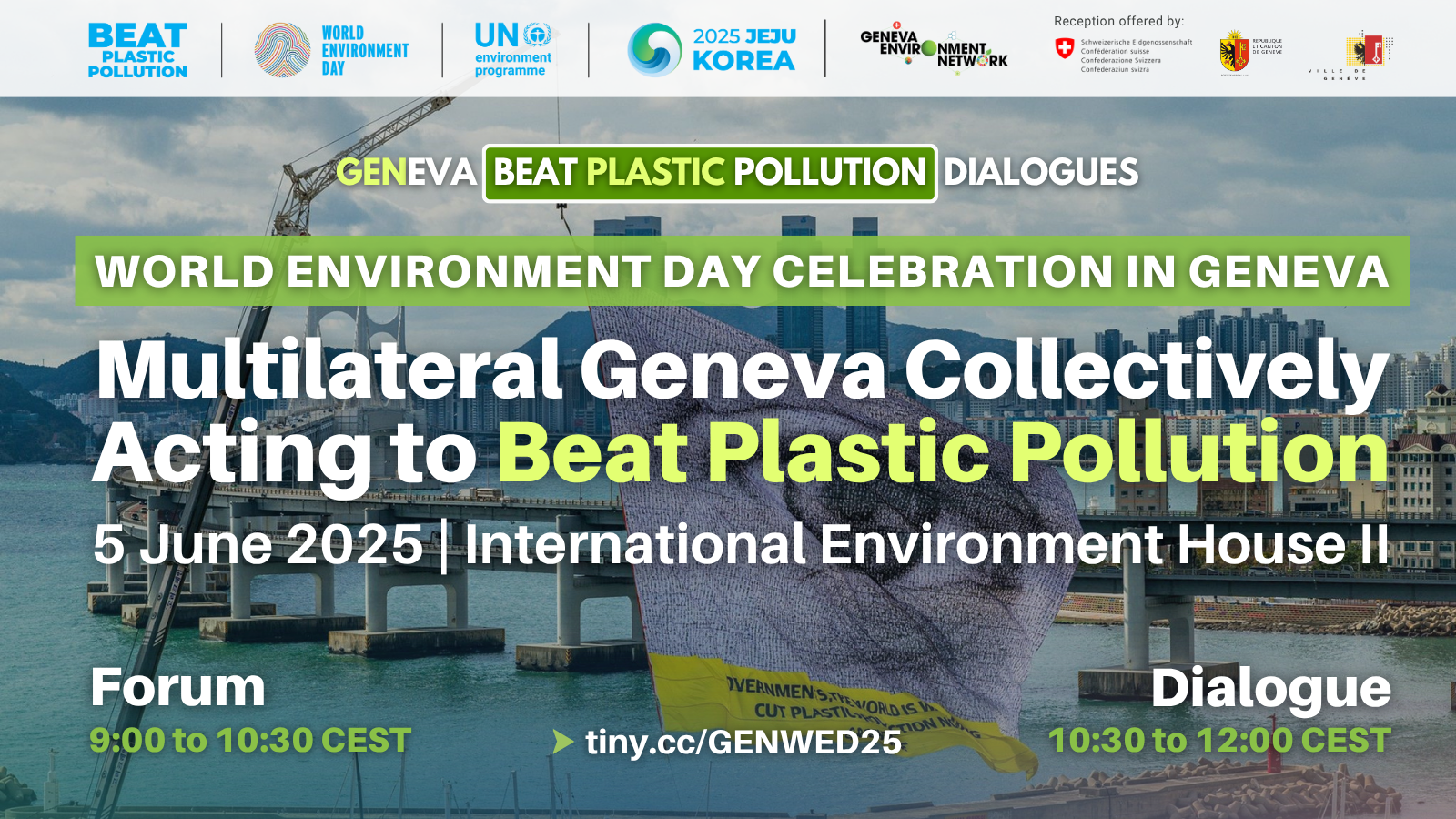
2025: Main Celebration in Geneva
The traditional World Environment Day Celebration at the International Environment House on 5 June 2025 will include a World Environment Day Breakfast offered by the host country (9:00-10:30 CEST), organized in parallel to the GENeva World Environment Day Forum showcasing how international Geneva is advancing the Beat Plastic Pollution agenda, and back to back to the World Environment Day Dialogue (10:30-12:00 CEST) building momentum towards the resumed fifth session of the Intergovernmental Negotiating Committee to develop an international legally binding instrument on plastic pollution, including in the marine environment.
2025: Other Celebrations in Geneva
Events by partners in Geneva as well as other activities throughout the week with the participation of various stakeholders are indicated in this section.
Nature | Ciné-ONU World Environment Day Screening
United Nations Office at Geneva
Cinerama
5 June 2025 | 18:45 CEST

Our Home | World Environment Day 2025 Concert
Planetary Collaboration, UNEP, Club diplomatique de Genève, Loterie Romande, Explora Journeys
Victoria Hall
5 June 2025 | 20:30 CEST


Showcase of World Environment Day PSA at Geneva Airport
Geneva Airport will showcase World Environment Day content on its screens to mark the observation.
1-5 June 2025

Right Here, Right Now | Global Climate Summit
UN Human Rights, in collaboration with the University of Oxford, the Right Here, Right Now Global Climate Alliance, the International Universities Climate Alliance
Oxford & Online
5 June 2025
Outdoor Activities
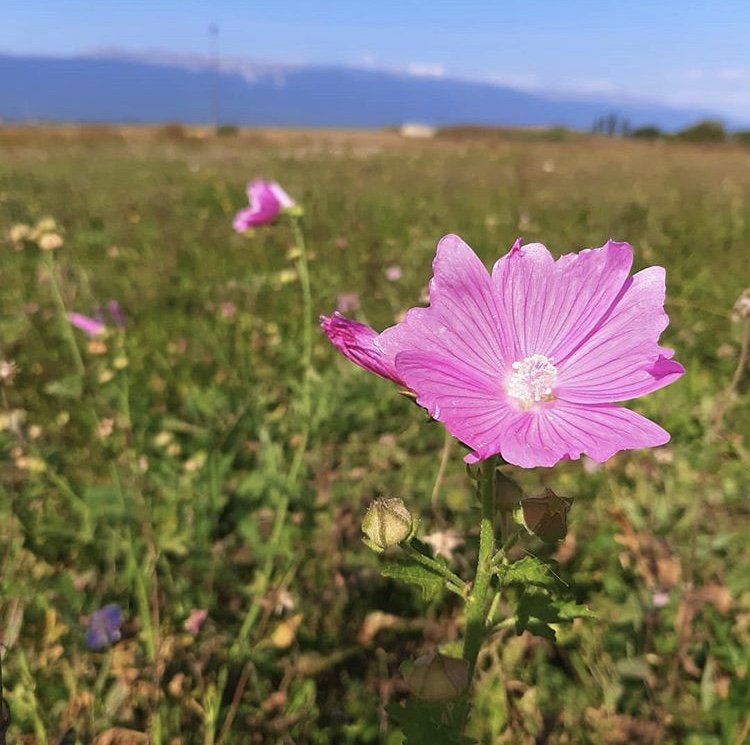
World Environment Day is the perfect occasion to explore the nature in your surroundings. Discover our suggestions below and find many more on the platform “Dans ma nature” from the Canton of Geneva. For hiking lovers, the interactive map from SwissMobile highlights national, regional and local hiking trails.

Nature Centre Pointe-à-la-bise
The Nature Centre Pointe-à-la-bise is located in the heart of a unique nature reserve on the shores of Lake Geneva. This exceptional natural area is home to a magnificent reed bed which is the home to many wild species.

Nature Centre Vallon de l'Allondon
The Nature Centre of the Allondon Valley is an open door to discover the wonders of nature, located in an exceptional site on the banks of the Allondon, a tributary of the Rhône and an important floodplain biotope. It offers various fun, educational and relaxing activities related to nature. A hiking path also follows the river.

Bioparc Genève
The wildlife park Bioparc in Bellevue is the opportunity to discover local and exotic animal species, and learn more about conservation. The park is home to 250 animals, a third of which are threatened species in the wild.

The Rhone hiking path
From Jussy to Anières, a walking route takes you through one of the most beautiful regions in the Canton of Geneva. Along the way, discover vineyards, mountain views, the lake and, of course, biodiversity with a variety of bird species.

Hike in Geneva Far West
This path will let you explore the far west of Geneva, to the westernmost region of Switzerland and to the famous border stone no.1. The path follows historic routes, with a beautiful view of the Rhone, for a quiet moment in nature.

Hike in the countryside of Geneva
From Jussy to Hermance, a walking route takes you through one of the most beautiful regions in the Canton of Geneva. Along the way, discover vineyards, mountain views, the lake and, of course, biodiversity with a variety of bird species. A part of this part (Corsier – Hermance) is wheelchair accessible.

Birdwatching in the Marais du château
The local river Seymaz is an important biodiversity hotspot following its renaturation project by the Canton, which allowed to restored 4 hectares of wetlands. The “Marais du château” (Castle Marsh) is a nature reserve managed by Pro Nature Genève and an ideal location to go birdwatching.

Biking Saturdays
Pro Vélo Genève offers guided biking tours and repair workshops on Saturdays. On 4 June, one of the organized bike tour will explore gardens around Geneva will poetic breaks to appreciate the natural world.

The Green Cycling Route
The Green Route brings you from Schaffhausen to Geneva in 7 routes, letting you discover six regional natural parks on your bicycle. Route 7 brings you from Le Sentier to Geneva, it is 68.9 km long.





Plastics and the Environment Resources


2010 – 2024 Celebrations
2024 | Land restoration, desertification and drought resilience
The 2024 edition of World Environment Day focused on land restoration, desertification and drought resilience, under the slogan “Our Land. Our Future. We are #GenerationRestoration”, as the year marked the 30th anniversary of the UN Convention to Combat Desertification (UNCCD). As a global hub for environmental governance, Geneva plays an important role in the global response to desertification, land degradation, and drought (DLDD). With leading organizations on environmental issues, nature conservation, water, health, human rights and many relevant areas of work, Geneva hosts a strong expertise to contribute to global processes tackling DLDD. From addressing the impacts and preventing the risks posed by this crisis on people and the planet to developing policies to halt DLDD, stakeholders from Geneva also play a role in making links to address other environmental crises.
2023 | Solutions to Plastic Pollution
The 2023 edition marked the 50th anniversary of World Environment Day, and focused on solutions to plastic pollution, using the hashtag and slogan #BeatPlasticPollution. With available science and solutions to tackle the problem, governments, companies and other stakeholders must scale up and speed actions to solve this crisis. This underscores the importance of this World Environment Day in mobilizing transformative action from every corner of the world. A resolution was adopted in 2022 at the United Nations Environment Assembly to develop a legally binding instrument on plastic pollution, including in the marine environment, with the ambition to complete the negotiations by end of 2024.
2022 | Only One Earth
The World Environment Day 2022 global campaign #OnlyOneEarth calls for transformative changes to policies and choices to enable cleaner, greener, and sustainable living in harmony with nature. It will focus on the need to live sustainably in harmony with nature, and our possibilities for shifting to a greener lifestyle through both policies and individual choices. “Only One Earth” was the motto for the 1972 Stockholm Conference. 50 years on, the motto is as pertinent as ever – this planet is our only home, and humanity must safeguard its finite resources.
2021 | Ecosystem Restoration
Launch of the UN Decade on Ecosystem Restoration. A call for the protection and revival of ecosystems all around the world, for the benefit of people and nature. It aims to halt the degradation of ecosystems, and restore them to achieve global goals. Only with healthy ecosystems can we enhance people’s livelihoods, counteract climate change, and stop the collapse of biodiversity.
2020 | Time for Nature
A call to action to combat the accelerating species loss and degradation of the natural world. One million plant and animal species risk extinction, largely due to human activities. Recent events, from bushfires in Brazil, the United States and Australia to locust infestations across East Africa – and now, a global disease pandemic – demonstrate the interdependence of humans and the webs of life in which they exist. Nature is sending us a message.
2019 | Beat Air Pollution
A call for action to combat one of the greatest environmental emerging challenges of our time. Often you can’t even see it, but air pollution is everywhere and affects your health from head to toe. With every breath, you are probably sucking in tiny particles that attack your lungs, heart and brain.
2018 | Beat Plastic Pollution
The aim was for people to strive and change their everyday lives to reduce the heavy burden of plastic pollution. People should be free from the over-reliance on single-use or disposables, as they have severe environmental consequences. In addition, we should liberate our natural places, our wildlife and our own health from plastics.
2017 | Connecting Nature to People
In the city and on land, from the poles to the equator, it encourages worldwide awareness for the protection of our environment.
2016 | Go Wild for Life
The campaign aimed to reduce and prevent the illegal trade in wildlife.
2015 | Seven Billion Dreams. One Planet. Consume with Care.
This was the slogan picked through a voting process on social media.
2014 | International Year of Small Islands Developing States (SIDS)
The UN General Assembly aimed to highlight the development challenges and successes of the SIDS, focusing on global warming and its impact on ocean levels. The slogan was “Raise your voice not the sea level” for this year.
2013 | Think. Eat. Save.
The campaign addressed the huge annual food waste and loss. With the amount added together, it would release a large quantity of food as well as reduce carbon footprint. The theme also aimed to empower people to make informed choices about the food they eat so as to reduce the overall ecological impact due to the worldwide production of food.
2012 | The Green Economy
The campaign invited people to examine their activities and lifestyle and see how the concept of a “Green Economy” fits into it.
2011 | Forests: Nature at Your Service.
Activities were organized with clean-ups, concerts, exhibits, film festivals, community events, tree plantings and much more.
2010 | Many Species. One Planet. One Future.
Celebrating the diversity of life on Earth as part of the 2010 International Year of Biodiversity.