
Event Conference
Geneva Environment Network High-Level 25th Anniversary Celebration
20 Jan 2025
09:00 – 13:30
Venue: International Environment House I & II
Organization: Geneva Environment Network
The celebration of the 25 Years of the Geneva Environment Network – the pivotal platform of international Geneva dedicated to GENerating participation and engagement for increased collaboration among stakeholders in the fight against the triple planetary crisis – concluded with the GEN@25 Environment Forum and a high-level closing ceremony on 20 January 2025, with the aim of creating a meaningful and impactful celebration, inspiring renewed commitment to environmental governance and collaborative action.
High-Level 25th Anniversary Celebration
Celebrating the Geneva Environment Network is celebrating the numerous institutions in international Geneva and beyond that contribute to make Geneva a global hub for environmental governance. To close the celebration of this important milestone, two key moments took place at the International Environment House: the GEN@25 Environment Forum, followed by the High-Level Closing Ceremony.


About the GEN@25 Environment Forum
9:00 – 10:45 CET | International Environment House I (13 ch. des Anémones)
Welcome and Opening | 9.05 CET
- Inger ANDERSEN | Executive Director, UN Environment Programme
- Katrin SCHNEEBERGER | State Secretary and Director, Federal Office for the Environment, Switzerland
Geneva Advancing Environmental Action
The GEN@25 Environment Forum will feature key thematic areas of work of international Geneva and how these are accelerating action to tackle the triple planetary crisis. Partners and stakeholders will gather at the International Environment House to get together and showcase how international Geneva creates synergies, drives innovation, and boosts ambition to advance environmental action:
- Climate Action
- Action on Nature, Land and Biodiversity Loss
- Action on Pollution and Waste
- Beating Plastic Pollution
- Future-Proofing Mineral and Metal Resources Governance
- Advancing Trade Solutions to the Environmental Crisis
- Placing Human Rights at the Heart of Environmental Action
- Catalyzing Environmental Action through Digital Transformation
- Strengthening the Science-Policy Interface
- Advancing the One Health Approach
- Ensuring Decent Work and a Just Transition
- Coordinating Action to Restore the Water Cycle
- Geneva Humanitarian Hub at the Frontlines of Environmental Action
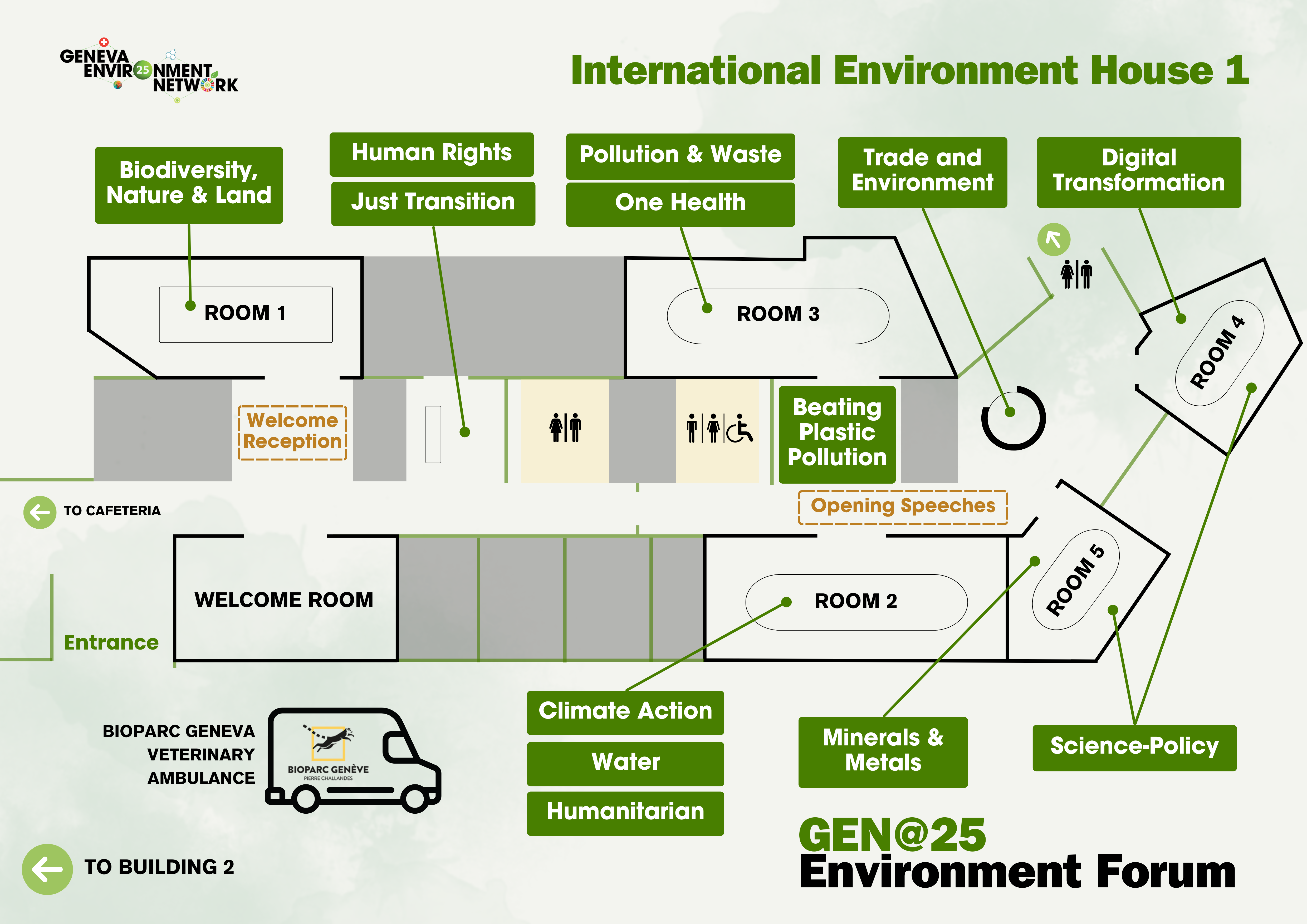
GEN@25 Environment Forum Map
About the High-Level Closing Ceremony
10:45 – 11:45 CET | International Environment House II (7-9 ch. de Balexert)
The 25th Anniversary Celebration of the Geneva Environment Network culminated with a High-level Closing Panel, held under the theme, “Multilateralism Looking at the Future – Protecting the Environment with Humanity at the Center“. Amid a turbulent geopolitical background, a fast-approaching deadline for the 2030 Sustainable Development Goals, and in the face of the global environmental crises, the panel will reflect on the importance of strengthened partnerships while fostering a vision for the future, encouraging continued collaboration and action, with people and the planet at the center.


Speakers

Inger ANDERSEN
Executive Director, UN Environment Programme

Katrin SCHNEEBERGER
State Secretary and Director, Federal Office for the Environment, Switzerland
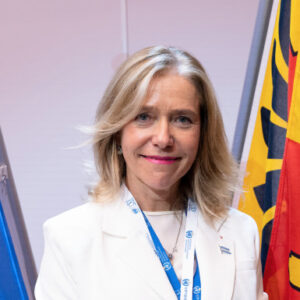
Celeste SAULO
Secretary-General, World Meteorological Organization
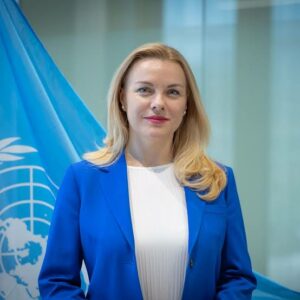
Tatiana MOLCEAN
Executive Secretary, UN Economic Commission for Europe
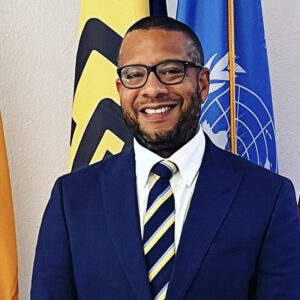
H.E. Amb. Matthew WILSON
Permanent Representative of Barbados to the UN Office and other international organizations in Geneva

Claire THUAUDET
Deputy Permanent Representative of France to the United Nations in Geneva and other international organizations in Switzerland
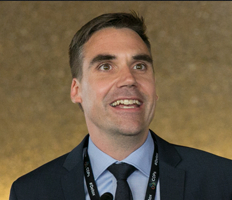
H.E. Amb. Felix WERTLI
Switzerland Ambassador for the Environment

Kirsten SCHUIJT
Director General, WWF International

Rev. Jerry PILLAY
General Secretary, World Council of Churches
Networking Reception
11:45 CET onwards
Official speeches will be followed by a networking reception, offered by Switzerland, Canton of Geneva, and City of Geneva.
- H.E. Amb. Felix WERTLI | Switzerland Ambassador for the Environment
- Inger ANDERSEN | Executive Director, UN Environment Programme


Highlights
Videos
Opening of the GEN25 Environment Forum.
High-Level Closing Ceremony.
Photo Gallery
Photos credits © Alejandro Laguna (UNEP), Jules Leistner (UNEP), Lisa Vroone (UNEP), Geneva Environment Network. Additional photos can be found on the GEN Flickr account and the BRS Flickr account.


Summary
Diana RIZZOLIO | Coordinator, Geneva Environment Network
Over the past months, GEN engaged with various communities to reflect on key themes:
- The scientific community to discuss strengthening the Global Environmental Agenda during COVID-19.
- Elders and experts to reflect on lessons learned from the past six decades.
- Citizens to explore how they can drive systems change and catalyze environmental action.
- Live-streaming the ICJ historical hearings on climate justice, with Geneva experts providing commentary on this momentous occasion.
- Engaging with the faith community to reflect on their role in tackling the triple planetary crisis.
The high-level closing panel will focus on multilateralism and the future, protecting the environment with humanity at the center.
Katrin SCHNEEBERGER | State Secretary and Director, Federal Office for the Environment, Switzerland
- For the past 25 years the Geneva Environment Network has been a cornerstone of international environmental governance, together with the many institutions that make Geneva a global hub for environmental governance.
- Multilateralism is under pressure, but it remains our strongest tool for addressing global environmental challenges while keeping humanity at the heart of our efforts.
- GEN has played a key role in fostering dialogue, cooperation, and action among diverse stakeholders to strengthen responses to the triple planetary crisis—climate change, biodiversity loss, and pollution.
- There are four key elements that are essential for progress:
- Science: A fundamental driver of environmental policy. Science-policy panels like the IPCC in Geneva provide robust scientific evidence. Ongoing negotiations on the science-policy panel for chemicals, waste, and pollution will help build a global scientific consensus on action.
- Commitment: The international community has committed to addressing and tackling plastic pollution through a treaty that must address all life cycle stages and hazardous chemicals. The Geneva Beat Plastic Pollution Dialogues, organised by the GEN, are a prime example of effective engagement and discussion in this space. Geneva’s institutions will also play a crucial role in implementing the treaty.
- Effectiveness: Resources must be used efficiently. The BRS conventions showcase how to create and leverage synergies. The Bern Process brings together biodiversity conventions to enhance collaboration and impact. The Swiss Federal Council has also approved the signing and ratification process of the BBNJ agreement (Agreement under the United Nations Convention on the Law of the Sea on the Conservation and Sustainable Use of Marine Biological Diversity of Areas beyond National Jurisdiction).
- Relevance: The demand for minerals is surging, driven by the energy transition, yet mineral production harms biodiversity and increases pollution. The new Geneva Dialogues on Mineral and Metal Resources—launching in February—will bring together stakeholders to find solutions.
- GEN plays a key supporting role in all these areas, acting as a hidden champion—small in size but highly effective due to its innovation and quality work.
- As a key instrument for awareness and engagement on environmental issues, GEN connects stakeholders in Geneva and globally to drive environmental action.
Inger ANDERSEN | Executive Director, UN Environment Programme
- The Geneva Environment Network has played a critical role in creating a global chorus that has successfully raised the profile and visibility of the imperative of environmental action, both individually and collectively.
- Geneva hosts UNEP’s second-largest presence, making it an important complement to Nairobi, which serves as UNEP’s home and the global environmental capital for environmental diplomacy. The International Environment House is viewed as UNEP’s home away from home in Geneva.
- GEN was established 25 years ago by UNEP’s predecessors along with the Environment House, bringing many organizations together in Geneva, where many now have their offices.
- Switzerland has been an exemplary host country, providing vital support to UNEP, its staff, and their families, as well as significant contributions to projects and budgets. Switzerland also brings critical thought leadership to UNEP, identifying emerging environmental challenges and advocating for preemptive action.
- The GEN community has served as an amplifying voice and force for action, fostering cooperation among UN agencies, multilateral environmental agreements, international organizations, federations, and NGOs.
- The forum demonstrates how the GEN community is advancing action on the triple planetary crisis.
- Key focus areas include beating plastic pollution, fulfilling the human right to a healthy environment, strengthening the One Health approach to human, animal, plant, and planetary health, using trade as a force for good, and aligning humanitarian and environmental action.
- The triple planetary crisis is interconnected, meaning that effective action in one area leads to positive impacts across health, prosperity, equity, and peace. However, despite ongoing efforts, the crisis continues to intensify.
- The past 50 years have seen fragmentation within the environmental movement, making it essential to overcome divisions and weave a stronger tapestry of action across organizations, agencies, and geographies.
- UNEP is working toward greater environmental policy coherence, exemplified by the first-ever MEA Day at the last UN Environment Assembly, which brought together global agreements, regional conventions, and scientific panels. Another MEA Day is planned for the next UNEA assembly at the end of the year.
- We call on GEN, UNEP, Geneva, Switzerland, Bonn, Montreal, and other locations to work better, faster, and harder together on shared environmental challenges, emphasizing that as one family working on one planet, a sustainable future must be built for everyone, everywhere.
Celeste SAULO | Secretary-General, World Meteorological Organization
- The urgency for stronger environmental action through science has never been greater. The climate crisis is deeply interconnected with the inequality crisis and other planetary crises, including biodiversity loss and pollution. Climate change does not operate within political or national interests—it follows the laws of physics, which are non-negotiable.
- WMO repeatedly issued a “red alert” about the state of the climate. WMO has confirmed that 2024 was the warmest year on record, temporarily surpassing 1.5°C above pre-industrial levels, reaching precisely 1.55°C, according to consolidated analyses of six data sets. The last decade was the hottest on record, with sea surface temperatures and ocean heat also at unprecedented levels.
- To illustrate the scale of the crisis, the increase in ocean heat content between 2023 and 2024 in the upper 2,000 meters was roughly 140 times the total electricity generated worldwide in one year. This underscores the urgency of addressing climate change.
- A single year above 1.5°C does not mean the Paris Agreement’s long-term temperature goals have been breached, as these are measured over decades. The latest analysis from WMO experts suggests long-term global warming is currently about 1.3°C above pre-industrial levels. However, the Paris Agreement is in critical need of revitalization.
- Science tells us that every fraction of a degree of warming matters, leading to more extreme weather, intensified tropical cyclones, accelerating sea level rise, ocean acidification, and glacier retreat. The largest glacier mass loss in five decades was recorded in 2023, including severe losses in the Swiss Alps. Glacial retreat, like sea level rise, is irreversible on timescales of centuries to millennia, according to the IPCC.
- On January 21st, WMO and UNESCO will launch the International Year of Glacier Preservation, emphasizing the need for stronger environmental action informed by science. With over 275,000 glaciers worldwide storing about 70% of global freshwater, their loss is a major concern.
- Urgent and sustained greenhouse gas emission cuts are necessary and must be science-driven. WMO’s Global Greenhouse Gas Watch initiative is now being rolled out to improve monitoring and inform action. Science is also crucial for climate adaptation, life-saving early warnings, and developing solutions like renewable energy.
- While progress is being made toward tripling installed renewable energy by 2030, climate change itself is impacting the ability to generate clean energy, affecting wind, solar, and hydropower production. Scientific tools are needed to anticipate these fluctuations and ensure sustainable energy transitions and goals.
- Science-driven environmental policymaking has made strides, such as the recovery of the ozone layer. Scientific discoveries about ozone depletion led to global action, resulting in the Vienna Convention and the Montreal Protocol, which phased out nearly 99% of harmful chemicals that were damaging the ozone layer. The ozone layer is now on track to recover within four decades, and the Montreal Protocol also contributed to climate change mitigation. The protocol is a true champion for the environment, it sets a precedent for the environment and shows that scientific knowledge, technological advances, and political will, can join as powerful forces for the good of the environment and the planet.
- The Geneva Environment Network was founded 25 years ago when warning signals about climate change were already evident. However, action was delayed, leading to a lost generation of opportunity. Now, with the knowledge and tools available, there is an urge for immediate and decisive action to turn the tide in 2025.
Tatiana MOLCEAN | Executive Secretary, UN Economic Commission for Europe
- We need to discuss what role the regional track plays in advancing global environmental outcomes. During this event, we hope you had the chance to witness firsthand the extent of cooperation within the Geneva Environmental Network. It’s hard to fully grasp the magnitude of the work carried out, but it’s clear that multilateralism and collaboration are key in tackling planetary crises. We also would like to take this opportunity to express gratitude to the founders for creating the network.
- At the Economic Commission, we believe that the local authorities (Geneva Council, Geneva City, etc.) are often the first line of response when it comes to delivering on environmental goals and addressing crises. At UNECE, we deeply believe that it is not only international organizations or central governments that should take the lead, but local authorities who often face these challenges directly. We are proud to partner with various initiatives in the Geneva region and beyond to support this approach.
- Our dedicated focus on climate action is reflected in our biennial agenda, with the next two years focusing on the main theme of climate action for resilient restoration. This is part of our broader commitment to tackle environmental issues head-on, with specific efforts aimed at restoring nature, combating land degradation, halting biodiversity loss, and addressing the plastic crisis that continues to impact ecosystems.
- We recognize that ecosystems are the very foundation of all life, and we place significant emphasis on forests. Our region, which spans North America, Europe, and Central Asia, covers over 42% of the world’s forests. Our work is geared towards not just preserving these vital ecosystems but restoring and expanding them as part of our environmental priorities.
- Ensuring access to clean air and safe drinking water is a fundamental part of our mission. While the multilateral agreement on water is a global initiative, the UNECE region has its own successful convention on clean air that has been in place for over 45 years. This convention has proven effective in delivering real results, and we believe there is potential for similar standards to be adopted globally to address air pollution.
- We are also addressing global challenges related to mineral and metal resources, particularly their role in green technology supply chains. UNECE is working to future-proof governance of mineral and metal resources, using tools like the UN framework classification and the UN resource management system, for resources to ensure sustainable and equitable management of these critical materials.
- Energy dependence remains a significant challenge, with over 80% of the UNECE region still reliant on fossil fuels for energy supply. Despite efforts towards energy transition, more needs to be done. We are working on energy transition solutions to reduce this dependency and are actively collaborating with the Geneva Environment Network to launch a new Geneva Dialogues on Mineral and Metal Resources in February that aims to find trade solutions to address environmental challenges, ensuring sustainable production and consumption.
- Our work is not limited to policy creation; we are committed to delivering tangible, practical results. For example, the Trees in Cities Coalition is an initiative launched with local communities, that has led to the planting of over 19 million trees in more than 80 cities worldwide. This initiative exemplifies our commitment to not just creating policies but also putting them into action on the ground.
- It is important to remember that while we focus on climate action and environmental protection, we must never lose sight of human rights. Our efforts in environmental action are driven by the understanding that humanity is at the core of these decisions. Programs like the Aarhus Convention empower communities to actively participate in environmental decision-making, which is a key part of ensuring that environmental actions are fair and inclusive.
- Through all of this, our goal at UNECE is to contribute meaningfully to global efforts in advancing the environmental agenda, ensuring that our actions are not isolated but part of a broader global movement aimed at addressing climate change and its effects on the planet.
H.E. Amb. Matthew WILSON | Permanent Representative of Barbados to the UN Office and other international organizations in Geneva
- The Geneva Environmental Network is an essential space for partnerships and platforms. The GEN is a catalytic space for knowledge sharing and building, advocacy, and capacity building. In today’s world, we need these platforms more than ever as global politics in 2025 will shape the economics and approach to environmental sustainability. Despite the clear climate crisis, the environmental agenda is slipping from our collective dashboards, with rising skepticism and growing backlashes in some sectors of the green agenda. Recent surveys show that climate concerns are no longer the top priority for business leaders, and investment in clean energy is being approached more cautiously.
- In 2025, with increasingly extreme weather events and rising sea levels largely caused by fossil fuels, the fact that we’re even considering reversing investments in renewables is alarming and shameful. Nevertheless, this shift is not surprising. The trend of greenwashing by big businesses and the comparative trickle of public finance for environmental issues, especially when compared to defense spending, is concerning. This tension, or global cognitive dissonance, continues to push the responsibility of addressing climate change onto future generations, which is no longer a feasible policy. We cannot afford to lose more time, especially after already losing a decade in addressing the crisis.
Sustainability should not be a passing trend, as the climate crisis is a long-term issue that requires consistent solutions.
- These solutions need to be continually ramped up, not reversed. During a recent trip that took me through developed and developing countries, Small Island Developing States (SIDS), LDCs, and emerging economies, I saw firsthand the universal struggle with issues like plastic pollution, climate-smart agriculture, and the lack of public awareness on sustainability. Countries, regardless of their development level, face similar environmental challenges.
- From Dublin’s digitally enabled bottle return scheme to Barbados’ world-first debt-for-climate-resilience initiative, and Laos’ integration of climate-smart agriculture with tourism, innovative local solutions are emerging. However, many regions are also battling with the widespread use of single-use plastic, especially in countries that do not even produce plastic. In places like Laos, plastic pollution from upstream countries is a significant problem. In these regions, a lack of infrastructure and investment in recycling or waste management further compounds the issue, leaving governments torn between funding adaptation, mitigation, and other essential services like health and sanitation.
- Despite these challenges, I also witnessed a great deal of local innovation that could contribute significantly to sustainability if scaled and replicated. This is where partnerships and platforms like GEN come in to help connect ideas and push for real progress. For countries with small delegations like Barbados, GEN serves as a crucial platform to amplify our voices and strengthen our involvement in global environmental policymaking. It provides us with the resources, research, and analysis needed to make informed decisions and design effective strategies.
- Moving forward, I call on GEN to continue expanding its work in Small Island Developing States, and in regions like the Pacific, Caribbean, and Africa. I urge GEN to help inform policies that promote greater access to finance for adaptation, such as the Bridgetown Initiative. Furthermore, GEN should work alongside organizations like TESS to enhance youth and women’s participation in sustainability efforts, particularly through collaboration with the International Gender Champions in Geneva.
- On this 25th anniversary of the Geneva Environmental Network, we celebrate the platform’s continued success in bringing communities together. Now more than ever, we need to advocate for sustainability and become ambassadors for these issues. We must remain vigilant and energized as environmental warriors, with a collective responsibility to continue pushing for meaningful action on climate change.
Claire THUAUDET | Deputy Permanent Representative of France to the United Nations in Geneva and other international organizations in Switzerland
- Climate has been a central issue throughout our careers, and it is inspiring to see so many motivated individuals gathered here, ready to become the environmental warriors we need. As we celebrate 25 years of the Geneva Environment Network, it is important to reflect on how much the world has changed since then. Even 40 years before its creation, clear warning signals about environmental threats were already clear—from Rachel Carson’s Silent Spring to the early IPCC reports. While we understood the challenges back then, we did not fully grasp the scale of the actions needed. The world has considerably changed and subjects such as water, biodiversity, and energy, have entered the diplomatic world. Today, environmental diplomacy is everywhere; development cannot be discussed without addressing climate resilience and adaptation, and health cannot be protected without considering pollution and water quality. Preventing pandemics is intrinsically linked to biodiversity and ecosystem health.
- GEN has been at the forefront of this evolution, serving as a key player in Geneva’s international environmental efforts. Since its establishment in 1999, it has become a crucial hub for collective intelligence, bringing together international organizations, experts, member states, and activists. Its work is increasingly visible and recognized, and France is proud to have been a committed partner from the very beginning. Through GEN, we have carried messages on climate action, biodiversity, pollution prevention, and sustainable development, actively mobilizing efforts to tackle plastic pollution, regulate chemicals, and promote responsible mining practices.
- Internationally, France has been a strong advocate for ambitious environmental action. We have supported initiatives such as the Air Convention, and the Aarhus Convention, all of which have the potential to be extended to a more global framework. Alongside our European partners, we have consistently pushed for stronger commitments to biodiversity and climate action at both national and international levels. In recent years, France has exceeded $6 billion in climate finance for vulnerable countries, with $2.2 billion dedicated to adaptation. The European Union has also set firm targets to phase out coal by 2030, oil by 2045, and gas by 2050, with carbon neutrality as our shared goal.
- However, as highlighted earlier, we still face significant challenges, and this year must be one of ambition. Building on the foundation of global solidarity established at COP21 and with an overall funding target of $13 trillion, we must ensure success at Belem later this year. To meet these goals, we need determination, responsibility, and fairness—ensuring that no country is forced to choose between development and climate action. This is the spirit behind the Paris Pact for People & the Planet initiative, launched by President Macron in collaboration with the Prime Minister of Barbados in late 2023. With 59 countries now part of this initiative, we are working together to achieve equitable and sustainable progress.
- Efforts need to be doubled and must also focus on securing the plastic treaty and finalizing a biodiversity funding agreement at COP16.2 in Rome by the end of February. France is also honoured to host the third UN Ocean Conference (UNOC3) in Nice this June. Over the past 18 months, we have organised numerous events in Geneva to raise awareness, engage stakeholders, and collectively prepare for this important gathering. In the spirit of GEN, we welcome further input and suggestions from all partners involved in ocean conservation. Additionally, the announcement of the swift ratification of the BBNJ Treaty is great news, reinforcing global commitments to protecting marine biodiversity.
- As we look ahead, the GEN spirit must continue to unite and inspire us. Through knowledge-sharing and collaboration, we can develop more effective and sustainable solutions, leveraging Geneva’s international expertise. France reaffirms its unwavering support for GEN, which has guided us for the past 25 years and will undoubtedly continue to do so for the next 25 years.
Kirsten SCHUIJT | Director General, WWF International
- The recent WWF Living Planet Report revealed that monitored wildlife populations declined by an average of 73% since 1970. In addition to species numbers, we are reaching serious negative tipping points worldwide including in coral reefs, glaciers, and the Amazon. Almost 15% of the rainforest is already lost, and if we reach 20 to 25% it would be a point of no return. We are currently facing not only biodiversity loss but also a major impact on the planet as a whole.
- The WWF, with partners and other stakeholders, has launched the Roadmap 2030, which focuses on the Global Biodiversity Framework, implementation of the 30 by 30 target, and main drivers of biodiversity loss:
- Our way of food production and food waste is the biggest driver of biodiversity loss.
- The financial sector must be transformed, to ensure that policies and investments include sustainability and that the financial resources actually reach the ground.
- Climate change and nature should be looked at together since nature conservation plays a key role in the mitigation and adaptation of climate change through nature-based solutions.
- We need to make sure we are building bridges and engaging with other conservationists and environmentalists, in health, humanitarian relief, economic and financial sectors. Putting people who live and work in the places that we are trying to conserve at the center and working directly with them is essential for moving forward sustainably.
- We look forward to continuing to engage with the environment community in Geneva and working together for a world where people and nature thrive
Rev. Jerry PILLAY | General Secretary, World Council of Churches
- The World Council of Churches (WCC) has been in Geneva for 76 years and has been working with many international organizations in Geneva. Since its formation, we have focused on climate change and worked on a program on justice and integrity of creation. The WWC placed climate change and climate justice as our number one priority in 2022 in its General Assembly.
- It is important that the voice of faith communities is included in this panel; it is crucial to the conversation we are having today on climate change.
- Climate change and the broader ecological crisis is the existential challenge of our generation which is accelerating and outpacing current multilateral efforts. Changing climate patterns and disasters indicate that the climate crisis is real and is already upon us.
- Those who are least responsible for the global climate breakdown are paying the highest price and facing the loss of lives, livelihoods, and homes, which is a profound injustice. Addressing the interconnected triple planetary crisis demands global coordination, cooperation, and governments.
- In the Christian tradition, 1 Corinthians 12:26 shows that every part of creation is interconnected and that if one part suffers, all parts suffer with it. Therefore, our response to the climate and planetary emergency requires a holistic, integrated, and concerted approach, recognizing the necessity of system change, which is the institutional, economic, and social transformation, as well as multilateral cooperation to unite and amplify our efforts.
- Despite the weaknesses of environmental multilateral processes, we cannot afford to give up on them. Equity is the path to sustainability; multilateralism must be inclusive and equitable in order to succeed in responding to the ecological crisis.
- While we need to share the benefits and burdens of building a climate-resilient future, those who have generated more pollution historically and possess more resources have the greater responsibility to radically reduce emissions, share technology, and provide timely and sufficient finance for adaptation and loss, and damage, as we read in our scriptures in Luke 12:48.
- Addressing equity is essential for building the social trust needed to act rapidly, especially in tackling the climate emergency. While the goal of limiting warming to 1.5C could be met by halving emissions in the next five years through shifting investments from fossil fuels to agroecology and renewable energy, the political will is currently missing. Moral courage is also needed to confront the systemic greed driving fossil fuel exploitation and unsustainable resource extraction for the pursuit of short-term financial gains, threatening lives and future generations.
- In Christian tradition, we believe that life in creation is a sacred gift from God, and therefore we must choose life over profit. The story of creation in the Book of Genesis tells us that all creation by God is good, and humans are responsible stewards of God’s creation to care for and protect the planet.
- Faith communities have a significant role to play in addressing climate justice and creation care. The WCC recognizes its role in the spiritual, moral, and ethical aspects of responding to the climate catastrophe. For this, we have appointed a Commission on Climate Justice and Sustainable Development, consisting of Christians and other religious leaders, to facilitate dialogue and action.
- Leaving climate action only to professional scientists is not enough. The WCC is working across silos to address climate issues from different angles and disciplines, integrating science, human and child rights, climate finance, and litigation.
- Collaboration, cooperation, and collective action are necessary to create awareness, gather information and responsively act together in the common task and mission of preserving the planet.
Closing Remarks
Inger ANDERSEN | Executive Director, UN Environment Programme
- UNEP is incredibly proud and privileged to be able to create this platform through the Geneva Environment Network.
- Changes have been made in the past decades, for example, solar panels and power becoming 80% cheaper compared to 2010. However, these changes are not happening fast enough. Loss of species is irreversible, and while there are movements that push renewable energy aside, science is unassailable; the forest fires, extreme weather, and sea level rise that we see today cannot be denied.
- While conventions on issues like air and water pollution have faced challenges, we also understand that multilateralism can work well, when countries stand up and mobilize efforts. In addition to science, moral values, and ethical approaches also play a key role in making progress.
- The new Nationally Determined Contributions (NDCs) must be delivered by February 2025. Despite promises and commitments, emissions rose by 1.3% in 2023, and the global temperature is projected to rise by nearly 2.8 degrees by 2100 at the current rate, highlighting the need for urgent action.
- While political leadership is crucial in addressing this issue, it is our responsibility to choose leaders who safeguard the environment for future generations and the planet.
H.E. Amb. Felix WERTLI | Switzerland Ambassador for the Environment
- Throughout today’s discussions, we have heard about the immense challenges humanity faces. But one key message stands out: none of us can tackle these issues alone. No single organization can solve them in isolation—we must work together. This spirit of collaboration is exactly what GEN has championed for 25 years, bringing people together, fostering ideas, and developing impactful initiatives.
- Often, the best moments for collaboration happen informally, and now we have the opportunity to continue these conversations during the reception. This gathering is made possible by the generous support of the Canton of Geneva, the City of Geneva, and the Swiss Confederation—demonstrating their strong commitment not only at the national level but also at the local and regional levels. Their support underscores the vital role that International Geneva plays in driving environmental action.
Links
- One united environment family: 25 years of the Geneva Environment Network | UNEP Press Release | 20 January 2025
- The Geneva Science-Policy Interface and the Geneva Environment Network: a shared commitment to science-informed environmental policy | GSPI | 29 January 2025
GEN 25th Anniversary
The celebration of the 25 Years of the Geneva Environment Network – the pivotal platform of international Geneva dedicated to enhancing collaboration among stakeholders in the fight against the triple planetary crisis – started with a series of events exploring and highlighting frameworks and partnerships that can strengthen environmental governance. It will conclude on 20 January 2025 with a closing ceremony. This approach aims to create a meaningful and impactful celebration, inspiring renewed commitment to environmental governance and collaborative action.

Faith-based Organizations Leadership in Tackling the Triple Planetary Crisis | GEN @ 25
16 December 2024 | 14:00 – 15:30 CET | International Environment House 1, Room 2 | With GIF
ICJ Oral Hearings on Climate Justice – Diplomatic Screening and Commentary | GEN @ 25
2 December 2024 | 9:00 CET | Palais des Nations, Room XXIII | With CIEL, Geneva Human Rights Platform, Earthjustice, World’s Youth for Climate Justice
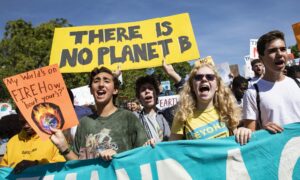
Pushing Boundaries Through Collective Action: How Can Citizens Drive Systems Change and Catalyze Climate Action? | Climate Solutions to Keep 1.5° Alive | GEN @ 25
2 December 2024 | 15:30 – 17:00 CET | Palais des Nations, Room XVII | With UNDP Geneva

From Stockholm to Rio and Geneva | Six Decades of Enhancing Collaboration in the Fight Against the Triple Planetary Crisis: A Roundtable with Elders | GEN @ 25
28 November 2024 | 14:00–15:30 CET | International Environment House I, Room 2 & Online | Webex

How to Keep the United Nations Environmental Agenda in Times of Crisis? | GEN @ 25
15 November 2024 | 10:00 – 11:30 CET | IEH 1, Room 2 | With Geneva Graduate Institute

Strengthening Scientists Engagement: Shaping the Future of Chemicals, Waste, and Pollution Prevention | Road to OEWG 3.2 | GEN @ 25
26 September 2024 | 14:00 – 15:30 CEST | Online (Webex) | With SPPCWP OEWG Secretariat