Newsletter 23 Nov 2026
Environment: What’s Up in GENeva | 23 – 29 November 2026
The Geneva Environment Network’s weekly newsletter includes the latest information on the global environmental agenda, main events, job vacancies, as well as other useful resources and updates. The Geneva Environment Network is not responsible for the content of any linked site or any link contained in a linked site. Stay tuned and follow us on X (Twitter), Facebook, LinkedIn, Instagram, Bluesky, Youtube, and WhatsApp, or visit our website regularly for additional updates.
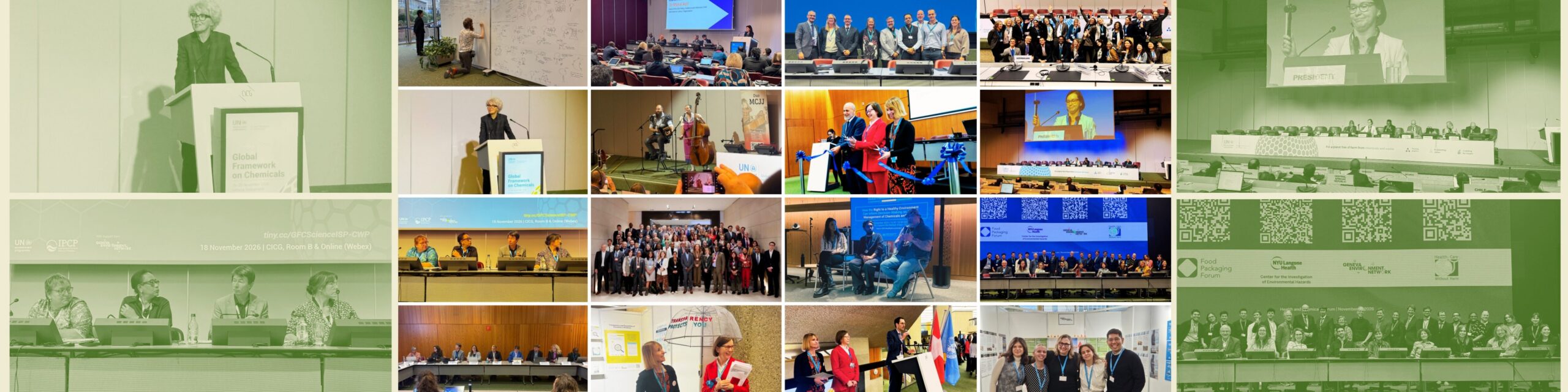
Image of the week | Snapshots from last week’s negotiations, dialogue, partnership-building, and action at the First International Conference of the Global Framework on Chemicals, advancing efforts towards a planet free of harm from chemicals and waste, held at the Geneva International Conference Centre (CICG) and the InterContinental. © UNEP, GEN and IISD ENB / Mika Benoni.
World AMR Awareness Week 2026 | From Pledges to Prevention, from Geneva to Abuja
Over the past week, the World AMR Awareness Week (WAAW) global campaign has generated momentum to improve awareness and understanding of antimicrobial resistance (AMR), encouraging the public, One Health stakeholders and policymakers to reflect on the 2026 theme “One Health, one action: Prevent AMR now”. WAAW 2026 shines a spotlight on the shared responsibility of governments, health professionals, veterinarians, environmental experts, farmers, researchers and communities to prevent this global threat. AMR is associated with an estimated 4.71 million deaths globally (data from 2021), including 1.14 million deaths directly attributable to resistant infections. Without stronger action, the annual cost of treating resistant bacterial infections alone could reach US$412 billion by 2035, alongside US$443 billion in productivity losses.
As the 2026 edition of the AMR Awareness Week draws to a close, join the session “From Pledges to Prevention: Measuring Progress on AMR Commitments and Accountability | From Geneva to Abuja” organized by the Health Diplomacy Alliance, UNEP and its Geneva Environment Network. Leading experts joining the panel of this event will examine the journey from pledges to prevention, assessing commitments made under the 2024 UN Political Declaration on AMR against the evidence on effective prevention and accountability. The discussion is also relevant in preparation for the Ministerial Conference on Antimicrobial Resistance taking place in Abuja in December 2026, where governments will review progress and consider the next steps for implementing global AMR commitments and the launch of the Independent Panel for Evidence for Action against Antimicrobial Resistance (IPEA). → Register to attend in person at Palais des Nations (limited places) via Indico or join online via Webex on Tuesday 24 November 2026, at 10:30 CET.
Other events organized by Geneva actors addressing AMR this week include:
- TrACSS at 10: Tracking Global Progress on Antimicrobial Resistance | Organized by the Quadripartite organizations (FAO, UNEP, WHO, WOAH) | 23 November 2026, 13:00–14:30 CET | Zoom
- Blueprint for strengthening responses to fungal disease and antifungal resistance: implementation guidance | Organized by WHO | | Zoom
- Expanding treatment options for gonorrhoea and strengthening global gonococcal antimicrobial resistance surveillance | Organized by WHO |
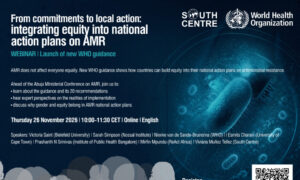
- From commitments to local action: integrating equity into national action plans on AMR Webinar | Launch of new WHO guidance | Organized by South Centre | 26 November 2026, 10:00–11:30 CET | Zoom
New reports and articles from international organizations, research institutions, and advocacy groups highlight the growing urgency of tackling AMR. From the impacts of climate change and conflict on the spread of resistant infections to the need for stronger national action plans, investment, agricultural research, and individual behaviour change, they underscore that AMR is a complex challenge requiring coordinated action across the human, animal, plant, and environmental sectors. Read more:
- Here are five ways you can help prevent antimicrobial resistance at home | UNEP | 18 November 2026
- Changing climate, other environmental factors can play role in spread of antimicrobial resistance | European Environment Agency | 18 November 2026
- MSF calls for stronger AMR response to protect people affected by conflict | MSF | 18 November 2026
- Pension funds are the overlooked powerhouse in the fight against antimicrobial resistance. Here’s why | WEF | 18 November 2026
- Connecting agricultural research and knowledge to support action against antimicrobial resistance | FAO | 17 November 2026
- Without Urgent Action, AMR Could Cause 39 Million Deaths by 2050 | Health Diplomacy Watch | 17 November 2026
- More countries have antimicrobial resistance plans but patients still lack testing and treatment | WHO | 16 November 2026
- ‘An unfulfilled plan helps no one’: Superbug plans have doubled, but few countries are delivering | UN News | 16 November 2026
Making One Health Work in Food Systems
The health of people, animals, plants, and ecosystems is deeply interconnected through the way food is produced, processed, and consumed. Challenges such as zoonotic diseases, the overuse of antimicrobials in agriculture, AMR, and pollution from farming practices all highlight the need for integrated solutions that bridge sectors traditionally addressed separately. The One Health approach seeks to tackle these interconnected risks through coordinated action across human, animal, plant, and environmental health. Despite growing political recognition of its importance, translating commitments into effective implementation remains a key challenge.
This week, the special event “Beyond Commitments: Making One Health Work in Food Systems” will bring together experts from government, international organizations, civil society and the private sector to explore how the One Health approach can move from political commitment to practical implementation across agrifood systems. Co-organized by the International Geneva Global Health Platform at the Global Health Centre, Geneva Graduate Institute and the FAO Liaison Office in Geneva, with the support of the Geneva Environment Network, the event builds on the outcomes of the FAO Global Conference for Actions on One Health in Agrifood Systems held in Rome in September 2026. The discussion will be followed by an interactive exchange with participants, providing an opportunity to share experiences, challenges, and solutions for advancing integrated approaches to human, animal, plant, and environmental health. A networking reception will conclude the event. → Register using the form to join the event in person on 26 November 2026 from 12:30 to 14:00 CET at Maison de la Paix, Auditorium Ivan Pictet A1B or via Webex to join the event online.
Geneva Climate Week 2026 | Rethinking Consumption
The fourth edition of the Geneva Climate Week (Semaine du Climat), hosted by the City of Geneva in collaboration with a wide range of partners, is taking place from 23 November to 6 December 2026, under the overarching theme of consumption. This year’s edition shines a spotlight on the impact of overconsumption and overproduction on the climate, highlighting how current patterns of production and consumption are placing unsustainable pressure on natural resources and contributing to the climate crisis. Through a rich programme of more than 50 free events across the city, including debates, workshops, film screenings, exhibitions, and participatory activities, Geneva Climate Week aims to encourage more local, responsible, and sustainable consumption and production practices. → Consult the programme
Events taking place this week include:
- Les Clés de l’Avenir – La célébration des solutions d’aujourd’hui pour un «demain plus durable» à Genève | 23 November 2026, 18:30 CET | Organized by Zero Waste Switzerland | Maison de l’Avenir
Organized as the official opening event of Climate Week, this competition aims to showcase local initiatives and projects focused on reducing waste at the source, preventing wastefulness, and advancing the circular economy. - Quelle voix pour la Nature dans la Gouvernance? | 23 November 2026, 12:00–14:00 CET | Organized by Ethos and The Positive Project, with support of the City of Geneva | Maison de l’Avenir
- Table ronde | Les fleuves et le sacré : des rituels au soin du vivant | 24 November 2026, 19:00 CET | Organized Plateforme interreligieuse de Genève | Maison de l’Avenir, Impact Hub
- « Et si on changeait d’histoire ? » Construire des nouveaux récits pour donner l’envie d’agir | 25 November 2026, 19:00–21:00 CET | Maison de l’Avenir
As part of Geneva Climate Week, the Geneva Environment Network and partners will be convening two events in the coming weeks:
- 2050Today Annual Event | From Commitments to Practice: Advancing Sustainable Workplaces in International Geneva | Organized by 2050Today, Mexico, Geneva Environment Network, Diplomatic Club of Geneva | 30 November 2026 | 16:00 – 18:30 CET | Campus Biotech
This event aims to share the experience of Mexico, the recipient of last year’s 2050Today Engagement Award, as a replicable model, while fostering a broader exchange on how institutions across International Geneva can operationalize sustainability commitments in their internal practices. - Small Islands: Climate Blueprint Film & SIDS Stories | Organized by Barbados, Resilient and Sustainable Islands Initiative at ODI Global with the support of the Geneva Environment Network | 16 December 2026 | 16:00 – 18:00 CET | Palais des Nations, Room XIV (Cinema Room)
This event will feature the screening of Climate Blueprint: Barbados and the launch of the State of SIDS Report 2026, highlighting the leadership of Small Island Developing States in advancing climate action, sustainable development and financing solutions.
Environment Highlights at the 15th UN Forum on Business and Human Rights
The environment is high on the agenda of the 15th United Nations Forum on Business and Human Rights. Taking place from 23 to 25 November 2026 at Palais des Nations, the Forum will bring together Members States, businesses, experts, and civil society to discuss progress, challenges and future priorities. Under the theme “UNGPs at 15: Building on Gains, Confronting Gaps, Reimagining the Future,” discussions will address key issues including climate change, environmental challenges, critical minerals, a just transition, Indigenous Peoples’ rights, and human rights due diligence. Environment-related events and external sessions with actors from International Geneva include:
- Update on the process to elaborate a legally binding instrument on business and human rights | External Event | 23 November, 9:00–10:00 CET | Palais des Nations, Room V | Ecuador, FES
- Opening Plenary | 23 November, 11:40–13:00 CET | Palais des Nations, Assembly Hall | UN WG Business and Human Rights
- The Global Race for Critical Minerals and its Impacts on Indigenous Peoples’ Rights: Perspectives from Affected Communities | External Event | 23 November, 13:00–14:30 CET | Room V | FIDH, Finland
- Defending Land, Defending Food: Protecting Human Rights Defenders in Brazil’s Soy Supply Chains | External Event | 23 November, 19:00 CET | Maison des Associations, Salle Allende | ECCHR, FIAN International, DUH
- From Global Commitments to Public Policies: Local and Regional Governments in Business and Human Rights | 24 November 2026, 13:00 to 15:00 CET | Restaurant Vieux Bois | Government of Catalonia |
- Launch of the Guidance on Heightened Human Rights Due Diligence in Conflict-Affected and High-Risk Areas for Commercial Banks | External Event | 24 November, 14:00–15:00 CET | Concordia 5 | UNEP FI, EIB
- Critical Energy Transition Minerals and Business and Human Rights | 24 November, 15:00–16:20 CET | Assembly Hall | UN WG Business and Human Rights, RAID, African Resources Watch, UNEP FI, Environmental Defenders, Earthworks, Terre des Hommes Netherlands
- Dialogue on Enhancing the Protection of Human Rights Defenders in the Context of Business Activities: Lessons Learned over the Past 15 Years and Ways Forward | 24 November, 16:40–18:00 CET | Assembly Hall | UN WG Business and Human Rights, ISHR, Zero Tolerance Initiative, Business and Human Rights Centre, Front Line Defenders, The B Team
- Integrated Approaches for Connecting People and Planet: Exploring New Tools and Initiatives for the Financial Sector | External Event | 24 November, 18:00–19:00 CET | Palais des Nations, H-207–209 | UNEP FI, Principles for Responsible Investment (PRI), World Benchmarking Alliance (WBA)
- UNGPs at 15: Climate Action, Human Rights and Closing the SME Gap | 25 November, 15:00–16:20 CET | Assembly Hall | UN WG Business and Human Rights, CHamBR, Eleda
- Closing Plenary | 25 November, 16:40–18:00 CET | Assembly Hall | UN WG Business and Human Rights
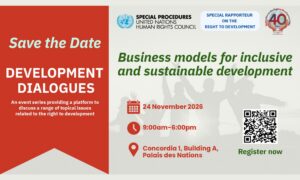
In the margins of the Forum, the 2026 edition of the Development Dialogues, organized by the UN Special Rapporteur on the right to development and taking place on 24 November at Palais des Nations, Concordia 1, will focus on “Business models for inclusive and sustainable development” and will launch the brief, “Beyond retrofitting: Designing responsible business models.” The session, “Obstructing justice: Corporate practices undermining accountability”, taking place from 13:00 to 14:30 CET, will focus on how the conduct of the companies themselves at times can become an additional barrier to effective remediation for harms linked to development projects.
Related news and updates include:
- UN Forum to assess 15 years of business and human rights progress amid global challenges | OHCHR | 20 November 2026
- UN experts alarmed by police operation against Indigenous Peoples opposing mining exploration in the Philippines | Various UN Special Procedures mandate holders | 20 November 2026
- UNEP FI at the 15th United Nations Forum on Business and Human Rights | UNEP FI
Endocrine-Disrupting Chemicals | New Report Calls for Stronger Action
A major new report, “State of the Science of Endocrine-Disrupting Chemicals 2026,” released last week by UNEP and WHO brings together the latest scientific evidence on endocrine-disrupting chemicals (EDCs), a diverse group of substances found in many everyday products, including plastics, pesticides, cosmetics, electronics, textiles, and food packaging. The report concludes that exposure to EDCs is widespread across populations worldwide, often beginning before birth, and is associated with an expanding range of adverse effects on human health and the environment. Particularly concerning are the risks to infants and children, with studies detecting certain EDCs in umbilical cord blood, breast milk, and other pathways of early-life exposure. Overall, the assessment underscores that, while scientific understanding of endocrine disruption has advanced significantly over the past decade, stronger and more coordinated measures are urgently needed to reduce exposure and prevent avoidable harm. Summary of the State of the Science and key messages from the report:
- Evidence showing that EDC exposure results in serious adverse effects in humans and wildlife is strong across multiple health domains.
- Widespread and ubiquitous human and wildlife exposure to EDCs is increasingly documented.
- An increasing number of chemicals have been identified as EDCs as testing programmes have advanced, yet most chemicals remain untested and major gaps persist.
- The estimated health, environmental and economic burden of EDCs is large and likely underestimated, with global health-related costs alone estimated to exceed US$1.1 trillion annually.
- Policy and governance frameworks have evolved since 2012 but remain fragmented and insufficient to transform products and sectors causing widespread EDC exposure.
The report, responding to the request of a United Nations Environment Assembly resolution, was released during the first International Conference of the Global Framework on Chemicals. → A media briefing held on the margins of the Conference featured the authors of the newly launched report.
To support this transition from knowledge to implementation, UNEP also released a companion synthesis report, “From Evidence to Action: Addressing Endocrine Disrupting Chemicals Across Sectors,” which translates the science into practical policy options. The publication outlines actions that governments, businesses, and other stakeholders can take across key sectors, including food packaging, cosmetics, toys, textiles, healthcare, agriculture, pharmaceuticals, and waste management, to reduce exposure to EDCs and promote safer alternatives.
Read more at:
- State of the Science of Endocrine-Disrupting Chemicals 2026 | UNEP | 16 November 2026
- From Evidence to Action: Addressing Endocrine-Disrupting Chemicals Across Sectors | UNEP | 16 November 2026
- Evidence mounts that exposure to hormone-disrupting chemicals starts before birth: UNEP–WHO report | WHO | 17 November 2026
- Evidence mounts that exposure to hormone-disrupting chemicals starts before birth: UNEP–WHO report | UNEP | 17 November 2026
- What are endocrine-disrupting chemicals and how do they affect our health and the environment? | UNEP | 17 November 2026
The report has prompted widespread reactions from scientists, civil society organizations and health advocates, many of whom stress that policy responses have not kept pace with the mounting scientific evidence. Several organizations, including IPEN, EDC-Free Europe and the Endocrine Society, have called for accelerated measures to reduce exposure and better protect human health and ecosystems. Reactions and related news:
- Plastics To Pesticides: Everyday Chemicals Found In Umbilical Cord Blood, Breast Milk, WHO Warns | Health and Me | 19 November 2026
- Indisputable Evidence Shows the Peril from Endocrine-Disrupting Chemicals, Yet Policies to Protect Human Health Lag Decades Behind the Science | IPEN | 17 November 2026
- Endocrine Society experts contributed to global report on endocrine-disrupting chemicals | Endocrine Society | 17 November 2026
- State of Science Report on hormone disruptors – EDC Free Europe calls for faster action on reducing people’s exposure | EDC-Free Europe | 17 November 2026
- New UNEP/WHO Report: Strong Scientific Evidence Demands Urgent Action on EDCs | HEJSupport | 17 November 2026
- International Civil Society Call for Action on Endocrine Disrupting Chemicals (EDCs)
For a Future without Hormone-Disrupting Chemicals | November 2026 - Toxic Pollutants Threaten Reproductive Health But Ideological Rift Stalls Gender Action Plan at UN Chemicals Summit | Health Policy Watch | 17 November 2026
- Latest science shows chemicals in many everyday items pose a growing threat, UN report says | AP | 17 November 2026
- UN Report Warns Everyday Chemicals Pose Growing Threat To Human Health | Tipp Insights | 17 November 2026
First Global Framework on Chemicals Conference Adopts Landmark Decisions to Advance Implementation
The First International Conference (IC1) of the Global Framework on Chemicals, attended by more than 1,200 participants, concluded on Friday at 23:24 CET in Geneva with the adoption of a series of landmark decisions aimed at strengthening the implementation of the framework. The Conference agreed on measures to accelerate action on issues ranging from highly hazardous pesticides and PFAS to endocrine-disrupting chemicals and chemicals in products, while strengthening national capacities and stakeholder engagement. It adopted a first set of global indicators to track progress toward its targets, approved implementation programmes to strengthen chemicals management and industry action across value chains, and extended the GFC Fund to support implementation through 2035. The decisions lay the foundation for measuring progress, mobilizing finance, and translating commitments into action ahead of the second International Conference, to be hosted by Malta in 2029. → Read UNEP Press Release and IISD Earth Negotiations Bulletin
At the closing plenary, the Conference adopted and agreed on:
- Draft resolution on the ‘Global Framework on Chemicals measurability structure and indicators’ without objections.
- Draft resolution on ‘Investing for impact: finance and investment’.
- Nominations of the regional government representatives appointed to the executive board of the GFC Fund.
- Draft resolution on the ‘Programme of work and budget’, following an amendment proposed by the plenary.
- Draft decision on the ‘2nd International Conference of the Global Framework on Chemicals’, accepting the offer of Malta to host it in 2029, with dates to be determined in consultation with the Bureau, ensuring efforts are made to avoid conflicts with MEAs and religious holidays.
- Future work of the Open-Ended Working Group, including a dedicated session in 2028 to review progress and implementation challenges.
- Draft terms of reference and a work plan for industry engagement and action along value chains, after a compromise was found.
- Draft resolution on ‘Issues of concern’ (including chemicals in products, endocrine-disrupting chemicals, environmentally persistent pharmaceutical pollutants, hazardous substances within the life cycle of electrical and electronic products, highly hazardous pesticides, lead in paint, nanotechnologies and manufactured nanomaterials, and managing per- and polyfluoroalkyl substances or PFAS).
Beyond the negotiations, IC1 showcased the Framework’s unique convening power through the Action & Partnership Hub, thematic forums (health, labour, youth), side events and networking opportunities that brought together governments, international organizations, civil society, academia, youth and the private sector. The week was characterized by a collaborative atmosphere, vibrant exchanges, new partnerships, lively forum discussions, impromptu guitar playing, and plenty of Swiss chocolate, reflecting the spirit of cooperation needed to advance the sound management of chemicals and waste worldwide.
Reactions include:
- Scientists Identify Chemical Health Threats, But Global Meeting Slowed by Chemical Industry Stalling | IPEN | 20 November 2026
- Even in a Voluntary Process, a Few Hold Back the Many: First Global Framework on Chemicals Conference Ends in Geneva | CIEL | 20 November 2026
Read more at:
- Nations Weigh Making Pharmaceutical Pollution a Global Chemicals Priority | Environmental Protection | 19 November 2026
- First chemicals conference chance to accelerate action | Inger Andersen, UNEP | 18 November 2026
- ILO calls for stronger action to protect workers from hazardous chemicals | ILO | 18 November 2026
- Science for delivering the Global Framework on Chemicals – why isn’t science enough, and how can we… | IPCP | 18 November 2026
- Delegates Clash Over Hazardous Pesticide Metrics at UN Chemicals Summit | Health Policy Watch | 17 November 2026
- One world, one standard: civil society groups unite to end Highly Hazardous Pesticides | PAN | 17 November 2026
- Knowing What Chemicals are in Products. Why transparency and traceability of chemicals are essential for product safety, circularity and the right to know | HEJSupport | November 2026
- European and British pesticides named in 1,600 poisoning cases in Brazil last year | Unearthed | 17 November 2026
- Leveraging Global Framework on Chemicals to Expand Access, Chemical Safety | IISD | 16 November 2026
COP31 Ends Without Deal, Action Must Continue
After two weeks of intense negotiations, the 2026 UN Climate Change Conference (COP31) in Antalya, Türkiye, ended without a consensus outcome on 22 November 2026. The conference officially closed at 19:33 local time, nearly 50 hours after its scheduled conclusion, making it the longest-running UN climate summit on record. Deep divisions over the inclusion of language on fossil fuels ultimately prevented agreement, with several Member States rejecting the final text as insufficiently ambitious and inconsistent with the urgency of the climate crisis. Bringing the marathon session to a close, COP31 President Murat Kurum declared: “I leave the deadlock in the negotiations to the judgment of the world and of humanity.” → Read the Earth Negotiations Bulletin report
In his closing statement, UN Secretary-General António Guterres expressed the deep frustration of those who had hoped governments would respond more decisively to the climate crisis. He stressed that while the science is unequivocal, climate action remains far too slow. As the world moves beyond the 1.5 °C threshold, he warned that the window to limit the overshoot is rapidly closing and called for faster action to phase out fossil fuels, cut emissions, strengthen adaptation, and deliver climate finance. Emphasizing climate justice and accountability, he urged governments, businesses, civil society, youth, Indigenous Peoples, and frontline communities to accelerate efforts to protect people and secure a sustainable future. → Read the statement
María Mendiluce, CEO of We Mean Business Coalition, described the failure of COP31 to reach an agreement as deeply disappointing, warning that consensus-based negotiations can allow a small number of countries to block progress despite the growing urgency of climate action. She highlighted a widening gap between negotiations and real-world progress, noting that businesses, cities and countries are already advancing electrification and clean energy investments, and argued that initiatives like the Santa Marta process can help willing leaders accelerate the transition away from fossil fuels. → Read her analysis in a Forbes article
In his closing statement, UNFCCC Executive Secretary Simon Stiell expressed deep disappointment that COP31 failed to agree on key decisions, warning that the world cannot afford further delays as climate impacts worsen and the 1.5°C overshoot approaches. While highlighting progress achieved through COP31’s Action Agenda, including on electrification and resilience, he stressed that the climate process must learn from this setback, strengthen cooperation, and continue advancing implementation. He concluded with: “The fight continues. We will never give up.” → Read his statement
COP31 concluded, triggering strong reactions from across the UN system, civil society, research organizations, and environmental advocacy groups. While many stakeholders welcomed the defense of previous commitments on fossil fuels, they also expressed concern over the lack of progress on climate finance, adaptation, and emissions reductions at a time when the impacts of climate change continue to intensify worldwide. Reactions include:
- COP31 ends without climate pact as UN chief warns there is ‘no ambiguity in the science’ | UN News | 22 November 2026
- COP31 falls well short of meeting climate overshoot challenge | IUCN | 22 November 2026
- COP31 runs into overtime and fails to meet the moment for a world at 1.5°C | WWF | 22 November 2026
- COP 31 Ends Without Antalya Pact—Time to Rebuild Trust | IISD | 22 November 2026
- Collapsed COP31 Fails on Finance, Fossil Fuels, and Repair: Urgent Reset Needed | CIEL | 22 November 2026
- COP31: Resistance stops ‘polluters’ charter’ as summit fails people and planet | Amnesty International | 22 November 2026
- UN’s COP31 Climate Conference Fizzles Out as Global Policy Divides Deepen | Inside Climate News | 22 November 2026
- COP31: A shameful failure as rich countries turn their backs on a world in crisis | CAN International | 22 November 2026
- STATEMENT: Hollow Outcome at COP31 a Failure of Political Leadership | WRI | 22 November 2026
- COP31 deadlock on fossil fuels and finance proves need for Fossil Fuel Treaty, being developed by 30 Global South nations | Fossil Fuel Treaty Initiative | 22 November 2026
- Mary Robinson on COP31’s inability to deliver an agreement | The Elders | 22 November 2026
Declarations, initiatives and reports launched last week include:
- COP31: Countries demand stronger climate deal as talks in Antalya reach final day | UN News | 20 November 2026
- UN Climate Change Conference: New initiative to combat SF6, the most potent greenhouse gas, and promote new technologies | The Federal Ministry for the Environment, Climate Action, Nature Conservation and Nuclear Safety of Germany | 19 November 2026
- WWF: Latest COP31 cover decision draft moves backward on key issues, and critical gaps remain | WWF | 19 November 2026
- World Energy Outlook 2026 | IEA | 19 November 2026
- Common Ground: Aligning Forest Protection and the Transition Away from Fossil Fuels | UNEP | 16 November 2026
- Wildland Fires in the Circumboreal Forest under Climate Overshoot | NRCan, UNEP, and IIASA | 16 November 2026
- 2025 WHO health and climate change global survey report | World Health Organization | 13 November 2026
- COP31: Ambition goes missing as fossil fuel language drops from draft deal | UN News | 17 November 2026
- As an unprecedented shock reshapes the energy world, its duration will determine the scale of the change | IEA | 19 November 2026
- Climate Change and El Niño Intensify Fires in Southeast Asia, Affect Health Across Nations | Health Policy Watch | 19 November 2026
- Greenpeace responds to IEA new report, calls for urgent clean energy investment to protect the planet and people’s economic and energy security | Greenpeace | 19 November 2026
- AMOC Risks Running AMOK: Putting Europe Into Deep Freeze and Disrupting Monsoon Patterns in Africa and Asia | Health Policy Watch | 19 November 2026
- New report: Climate overshoot could cause lasting, irreversible harm to northern forests | IIASA | 18 November 2026
- COP31 deadlock persists as countries launch new ‘climate reality check’ | UN News | 18 November 2026
- The ocean connects us all | WMO | 18 November 2026
- GFCR Announces Over US$30 Million to Accelerate Coral Reef Resilience and Community Adaptation Across 22 Nations | Global Fund on Coral Reefs | 17 November 2026
- COP31: The push to protect warming oceans reaches the negotiating table | UN News | 17 November 2026
- Tuvalu and Vanuatu Join Coalition to Phase Out Fossil Fuel Subsidies | IISD | 17 November 2026
- Minerals for the planet or for war and AI? COP31 must make clear what we prioritise | Climate Home News | 17 November 2026
- How an Indian meteorologist founded the IPCC in his Geneva flat – without telling anyone | Luis Lema (Le Temps) | 17 November 2026
- Health Wins Key Mention in First COP31 Draft Decision Text | Health Policy Watch | 17 November 2026
- Draft text cover decision 16 Nov 2026 @ 13:30 | UNFCCC | 16 November 2026
- Tackling super pollutants for a more stable climate and cleaner air | Speech delivered by Inger Andersen | UNEP | 16 November 2026
- Record 700 Carbon Capture Lobbyists Secured Access to COP31 Climate Talks | CIEL | 16 November 2026
- AI gets climate science right – until users push back | UN News | 16 November 2026
- Advancing heat resilience and sustainable cooling together | Speech delivered by Inger Andersen | UNEP | 16 November 2026
- Time to Home | Amy Pope and Anacláudia Rossbach | Inter Press Service | 16 November 2026
- COP31: bluster and rhetoric, but still short of ambition to end fossil fuels | Greenpeace International | 14 November 2026
- Antalya Communiqué of the Third Annual Cooling Ministerial: Heat Resilience and Sustainable Cooling | UNEP Cool Coalition | Draft of 12 November 2026
- Global Heat Resilience and Sustainable Cooling Roadmap: Protecting people, keeping the lights on, delivering on our climate goals in a warming world | UNEP Cool Coalition | Draft of 12 November 2026
- Food Loss and Waste Action for Reducing Emissions (FLARE) | WRI
- The Peatland Breakthrough | Global Peatlands
UNECE Committee on Environmental Policy
The 31st session of the UNECE Committee on Environmental Policy (CEP) takes place from 25 to 27 November 2026 in Geneva, bringing together governments and environmental stakeholders to advance regional environmental cooperation. Discussions will focus on preparations for the 10th Environment for Europe Ministerial Conference in 2028 and the Eighth Pan-European Environmental Assessment. Participants will also review environmental monitoring and assessment activities, Environmental Performance Reviews, developments under UNECE environmental agreements, and the future direction of the UNECE Environment subprogramme. The Committee will consider its programme of work for 2026–2028 and exchange views on key regional and global environmental developments. → Access all documents, register to participate or listen live.
Geneva Water Community Meets Ahead of the 2026 UN Water Conference
As preparations intensify for the 2026 United Nations Water Conference, co-hosted by the United Arab Emirates and Senegal, in Abu Dhabi this December, the Permanent Missions of Bangladesh and the Kingdom of the Netherlands, together with UN-Water, are convening this week the fifth and final gathering of the Geneva Water Community. Bringing together Geneva-based Member States and international organizations, the meeting will provide an opportunity to take stock of progress across the Conference’s six interactive dialogue themes and exchange views on priorities and expected outcomes ahead of Abu Dhabi. Participants will hear briefings from the co-chairs of the dialogues covering Water for People, Water for Prosperity, Water for Planet, Water for Cooperation, Water in Multilateral Processes, and Investments for Water, reinforcing Geneva’s contribution to shaping the global water agenda and maintaining momentum for action on water-related challenges. → The gathering takes place on 26 November 2026 at 10:30 CET at Palais des Nations, Room VIII.
Building Momentum Towards the Plastics Treaty
Preparations are continuing for the fourth part of the fifth session of the UN Intergovernmental Negotiating Committee on plastic pollution (INC-5.4), tentatively scheduled to take place in March 2027. The Chair’s summary of the second informal in-person meeting of Heads of Delegation to the INC held from 27 to 30 September 2026 is now available on the INC website. The INC Chair recalls in the summary that he will prepare a second iteration of the Aid to Negotiations, reflecting progress made during the first and second informal Heads of Delegation meetings and highlighting areas of convergence ahead of INC-5.4. The next milestone will be the third informal meeting of Heads of Delegation, to be held in Nairobi from 28–30 January 2027, preceded by regional consultations on 25–27 January, with discussions expected to explore balanced approaches and possible compromises on outstanding issues.
As negotiations continue, dialogue and knowledge-sharing on plastic pollution remain active. The Plastic Pollution Action Dialogues, launched by UNEP and the Ellen MacArthur Foundation, will hold their next session this week, focusing on the role of product design in reducing plastic pollution. The discussion will explore policy approaches, national experiences, circular design solutions, and lessons learned from initial implementation. → Join the dialogue on Teams on 25 November at 13:00 CET.
Recent publications include:
- Review of Plastic Pollution in Mangrove Ecosystems: Impacts, Mitigation Actions and Policy Responses | Basel, Rotterdam, Stockholm Conventions (BRS) and Convention on Wetlands Secretariat | November 2026
- Shapers for Plastic Action: From Local Action to Systems Change | Community Paper | November 2026
UN80 Initiative | Environment Brief Discussed at UNEP Governing Bodies
The implementation of the UN80 Initiative continued to feature in discussions among Member States last week. The Subcommittee of the Committee of Permanent Representatives (CPR) to UNEP met in Nairobi to consider issues related to the reform process, including the environment-related work under Work Package 27 (WP27). The discussions build on the Environment Information Brief prepared under the UN80 Initiative, which outlines the contribution of the environmental dimension to the broader UN reform efforts. → Read the presentation
The topic will also be discussed at the 176th meeting of the Committee of Permanent Representatives, taking place in Nairobi on 23 November 2026. Under the agenda item on the Executive Director’s report, the statement by the Executive Director of UNEP is expected to include reflections on the Secretary-General’s Information Brief on Environment. The discussions provide an opportunity for Member States to consider how environmental action can be further integrated into the future direction of the United Nations system.
Sustainable Transport Day in the UN Decade of Sustainable Transport
Recognizing the important role of safe, affordable, accessible, and sustainable transport systems for all in supporting sustainable economic growth, improving the social welfare of people, and enhancing international cooperation and trade among countries, at its seventy-seventh session in May 2023, the UN General Assembly, in its resolution A/RES/77/286, declared 26 November as World Sustainable Transport Day. Transport touches every part of our lives, from clothing to food, raw materials, stocks, and more. Transport makes jobs accessible and allows commerce. Therefore, making transport as safe, accessible, and sustainable as possible is one of the keys to a brighter and more sustainable future.
This year’s celebration takes place within the framework of the UN Decade of Sustainable Transport 2026–2035, declared in 2023 by the UN General Assembly. Through resolution 78/148, entitled “Strengthening the links between all modes of transport to achieve the Sustainable Development Goals”, the UNGA called for strengthened coordination across transport modes and requested UN DESA, in collaboration with the United Nations Regional Commissions, to develop an Implementation Plan for the Decade, in consultation with Member States, the UN system, and other relevant stakeholders. The United Nations Decade of Sustainable Transport will be an opportunity to further raise awareness of transport’s crucial role in advancing the Sustainable Development Goals and to gather and rally new solutions, resources and partnerships to advance sustainable transport globally. → Learn more about Sustainable Transportation and the Role of Geneva
Enjoying the Last Weeks of Green Autumn in Geneva
As autumn enters its final month, it brings a wide variety of experiences, from cultural festivals and thought-provoking exhibitions to outdoor walks, forums and community events, while offering opportunities to connect with nature and enjoy the beauty of the changing landscape. Activities to help you make the most of a Green Autumn this week include:
- Semaine du climat – 4e édition | From 23 November to 6 December 2026 | Various Locations
Join the 40+ free events taking place across Geneva to celebrate the 4th edition of Geneva Climate Week. This year’s theme is « consumption », which focuses on the environmental and local economic benefits of choosing to buy local, sustainable products. - Océans | Until 24 November 2026 | Grand Théâtre de Genève
A two-part dance show inspired by the power and movement of water. The two halves of the performance highlight the different facets of water: how it can be both strong and gentle. The first part, the Brise-lames (“breakwater” in English) was shown in Paris in 2020 and is now coming to Geneva for the first time. The second part, River Without Banks, uses the imagery of a river to explore how time passes. This is a new work, debuting in Geneva. Recommended age: 10 and up. - Bâti Durable | Guichet énergie | Until 24 November 2026 | Espace Ville de Genève
If you are planning to renovate your home, replace your heating system or install solar panels, this event is for you. The Energy Advice Service offers villa owners and small co-ownership properties a personalized consultation with an energy specialist to assess their building’s performance, explore suitable solutions and learn about available subsidies. - Marché de Noël de Lancy | From 25 to 29 November 2026 | Place de Pont-Rouge de Lancy
Join the Christmas celebrations at the Lancy Christmas market. During the day, expect to find fun activities for the whole family, including the opportunity to send letters to Santa, while the evening programs include live Christmas music from local DJs. - « Hasards sauvages » – Café scientifique : Composer avec la montagne entre changements, catastrophes et retour du loup | 26 November 2026 | Musée d’ethnographie de Genève
This event is designed as a conversation and exchange about the practices, narratives, and representations of the wild that shape the ways we live in the mountains and cope with the unexpected. - Atelier Wool & Wine “Transformez la Laine de Mouton en Boules de Noël” | 27 November 2026 | Maison de l’Avenir
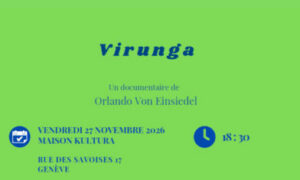
A workshop to make your own Christmas bauble from the wool of local Geneva sheep, scented with essential oils. The workshop includes a complimentary aperitif of drinks and light snacks. - Ciné club d’Africa 21 : Virunga de Orlando von Einsiedel | 27 November 2026 | Africa21 | Maison Kultura
Join this documentary screening set in the Virunga National Park in the Democratic Republic of Congo, exploring the intersection between nature conservation, human interests and environmental challenges. The screening will be followed by a debate, giving the audience a chance to explore the film’s themes. The evening will end with a casual apéro. - Vernissage Le Vivant sous nos yeux | 28 November 2026 | WWF Switzerland | Bains des Pâquis
As part of the WWF Photomarathon—during which participants captured through their lenses the diversity, beauty, and sometimes the subtle presence of the living creatures that share our cities and neighbourhoods—we are organizing, with the support of the City of Geneva and in collaboration with the Groupe Expos des Bains des Pâquis, the opening reception for the exhibition Le Vivant sous nos yeux. - Pics & Co | 28 November 2026 | Bois de la Bâtie
A chance for children to have fun outdoors and learn more about the nine species of woodpeckers found in Switzerland. This event is hosted by Panda Club Geneva and is intended for children aged 8 to 12. - DéLivre-moi tes secrets avec Christine Flament, illustratrice et autrice | 28 November 2026 | Bibliothèque des Eaux-Vives
A creative workshop led by illustrator and author Christine Flament. The event is split in two parts; the first half will explore three albums of illustrations dedicated to documenting different species of birds. For the second half of the event, participants will work together to create a watercolour concertina book, inspired by local birds, flowers, and insects. - KESKONFABRIK #3 | 28 November 2026 | La Maco – Manufacture Collaborative
Join this shared manual and digital workshop in Geneva’s circular economy scene, where people can learn how to repair, transform and make things by hand, access reused materials, tools, machines and skills for making and repairing things themselves. This is an opportunity to prepare for the holidays differently, celebrating with homemade gifts. - Repair Café de la FRC – EQ Minoteries (Aînés) | 28 November 2026 | Espace de Quartier Plainpalais
The FRC Repair Café stand lets you bring broken items (appliances, electronics, furniture, toys, bikes) to be repaired or to learn how to fix them with specialized technicians. Visitors are recommended to bring their own spare parts, as none are provided. The event is free, requires no registration and is open to everyone. - Drôles d’oiseaux – Des contes qui donnent la parole aux animaux | 29 November 2026 | Bibliothèque de la Cité
What if birds could tell us their stories? On 29 November, storyteller Patrick Mohr and musician Denis Favrichon invite audiences aged 7 and above on a journey through the fascinating world of birds, from hummingbirds to condors. Blending storytelling, music, bird calls and playful words, this one-hour performance at the Bibliothèque de la Cité celebrates our feathered companions and their place in our lives. - Atelier familles en nature – explorez votre lien au vivant | 29 November 2026 | Le Bois de la Bâtie
Embark on an immersive workshop in the heart of Geneva’s largest forest. This workshop is a true creative and sensory journey where parents and children are invited to co-create an ephemeral artwork, playfully exploring the connections that bind us to living things and our environment. - Les Créatives – 22e édition | Until 29 November 2026 | Various Locations
The 22nd edition of Les Créatives celebrates women and gender minorities in culture through music, theatre, literature and speeches. The two exclusive Swiss dates are First Aid Kit, the Swedish sister duo, closing the festival on 29 November, and Peaches, who plays the Alhambra on 23 February 2027 as a surprise bonus. - Hortus Botanicus Helveticus: Together for 30 years | Until 29 November 2026 | Jardin Botanique de Genève
Marking the 30th anniversary of Hortus Botanicus Helveticus, this outdoor exhibition celebrates the work of Switzerland’s 30 botanical gardens. As you walk through the Jardin Botanique de Genève, discover 30 illustrated displays, each featuring a representative plant species and highlighting the important role these gardens play in protecting biodiversity and preserving plant life for future generations. - Préparons les fêtes avec la nature! | 29 November 2026 | Centre Nature de la Pointe à la Bise
A chance to prepare festive Christmas decorations and gifts using all natural materials. - Des Histoires de la Terre: Les étranges fossiles de Burgess | 29 November 2026 | Musée d’Histoire des Sciences
Join this event to discover how paleontologists work by exploring the story of the Burgess Shale, one of the most significant fossil discoveries of the 20th century. Located in the Canadian Rockies of British Columbia, the fossil deposit offers a great insight into the history of life on Earth. - Matières vivantes | Clarissa P. Valaeys & Lisa Novel | Until 4 December 2026 | Renaissance Galerie d’Art, Geneva
What happens when art and nature meet through pigments, fibres and organic forms? Matières vivantes brings together the botanical paintings of Clarissa P. Valaeys and the sculptures of Lisa Novel in an exhibition celebrating the beauty and expressive potential of natural materials. From plant-inspired compositions to creations made with biomaterials, come and discover these two artistic approaches. - Look up ! Cent montgolfières dans le ciel | Until 5 December 2026 | Bibliothèques municipales de Genève
What would our world look like without an atmosphere? Through her original installation “Look Up”, artist Rosanna Baledda invites visitors to look up at a sky filled with a hundred hot-air balloons and reflect on the vital role the atmosphere plays in protecting life and maintaining the Earth’s climate balance. This exhibition is available at the Bibliothèque des Eaux-Vives from 6 November to 5 December, as part of Geneva’s Climate Week. - Atelier découverte de la nature pour enfant | Until 12 December 2026 | Swiss Food Academy | Espace de quartier Le 99 aux Charmilles, Plainpalais et Eaux-Vives
This autumn, children can discover the chestnut through a fun and sensory workshop! They will explore, taste and learn about this seasonal Swiss favourite while taking part in a gardening activity and enjoying a comforting chestnut tasting. - Art Exhibition – Michel Roggo | Until 16 December 2026 | The FAB, Maison de la Paix | Geneva Graduate Institute
Discover Lake Geneva’s secrets. Its underwater ecosystem, depth-crawling creatures and aquatic plants will be revealed through the underwater lens of photographer Michel Roggo. The exhibition asks us to reflect on the ecological and cultural value of the lake, reminding us of the importance of protecting these natural spaces. Join the opening ceremony on the 16 November 2026 at 12:45 CET to hear from Michel Roggo himself, as well as the following experts in biodiversity research: Jean-François Rubin, Nuala Caomhanach, and Bastiaan Willem Ibelings. - Create Your Own Rousseau-Style Herbarium | Until 23 December 2026 | Jardin Botanique de Genève
Discover the art of herbarium making in this hands-on workshop inspired by Jean-Jacques Rousseau. Using dried flowers, plants, and traditional paper, participants can create their own herbarium sheet while learning about plant identification and the scientific techniques behind this botanical practice. The activity is free and suitable for visitors aged four and above. - Noël au Quai | Until 24 December 2026 | Quai du Mont-Blanc
Join the holiday celebrations and experience the magic of the Jardin Anglais. This Christmas market is a great opportunity to go holiday shopping, among the vast selection of local artisans. End your visit with a nice walk along the shore of Lake Geneva, where you can stop to enjoy an authentic cheese fondue at Chalet à Fondue.
What (Else) to Read Next?
- From Yerevan to 2030: global goals need local solutions | WWF | 20 November 2026
At COP17 in Yerevan, important progress was made towards strengthening the participation of Indigenous Peoples and local communities in global biodiversity decision-making. Agreement on the governance arrangements for the permanent Subsidiary Body on Article 8(j) strengthened the role of Indigenous Peoples and local communities within the Convention and marked another step towards full and effective participation. - Data centers’ electricity use is soaring — especially in these states | GRIST | 20 November 2026
A Harvard-led study published this week in Nature Sustainability gets us closer to these numbers. Researchers extracted locations and building footprints for as many U.S. hyperscale data centers as possible, ultimately cataloguing 403 of the warehouse-sized facilities across the country. Translating power capacity to theoretical electricity usage, the authors estimated these facilities gobble up roughly 82 terawatt-hours of electricity annually, the equivalent of nearly 8 million homes. They suggest this electricity is associated with about 26 million metric tons of carbon dioxide emissions. - Progress on compliance, elephants, great apes, seahorses, Brazilwood and more at CITES Standing Committee’s 81st meeting | CITES | 19 November 2026
More than 640 participants from Parties, intergovernmental and non-governmental organizations gathered in Geneva from 2 to 6 November for the 81st meeting of the Standing Committee (SC81) of the Convention on International Trade in Endangered Species of Wild Fauna and Flora (CITES). The Standing Committee, comprising Representatives of 18 Parties, worked through 67 agenda items and 95 working documents to advance progress on implementation of the decisions adopted at the 20th meeting of the Conference of the Parties (CoP20), and providing guidance on compliance, enforcement, science, trade and administration. - UNECE adopts new and revised agricultural quality standards as survey confirms benefits for international trade | UNECE | 18 November 2026
A new survey of private-sector users confirms that UNECE agricultural quality standards continue to provide significant benefits for international trade, market access and quality assurance across global agricultural supply chains. - Here’s How Much Electricity Powerful Data Centers Use | Meryl Davids Landau, National Geographic | 18 November 2026
A paper recently published in the journal Nature Sustainability documents the consumption and output of the largest and most powerful data centers across the United States. Those roughly 400 hyperscale centers use almost as much electricity in a year as massive, mature industries like steel and aluminum and even as much as all the collective homes, businesses, and facilities in some individual states.
- New UNECE expert group to support continued international cooperation on statistics to address environmental challenges | UNECE | 16 November 2026
Extreme heat, invasive species and “forever chemicals” do not stop at national borders, and neither should the data used to track them. UNECE’s new Joint Working Group on Environmental Statistics and Indicators met for the first time in Geneva on 10–11 November 2026 to start work on the data governments need to respond to these and other environmental pressures.
- Vulnerable wealth. Who will profit from Central Africa’s critical minerals? | GI-TOC | 16 November 2026
This report is the first attempt to examine the nexus between organized crime and CRMs across Central Africa. It provides a comprehensive analysis of the structural vulnerabilities that facilitate criminal involvement in the region’s CRM sector, while documenting a range of emerging criminal dynamics. It also sheds new light on the elite capture of Chad’s growing antimony industry and on Russian geocriminal activities targeting the Western-backed Lobito Corridor.
Events
See all


Body Meeting
4th session of the Commission for Observation, Infrastructure and Information Systems (INFCOM-4)
23 – 27 Nov 2026
WMO
WMO
Conference
15th United Nations Forum on Business and Human Rights
23 – 25 Nov 2026
Palais des Nations
OHCHR
Body Meeting
Joint meeting of the bureaux of the conferences of the Parties to the Basel, Rotterdam and Stockholm conventions
23 – 24 Nov 2026
International Environment House
BRS

Conference
Update on the process to elaborate a legally binding instrument on business and human rights | 15th UN Forum on Business and Human Rights
23 Nov 2026 | 09:00 – 10:00
Palais des Nations | Room V
Ecuador, FES
Conference
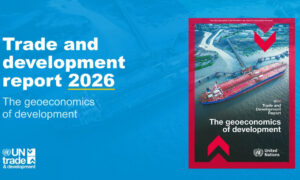
Panel discussion on the Trade and Development Report 2026
23 Nov 2026 | 10:00 – 13:00
Palais des Nations | Council Chamber
UNCTAD

Virtual
Ottawa Charter at 40: Health promotion, well-being and sustainability
23 Nov 2026 | 13:00 – 14:30
Online | Zoom
WHO
Conference
Road To Geneva | The conversation that hasn’t happened Yet: Labour, health and climate. What futures do we want?
23 Nov 2026 | 13:30 – 17:00
Domaine de la Pastorale
Women @ the Table, GHRH, Friedrich Naumann Foundation

Virtual
Trade, Critical Energy Transition Minerals and Women: From Policy Analysis to Practice
23 Nov 2026 | 14:00 – 15:30
Online | Zoom
UNCTAD
Conference
Defending Land, Defending Food: Protecting Human Rights Defenders in Brazil’s Soy Supply Chains
23 Nov 2026 | 19:00
Maison des Associations
FIAN International, European Center for Constitutional and Human Rights
Conference
Development Dialogues: Business models for inclusive and sustainable development
24 Nov 2026 | 09:00 – 18:00
Palais des Nations | Concordia 1
Special Procedures of the UN Human Rights Council

Conference
From Pledges to Prevention: Measuring Progress on AMR Commitments and Accountability | From Geneva to Abuja | 2026 AMR Awareness Week
24 Nov 2026 | 10:30 – 12:00
Palais des Nations | Room S-29 & Online | Webex
Health Diplomacy Alliance, UNEP, GEN
Virtual
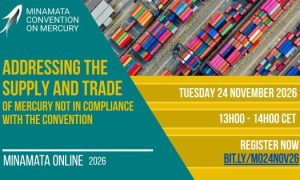
Addressing the supply and trade of mercury not in compliance with the Convention | Minamata Online
24 Nov 2026 | 13:00 – 14:00
Online | Webex
Minamata Convention
Virtual
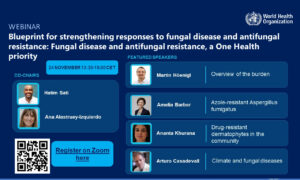
Blueprint for strengthening responses to fungal disease and antifungal resistance: implementation guidance
24 Nov 2026 | 13:30
Online | Zoom
WHO
Conference
Launch of the Guidance on Heightened Human Rights Due Diligence in Conflict-Affected and High-Risk Areas for Commercial Banks
24 Nov 2026 | 14:00 – 15:00
Palais des Nations | Concordia 5
UNEP FI, EIB


Conference
Science-Policy Breakfast Briefing | Artificial Intelligence in Agrifood Systems | 15th United Nations Forum on Business and Human Rights (By Invitation Only)
25 Nov 2026 | 08:30 – 09:30
Geneva
UNU-CPR, GSPI, FAO

Conference
Climate Responsibility in Economic Statecraft
25 Nov 2026 | 18:15 – 19:45
Maison de la Paix, Room S10
IHEID
Body Meeting
Dialogue on Plastics Pollution and Environmentally Sustainable Plastics Trade (DPP) – Pre-Plenary Meeting
26 – 27 Nov 2026
WTO
WTO

Virtual
From Commitments to Local Action: Integrating Equity into National Action Plans on AMR | Launch of New WHO Guidance
26 Nov 2026 | 10:00 – 11:30
Online | Zoom
South Centre, WHO
Conference
From Commitments to Clean Air: Building Cross-Sector CSO engagement (Closed Door Meeting)
26 Nov 2026 | 10:30 – 15:30
NCD Alliance Office
NCD Alliance

Conference
5th Gathering of the Geneva Water Community to be hosted by the Permanent Missions of Bangladesh and the Kingdom of the Netherlands in Geneva
26 Nov 2026 | 10:30 – 12:00
Palais des Nations | Room VIII
Bangladesh, Netherlands, UN Water
Conference
Beyond Commitments: Making One Health Work in Food Systems
26 Nov 2026 | 12:30 – 14:00
Maison de la paix, Auditorium Ivan Pictet A1B
FAO, Geneva Global Health Platform
Virtual
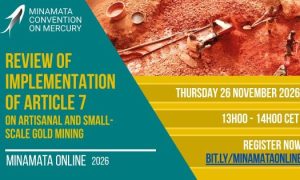
Review of Implementation of Article 7 on Artisanal and Small-Scale Gold Mining | Minamata Online
26 Nov 2026 | 13:00 – 14:30
Online | Webex
Minamata Convention
Virtual
The Cost of Inaction: Economic Costs, Risks, and Environmental and Health Vulnerabilities of POPs and Chemicals Pollution
26 Nov 2026 | 14:00
Online | Zoom
GGKP

Virtual
Scaling Credible Transition Finance: Launch of UNEP FI Transition Finance Guidance for Banks
26 Nov 2026 | 14:00 – 15:00
Online | BrightTalk
Conference
Recent Developments and Achievements Under Each of the MEA | 31st Session of the Committee on Environmental Policy
26 Nov 2026 | 15:00 – 18:00
Palais des Nations | Room V
UNECE
Conference
Hydroscapes of Knowledge: A Multiscale History of Measuring and Governing Water in Switzerland, 1880–1945
26 Nov 2026 | 17:15
UNIGE Carl-Vogt | Room E 712
UNIGE
Conference
Adaptation Economics: Shaping Markets to Meet Adaptation Needs in a Climate-Impacted Future
27 Nov 2026 | 09:30 – 12:00
Maison de la Paix | Room S8
IHEID
Cinema
Ciné club d’Africa 21 : Virunga de Orlando Von Einsiedel
27 Nov 2026 | 18:30
Maison Kultura, Rue des Savoises 15, Genève
Jobs
See all
Consultant
Information Management Specialist (Loss and damage report submissions)
23 Nov 2026
Santiago Network

Updates
See all