
Newsletter 12 Oct 2026
Environment: What’s Up in GENeva | 12 – 18 October 2026
The Geneva Environment Network’s weekly newsletter includes the latest information on the global environmental agenda, main events, job vacancies, as well as other useful resources and updates. The Geneva Environment Network is not responsible for the content of any linked site or any link contained in a linked site. Stay tuned and follow us on X (Twitter), Facebook, LinkedIn, Instagram, Bluesky, Youtube, and WhatsApp, or visit our website regularly for additional updates.
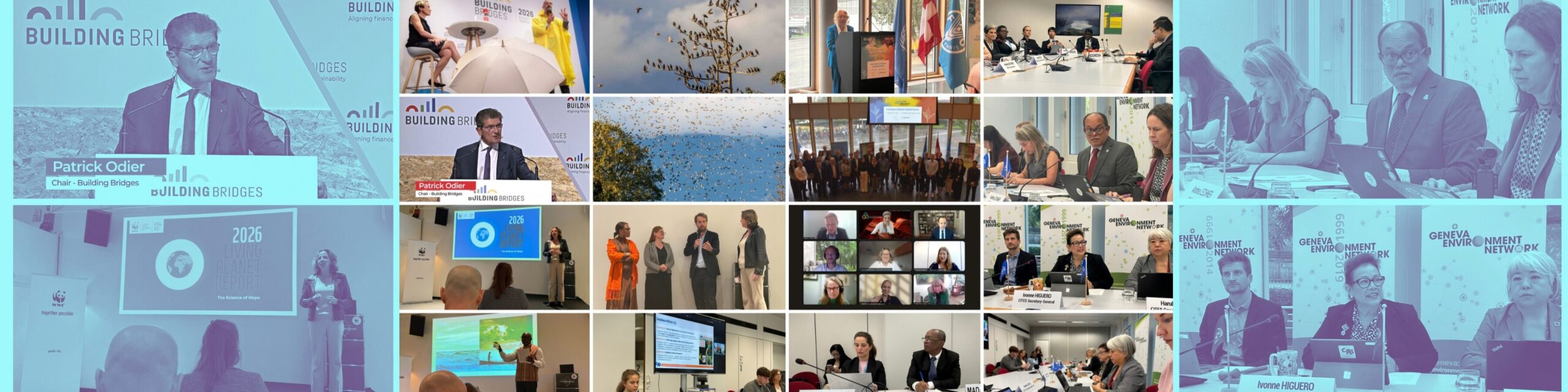
Image of the week | A non-exhaustive snapshot of events and observations from last week at Palais des Nations, the International Environment House, the International Conference Centre Geneva (CICG), and Bernex, highlighting ongoing efforts to advance the global environmental governance agenda. © UNEP/GEN, Building Bridges/Antoine Tardy, Bermiche.
Strengthening the Health Dimension in Climate Action
Under the Paris Agreement, governments update their national climate plans – known as Nationally Determined Contributions (NDCs) – every five years. These plans set out emissions reductions targets and interventions across sectors to address climate change. Health is a vital part of effective climate action. Ensuring the integration of health into climate policy protects populations, maximizes economic benefits, and builds public support for ambitious climate policies which are so urgently needed.
One month ahead of the 2026 UN Climate Change Conference (UNFCCC COP31), the Global Climate and Health Alliance (GCHA) is launching the latest iteration of the Healthy NDC Scorecards, which provide a global assessment of how comprehensively health is integrated into national climate plans.
This week, the event “How Well Are National Climate Plans Protecting Health? Launching the GCHA Healthy NDC Scorecards“ is bringing together governments, policymakers, international organizations, civil society, and health and climate experts to explore what the findings tell us about the current state of health integration in national climate planning. Organized by GCHA, the Geneva Graduate Institute’s Global Health Centre, the Geneva Environment Network, the Climate Solutions for Health Lab, the Wellcome Trust and the Clean Air Fund, this event will aim to identify what is needed to strengthen it in the next round of NDCs. → Join the event taking place on 14 October 2026, from 18:30 to 20:00 CEST. Register to join the event in person at Maison de la Paix, Auditorium A2 or online via Webex.
Climate and health featured prominently in discussions last week, with some key developments underscoring the growing recognition that effective climate policies must also deliver health benefits, and that health :
- Last Sunday, the World Health Summit 2026 opened in Berlin with a special session featuring prospective candidates for the post of WHO Director-General. Climate change was highlighted in the discussion as a growing pressure on global health, alongside conflict, economic challenges, and rising inequalities. Strengthening climate resilience and addressing environmental risks were presented as essential to preventing disease and building more resilient health systems. → Read more in the Health Policy Watch article “WHO Director-General Candidates Address Global Health Reform in First Public Campaign Event“
- Health was also on the agenda of the Global Heat Forum that took place last week in Bangkok, highlighting extreme heat as a health emergency. → Read more in the WMO article Global Heat Forum seeks to galvanize action and investment of 6 October 2026
Geneva Hosts Global Dialogues on Minerals and Metals and their Sustainable Value Chains
This week, Geneva is hosting a number of events on critical minerals, sustainable mining, commodity trade, and the clean energy transition. Centred around the 22nd Annual General Meeting (AGM) of the Intergovernmental Forum on Mining, Minerals, Metals and Sustainable Development (IGF), these discussions bring together governments, international organizations, industry, researchers, and civil society to exchange ideas on building more sustainable and resilient mineral value chains. Alongside policy dialogues, several new publications and reports will also be launched, offering insights on international cooperation and governance for critical minerals. Events taking place this week include:
IGF 22nd Annual General Meeting
The Intergovernmental Forum on Mining, Minerals, Metals and Sustainable Development is holding its 22nd Annual General Meeting from 12 to 14 October at Palais des Nations, hosted by UN Trade and Development (UNCTAD), under the theme “Trust in an Interdependent World: Advancing inclusion and resilience in mineral value chains“. As the leading international mining policy forum, the AGM provides a unique opportunity for policy-makers to connect with their global peers alongside actors from industry, civil society, and non-governmental and international organizations. The AGM will include expert-led sessions that examine important aspects of mining governance, including critical minerals, legal frameworks, gender equality and social inclusion, equitable benefits sharing, mineral exploration, environmental management, sustainability standards, artisanal and small-scale mining, and more. → Follow the live coverage of the Earth Negotiations Bulletin
Dialogue Series of the UNEA resolution 7/3 | From Resolution to Action: Advancing Circularity and Material Efficiency Across Minerals and Metals Value Chains
In accordance with the United Nations Environment Assembly (UNEA) resolution 7/3 on strengthening international cooperation on the environmentally sound management of minerals and metals, the United Nations Environment Programme (UNEP) is hosting the second dialogue, entitled “From Resolution to Action: Advancing Circularity and Material Efficiency Across Minerals and Metals Value Chains” on 14 October from 9 to 10:30 CEST, at WIPO headquarters in a hybrid format. The dialogue takes place on the margins of the 22nd IGF AGM and is bringing together Member States, stakeholders, right holders, and partners to deepen shared understanding, discuss and identify priorities for international cooperation and practical inputs for subsequent dialogues under UNEA resolution 7/3, including synergies with the UN Task Force on Critical Energy Transition Minerals.
Launch of 2026 Swiss Academies’ Report: Commodity Trade and Sustainable Development at the IGF 22nd Annual General Meeting
The 2026 Report of the Swiss Academy of Sciences’ Alliance for Global Research Partnerships (SCNAT GRP-Alliance) “Beyond the Transaction: Commodity Trade and Sustainable Development – Interdisciplinary Literature Review” is being officially launched in the margins of the IGF 22nd Annual General Meeting, on 13 October 2025, from 18:30 to 20:30 CEST, at the Graduate Institute, Maison de la Paix. The report takes stock of the current evidence on commodity trade, including minerals, and global sustainable development across the academic disciplines of law, economics, environmental, political and social sciences.
TESS Annual Conference | Session on Trade, Critical Minerals, and the Clean Energy Transition
The 2026 Forum on Trade, Environment, & the SDGs (TESS) Annual Conference on Trade, Climate, and Sustainable Development (TCSD 2026) is taking place on 15-16 October at the Villa Barton. TCSD features public panels and thematic brainstorming and interactive sessions to deepen dialogue and generate practical ideas for concrete outcomes, collaboration, and ways forward, including on critical minerals.
The session “Trade, Critical Minerals, and the Clean Energy Transition” will reflect on the most pressing gaps in international cooperation on trade and critical energy transition minerals, identify priority areas for action, explore concrete cooperation mechanisms to balance supply security, value addition, development, and environmental and social sustainability, and assess which pathways can be advanced through bilateral, regional, and multilateral avenues, as well as where new approaches are needed. Cooperation areas for discussion will include gaps emerging from the ongoing work of the TESS–UNCTAD International Expert Group on trade and critical energy transition materials.
Additional Resources
A new report from the United Nations University Centre for Policy Research (UNU-CPR) “Governing Critical Minerals: Histories, Gaps, Actions and Innovative Models“, by Michael Franczak and Irfana Khatoon, examines the historical evolution of critical minerals governance, identifies current gaps in the international framework, and explores innovative approaches to strengthen global coordination in support of sustainable development and the energy transition. The report identifies five priorities for critical minerals governance and matches each with relevant models for addressing them. → Read more in the UNU-CPR blog article “Critical Minerals: Models for Improving the De Facto Global Architecture“, of 8 Ocotber 2026.
City Leaders Convene in Geneva for the UN Forum of Mayors 2026 | Urban October
Celebrations of Urban October continue this week in Geneva with the 6th meeting of the UN Forum of Mayors (2026), convening on 12 and 13 October 2026 at the WIPO Headquarters, under the theme “Cities Delivering for a Sustainable Future”. The Forum, held under the auspices of UNECE, brings together some 80 city leaders from more than 50 countries to discuss the local implementation of the Sustainable Development Goals and focus on sustainable mobility, innovation, green cities, urban resilience, affordable housing, and cultural and natural heritage protection. Mayors are expected to adopt an outcome document outlining shared priorities for advancing sustainable urban development. → Read more at UNECE Press Release and dedicated highlights
Sessions and side events with a focus on the environment include:
- Sustainable mobility and road safety (SDG 11.2) | 12 October 2026 | 11:00 – 13:00 CEST | WIPO Conference Hall
- Innovation and Creativity at the City Level – Segment A – Innovation for sustainable cities | 15:00 – 16:50 CEST | WIPO Conference Hall
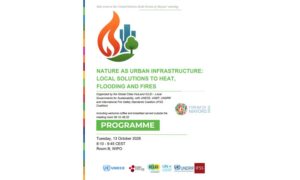
- Side Event | Nature as Urban Infrastructure: Local Solutions to Heat, Flooding and Fires | Co-organized by Global Cities Hub and ICLEI – Local Governments for Sustainability, with UNECE, UNEP, UNDRR and International | 13 October 2026, 08:30 – 09:45 CEST | WIPO, Room B
Green cities and environmental quality (SDG 11.6 and 11.7) | 13 October 2026, 10:00-11:30 CEST | WIPO Conference Hall - Side Event | Mayors × International Organizations High-level Exchange | Organized by Global Cities Hub and UNECE | 13 October 2026, 13:30 – 14:45 CEST | WIPO, Room B
- Cultural and natural heritage protection (SDG 11.4) | 13 October 2026, 16:00 – 16:45 CEST | WIPO Conference Hall
- UNITAC Training for Mayors on People-centred smart cities: Digital tools and data for sustainable urban development and inclusive digital transformation | Organized by UN-Habitat, UNITAC, HCU in partnership with UNECE, ITU, UNITAR and Global Cities – Hub Geneva | 14 October 2026 | 08:30 – 10:00 CEST | Villa Rigot
Other events to move forward the sustainable urban agenda this week include:
- 87th session of the UNECE Committee on Urban Development, Housing and Land Management | 14–16 October 2026 | Palais des Nations, Council Chamber
The Committee will review progress across its programme of work, covering urban resilience, smart sustainable cities, sustainable and energy-efficient buildings, land administration, and support to countries through policy reviews and technical cooperation. The session will feature thematic discussions on the role of artificial intelligence in urban design and integrative planning, and on systemic approaches to delivering affordable, energy-efficient and resilient housing.
Rethinking UN Financing in the UN80 Context: A Spotlight on Pollution
The United Nations is currently facing significant financial pressures that extend beyond a short-term liquidity challenge. These pressures underscore the need to strengthen the Organization’s financial sustainability and its ability to deliver on increasingly complex mandates in a rapidly evolving global financing landscape. The UN80 Initiative provides a timely opportunity to look beyond efficiencies and cost reductions and examine how the UN system can diversify and strengthen its funding base, improve the predictability and reliability of resources, make more strategic use of limited public funds, and develop innovative approaches to financing its work.
Taking advantage of the visit to Geneva of Michael Franczak, Senior Researcher at the United Nations University Centre for Policy Research (UNU-CPR) and lead of the Global Governance Innovation Platform’s Hub for Innovative Resource Mobilization, the Secretariat of the Basel, Rotterdam and Stockholm Conventions and UNU-CPR, in collaboration with the Geneva Environment Network, are bringing the ongoing UN-wide discussion to International Geneva. Designed as awareness-raan accessible rising and exchange event rather than a technical workshop, the event “Rethinking UN Financing in the UN80 Context: A Spotlight on Pollution” aims to engage colleagues interested in understanding how innovative resource mobilization can support the work of the United Nations in practice. The event will spotlight environment and pollution financing, including the Transforming to Cleaner and Greener (TCG) Strategy of the Basel, Rotterdam and Stockholm Conventions Secretariat as an example of an innovative financing approach currently under development. The target audience for this event is UN agencies, international organizations and other interested stakeholders from across International Geneva, as well as a wider audience through online participation and recording. → Register to join in person at the International Environment House I or join online the event taking place on 14 October 2026 from 12:30 CEST.
Advancing the Human Rights and Environment Agenda | Outcomes of HRC63 and Upcoming Discussions
The intersection of environmental protection and human rights continued to gain momentum, with important developments. Highlights include the outcomes of the Human Rights Council’s 63rd session, discussions on corporate accountability and environmental harms, and initiatives to strengthen the implementation of the right to a clean, healthy and sustainable environment.
Environment @ HRC63 Outcomes
Last week, the UN Human Rights Council concluded its 63rd regular session after adopting 34 resolutions, two decisions and one president’s statement. Resolutions tabled by their main sponsors that were adopted in this session addressing environmental issues include:
- Mandate of Special Rapporteur on the implications for human rights of the environmentally sound management and disposal of hazardous substances and wastes | A/HRC/63/L.27 | Kenya (on behalf of) Group of African States | Adopted without a vote
Decides to extend, for a further period of three years, the mandate of the Special Rapporteur on the implications for human rights of the environmentally sound management and disposal of hazardous substances and wastes. - Human rights to safe drinking water and sanitation | A/HRC/63/L.34| Spain and Germany | Adopted without a vote
Reaffirms the request in paragraph 4 of its resolution 60/9 for the Special Rapporteur on the human rights to safe drinking water and sanitation with regard to the 2026 and 2028 United Nations Water Conferences; Encourages the Office of the United Nations High Commissioner for Human Rights, with a view to promoting the progressive realization of the human rights to safe drinking water and sanitation at the 2026 and 2028 United Nations Water Conferences. - Human rights and Indigenous Peoples | A/HRC/63/L.20/Rev.1 | Mexico and Guatemala | Adopted without a vote
Decides that the theme of the annual panel discussion on the rights of Indigenous Peoples, to be held during the sixty-third sixth session of the Human Rights Council, will be “Taking stock of the twentieth anniversary of the United Nations Declaration on the Rights of Indigenous Peoples: celebrating key achievements and addressing emerging challenges”, decides that the theme of the annual panel discussion to be held during the sixty-ninth session of the Council will be communicated in 2027, following the recommendation by the Expert Mechanism on the Rights of Indigenous Peoples. - Technical assistance and capacity-building to address the human rights implications of the nuclear legacy in the Marshall Islands | A/HRC/63/L.16 | Marshall Islands, Fiji, Kiribati, Micronesia (Federated States of), Nauru, Papua New Guinea, Samoa, Vanuatu | Adopted without a vote
Requests the Office of the High Commissioner to prepare a report on addressing the challenges and barriers to the full realization and enjoyment of the human rights of the people of the Marshall Islands, stemming from the State’s nuclear legacy, and to submit it to the Human Rights Council at its sixty-ninth session, to be followed by an enhanced interactive dialogue, with the participation of the National Nuclear Commission of the Marshall Islands. - Working Group on the rights of peasants and other people working in rural areas | A/HRC/63/L.22 | Bolivia (Plurinational State of), Cuba, Gambia, Indonesia, Luxembourg, South Africa | Adopted by recorded vote (33 to 0, with 14 abstentions)
Decides to extend, for a further period of three years, the mandate of the Working Group on the rights of peasants and other people working in rural areas - Implications of artificial intelligence for the promotion and protection of human rights | A/HRC/63/L.25 | Bangladesh, Algeria, Austria, Egypt, Greece, Guyana, Kuwait, Nepal | Adopted without a vote
Recognizes that the development, deployment and use of artificial intelligence systems can have adverse impacts on the enjoyment of a clean, healthy and sustainable environment throughout their life cycle, including in relation to energy and water consumption, greenhouse gas emissions, the extraction of critical minerals, land use and electronic waste, and noting with concern that such impacts may be experienced disproportionately by communities and countries already facing resource scarcity, environmental degradation and heightened vulnerability to climate change.
The Human Rights Council appointed expert mechanism and special procedure mandate holders at its 63rd session, with Juliet Willetts (Australia) as the UN Special Rapporteur on the human rights to safe drinking water and sanitation.
→ Consult our dedicated update on highlights of key environmental issues at HRC63, including side events, relevant news, and further resources. Consult the report by the UN Information Service in Geneva on the outcomes of HRC63.
Relevant updates on HRC63 include:
- Statements at the 63rd Session of the UN Human Rights Council | Franciscans International | 9 October 2026
- Report on the 63rd session of the Human Rights Council | URG | 9 October 2026
- World Heritage protection must put Indigenous Peoples at the centre | OHCHR | 7 October 2026
- HRC63: Civil society presents key takeaways from the session | ISHR | 7 October 2026
- 63rd Human Rights Council Session: what’s there for local governments? | Global Cities Hub – Geneva | October 2026
- Panamá, Tonga, and Vanuatu Launch the For Nature Coalition of States to Advance Global Dialogue on the Rights of Nature at the United Nations | For Nature | 30 September 2026
Business and Human Rights
The 12th session of the Open-ended Intergovernmental Working Group on transnational corporations and other business enterprises with respect to human rights (OEIGWG on TNCs and OBEs) is taking place from 12 to 16 October 2026 at Palais des Nations, Room XII. In the lead-up to the 12th session, numerous intersessional activities took place, including the thematic consultations mandated by Council decision 56/116. See the summary report on the 2026 intersessional thematic consultations. Following these consultations, the Chair-Rapporteur also circulated an addendum to the summary report with suggested redrafting of selected provisions of the updated draft legally binding instrument. The 12th session is expected to continue discussions on the intersessional thematic consultation on Articles 12 to 24 and on Articles 1 to 3, as well as the Chair’s proposals resulting therefrom.
Various side events expected to tackle environmental issues. → Consult our dedicated page on the 12th OEIGWG for a list of environment-related side events and our update providing an overview on the connections among business, human rights, the environment, and the role International Geneva plays in strengthening such links.
Advancing the Right to a Healthy Environment
8 October marked five years since the recognition by the UN Human Rights Council that everyone, everywhere has the right to a clean, healthy and sustainable environment. The fruit of “five decades of intergenerational and interdisciplinary work by thousands of people around the world“, this milestone is a reminder of the work needed to advance this recognition through its implementation. In celebration of this milestone, the UN Special Rapporteur on the right to a healthy environment, Astrid Puentes Riaño, has launched a website dedicated to inform, promote and educate about the human right, including its progress, status, related themes, topics and contexts.
This week, the Steering Committee on the Environment (CDENV) of the Council of Europe is holding its second meeting in Strasbourg on 13 and 14 October 2026. The two-day meeting will take stock of progress in implementing the Council of Europe Strategy on the Environment, and further develop priorities at the intersection of environmental protection, human rights and democratic governance. It will bring together representatives of member States, Council of Europe bodies, international organizations and civil society, alongside experts and other prominent figures, including Michel Forst, UN Special Rapporteur on Environmental Defenders under the Aarhus Convention, and Astrid Puentes Riaño, UN Special Rapporteur on the human right to a clean, healthy and sustainable environment. → Read press release
Ahead of the meeting and in celebration of the recognition, more than 30 UN human rights experts have joined to urge all States, international entities and businesses to demonstrate leadership and advance practical solutions on the ground to address the triple planetary crisis, mainstreaming this right, instead of increasing resistance to its implementation. The UN Special Rapporteur on Environmental Defenders under the Aarhus Convention, Michel Forst, has also urged COE Member States to adopt a legally binding instrument recognizing the right to a clean, healthy and sustainable environment at the Council of Europe. An Open Dialogue on a European Standalone Convention on the Right to a Healthy Environment is taking place on 12 October 2026, from 16:30 CEST onwards, at the Council of Europe and online.
Relevant updates include:
- Five years since the recognition of the right to a clean, healthy and sustainable environment | ISHR | 8 October 2026
- Five years of the recognition of the right to a healthy environment: UN experts urge to move forward to its implementation | OHCHR | 7 October 2026
- Five years on, it’s time for Europe to recognize the right to a healthy environment | Sébastien Duyck and Francesca Mingrone (CIEL), Geneva Solutions | 7 October 2026
Road to Antalya | Key Outcomes from the COP31 Pre-COP
The official COP31 Pre-COP concluded on 8 October 2026 in the Pacific, bringing together around 4,000 participants from more than 100 countries. Over four days, discussions spanned energy security, electrification, climate resilience, finance and the opportunities presented by the clean energy transition. As a key milestone on the road to COP31 in Antalya, Türkiye, the meeting focused on Pacific priorities, including keeping the 1.5°C goal within reach, strengthening the ocean-climate agenda and improving access to climate finance. Key outcomes include:
- The adoption of the Taku Pakasoa Declaration, a Pacific-led call for unity and action to keep 1.5°C within reach and deliver real outcomes for communities on the frontlines of climate change. The declaration sets a clear vision for COP31, bringing countries together behind stronger climate action, resilience, finance and Pacific leadership.
- New international commitments to the Pacific Resilience Facility (PRF), a Pacific-led initiative that helps communities prepare for climate and disaster risks before disasters occur.
- Broad recognition of electrification as a key pathway to cut emissions, strengthen energy security, lower energy costs and unlock economic opportunity. Australia announced its support for Türkiye’s goal to lift electricity to 35 per cent of global final energy consumption by 2035.
- Strong momentum behind the ocean-climate nexus. Ocean action must be at the heart of global climate action, reflecting the Pacific’s long-standing call to recognise the ocean’s central role in regulating the planet’s climate. Türkiye confirmed it will work towards an Antalya Ocean Declaration at COP31 to strengthen international cooperation on ocean-based climate solutions.
- Support for a focused COP31 presidency-led outcome aimed at accelerating implementation, strengthening cooperation and maintaining a credible pathway to limiting warming to 1.5°C.
Just ahead of the opening of Pre-COP31, Australia-Türkiye issued the 4th Presidency Letter. In the second joint letter, President-designate Murat Kurum and COP31 President of Negotiations Chris Bowen outline their vision for the Pacific Meeting, stressing the importance of focusing on implementation, advancing progress around key negotiation outcomes, and reinforcing confidence in the Paris Agreement as an effective framework for international climate cooperation. Among the priorities highlighted by the Presidencies:
- Taking stock of UNEP’s Limiting Overshoot report’s findings, the Presidencies call for any overshoot to be kept as low and short as possible, given the importance of keeping 1.5°C within reach, improving access to finance, and integrating the ocean into climate plans and action are important to every region, especially the Pacific one.
- Outline various opportunities for progress, including in Just transition, climate finance, mitigation, adaptation and loss and damage.
- Encouraging Parties to submit outstanding Nationally Determined Contributions (NDCs) ahead of COP31, complete Biennial Transparency Reports (BTRs) and continue developing and implementing National Adaptation Plans (NAPs).
- Spotlight electrification as a COP31 priority, as a practical pathway to strengthen energy security, reduce costs and lower emissions. It complements the global goals to triple renewable capacity and double the rate of energy efficiency improvements by 2030.
- Advancing the COP31 Implementation Agenda, including the Belém Mission to 1.5, the Global Implementation Accelerator and the Climate Implementation Bridge (BRIDGE), designed to better connectct nional priorities with implementation support and finance, particularly in developing countries, LDCs and SIDS.
- Support the development of an Access to Finance Declaration, led by Australia and Pacific partners, calling alling for greater provision of grants and concessional finance for vulnerable countries and stronger engagement from development banks, investors, businesses and cities in delivering climate action..
Read more at:
- Pacific Pre-COP sets launchpad for climate summit in Türkiye | COP31 Pre-COP | 8 October 2026
- Pre-COP 31 – The Taku Pakasoa Declaration: Strength in Unity | UNFCCC | 8 October 2026
- Pre-COP closing day wrap | UNFCCC | 8 October 2026
- ‘Overshoot is not a reason to surrender’: UN calls for accelerated climate action ahead of COP31 summit | UN News | 8 October 2026
The Host Country Agreement between the government of Türkiye and the UNFCCC has now been finalized and come into force, with a range of strengthened measures to support an inclusive, efficient and effective COP31 in Antalya in November this year. → Read more in UNFCCC News release of 9 October
This week, the Sixty-fifth Session of the IPCC (IPCC-65) is convening in Addis Ababa, Ethiopia, where governments are expected to find an agreement on the timeline for delivery of the components of its Seventh Assessment Report on the state of knowledge on climate change (AR7). The outcomes of the session will also determine the Panel’s workload and budget for the remainder of the assessment cycle. Ahead of the meeting, the High Ambition Coalition – a diverse and informal group of developed and developing countries within the UNFCCC that pushes for progressive and high-ambition climate policies – called on governments to safeguard the scientific integrity and apolitical nature of the IPCC, stressing the importance of maintaining a strong link between the IPCC’s timely, policy-relevant scientific assessments and the implementation of the Paris Agreement. The Coalition warned that delaying or weakening the delivery of climate science could undermine evidence-based decision-making at a time of escalating climate impacts and growing concerns over a potential 1.5°C overshoot. → Follow the daily coverage of the Earth Negotiations Bulletin
Recent news continue highlighting the importance of moving forward climate action:
- Amid heartache of Nepal flooding disaster, fear remains | UN News | 9 October 2026
- Sea-surface temperatures reflect strengthening El Niño | WMO | 8 October 2026
Sea-surface temperatures in the central and eastern tropical Pacific are forecast to increase to record levels during October-November-December 2026, reflecting the strengthening of the El Niño event which will drive weather patterns and impact economies, ecosystems and communities across the globe. The monthly Global Seasonal Climate Update from the WMO says that El Niño will continue to intensify ahead of its forecast peak in December. It is likely to bring above-average temperatures to much of the globe and shift rainfall patterns, increasing the risk of drought and floods in different regions. - Chaos is never going to disappear. The real question is how much of it we meet prepared | Celeste Saulo, WMO Secretary-General | 7 October 2026
- New data reveal weakening emissions reporting and rising military spending | CEOBS | 7 October 2026
- From drought to deluge: ‘Super’ El Niño’s expanding reach | UN News | 6 October 2026
- The world is overlooking a powerful brake on global warming | Maria Mendiluce | Reuters | 5 October 2026
- Nepal’s floods put the global loss and damage system to the test | Bhargabi Bharadwaj and Beatrice Mosello | Chatham House | 5 October 2026
Road to Abu Dhabi | Key Updates Ahead of the 2026 UN Water Conference
With less than 100 days remaining until the 2026 United Nations Water Conference, co-hosted by the United Arab Emirates and Senegal in Abu Dhabi from 8 to 10 December 2026, preparations are intensifying across the water community.
As his mandate draws to an end, the UN Special Rapporteur on the human rights to safe drinking water and sanitation, Pedro Arrojo-Agudo, is hosting a series of briefings this week at the Palais des Nations (Room XI) to share the findings and recommendations of three policy briefs he prepared:
- Global Water Governance Policy Brief | 15 October 2026, 10:00 CEST
- Human rights to safe drinking water and sanitation in Amazonia | 15 October 2026, 15:00 CEST
- Human rights to water and sanitation during conflict | 16 October 2026, 10:00 CEST
Key updates on the Conference and ongoing activities in preparation include:
- Interactive Dialogues Concept Papers | As per General Assembly Resolution 78/327, the 2026 UN Water Conference will include six interactive dialogues, held in parallel with the plenary meetings. The advanced, unedited versions of the Concept Papers on each interactive dialogue theme have been recently released, setting out the status, challenges, emerging issues, solutions and recommendations across the six Interactive Dialogue themes.
- Registration | Accredited non-governmental organizations, major groups and other relevant stakeholder organizations can now request registration for their representatives to attend the Conference in person. Non-governmental organizations, major groups identified in Agenda 21 and other stakeholders in consultative status with the Economic and Social Council (ECOSOC) should request registration here. Organizations specially accredited to any of the United Nations conferences indicated in General Assembly resolution A/RES/78/327 should request registration here. Each organization can register up to 10 representatives. The deadline for registration is 6 November 2026.
- Call for Virtual Side Events | Applications for virtual side events to be held in parallel with the official programme are open. UN Member States, UN entities, intergovernmental organizations and accredited stakeholders can apply to organize an event, providing additional opportunities to collaborate, share knowledge and accelerate implementation of SDG 6 and the 2030 Agenda. The deadline for virtual side event applications is 16 October 2026.
- Wetlands and the UN Water Conference | The Convention on Wetlands will host a briefing in preparation for the 2026 UN Water conference under the title “From Geneva to Abu Dhabi through Dakar: Positioning Wetlands in the Global Water Agenda” → Save the date to attend on 3 November 2026 from 15:00 – 16:00 at Palais des Nations
- Water Bankruptcy Is More Than a Metaphor: 13 Misconceptions Worth Avoiding | Kaveh Madani, director of UNU-INWEH, who introduced the concept of water bankruptcy, argues that it is more than a synonym for water scarcity or crisis, describing situations where unsustainable human activities push water systems beyond recoverable limits. He highlights 13 common misconceptions and calls for transformative, cross-sectoral policies that address both water quantity and quality, protect ecosystems, and prioritize equity and resilience. Read more at Water Bankruptcy Is More Than a Metaphor: 13 Misconceptions Worth Avoiding
Road to Geneva | Updates on Artificial Intelligence Governance and the Environment
Artificial intelligence (AI) is increasingly shaping sustainable development efforts while also raising concerns about its environmental and human rights impacts, including energy and water consumption, greenhouse gas emissions, critical mineral extraction and e-waste. Recent research, policy developments and international initiatives reflect growing attention to both the challenges and opportunities associated with AI. This week’s highlights include new evidence on AI’s environmental footprint, a Human Rights Council resolution on AI and human rights, and upcoming discussions on global AI governance as Member States and stakeholders prepare for the Geneva AI Summit 2027 and the AI for Good Global Summit 2027, both convening in Geneva in June 2027:
- The Human Rights Council concluded its 63rd session with the adoption of 34 resolutions, including two new resolutions addressing artificial intelligence and human rights. Resolution A/HRC/63/L.25 adopted without a vote recognizes the environmental impacts of AI systems throughout their life cycle and calls attention to concerns related to energy use, water consumption, greenhouse gas emissions, critical minerals, land use and e-waste.
- The Green IT Association released on 30 September a Study on the environmental and health impacts of artificial intelligence worldwide in 2025 and 2030 (available in French here; English version to be released early December). This study is the only Life Cycle Assessment (LCA) to have been carried out on this topic on such a scale. The study focuses on the manufacture of AI servers and their subsequent operation in data centres worldwide for the years 2025 and 2030. The objective was to assess the environmental and health impacts of artificial intelligence worldwide in 2025 and 2030, using standard methods. Compared to the first edition published in late 2025, the overall scope of the study is exactly the same. Environmental impacts, however, have increased significantly.
Events related to AI and the environment taking place this week include:
- United Nations Environment Assembly (UNEA) resolution 7/9 on the environmental sustainability of artificial intelligence systems virtual kick-off meeting | 14 October 2026, 14:00 to 15:30 CEST| Microsoft Teams
UNEP is launching implementation of Resolution 7/9 to strengthen the global evidence base on the environmental sustainability of artificial intelligence, facilitate knowledge exchange, support Member States, and promote international cooperation — work that will also inform the Executive Director’s report to UNEA-8 in 2027. This session convenes experts across thematic domains (energy and greenhouse-gas emissions, water, critical minerals and materials, e-waste and circularity) and interdisciplinary domains (methodology, policy, cross-domain linkages). It will brief participants on the implementation roadmap, areas of expertise being convened, expected modes of engagement, and next steps.
UNEP invites Member States to nominate relevant experts from government institutions to contribute to the implementation process. Relevant expertise may include artificial intelligence and computing infrastructure; energy and greenhouse gas emissions; water; critical minerals and materials; e-waste and circularity; climate, biodiversity and pollution; environmental data and AI applications; AI governance and standards; and methodologies, metrics and indicators for assessing environmental impacts. Member States that have not yet submitted nominations are kindly invited to do so through the nomination form. Member States that have already submitted nominations are not required to take any further action. Nominated representatives are requested to register for the kick-off meeting. - UNITAC Training for Mayors on People-centred smart cities: Digital tools and data for sustainable urban development and inclusive digital transformation | Organized by UN-Habitat, UNITAC, HCU in partnership with UNECE, ITU, UNITAR and Global Cities – Hub Geneva | 14 October 2026 | 08:30 – 10:00 CEST | Villa Rigot
The training will explore how cities can use digital technologies, geospatial data and emerging innovations to improve urban governance, unlock land for development, expand affordable housing opportunities, transform informal settlements, enhance public services and accelerate progress towards the SDGs. - NGO Digital Transformation Conference | Organized by Greenpeace and Tactical Tech | 15 October 2026 | Online
Organised in collaboration with Tactical Tech, the 2026 Greenpeace-hosted digital transformation conference will explore how technology can support our work, what campaigning, engagement and fundraising teams need from it, and how to shape a technology strategy in a fast-moving world. The programme will also include an interactive workshop that will inform a report on the use of technology in non-profit organisations, which will be sent to all participants.
Read more at:
- The impact of AI on human rights | Federal Department of Foreign Affairs, Switzerland | 7 October 2026
- Powering data centers on nuclear? That’s a tough sell in Utah’s coal country | GRIST | 7 October 2026
- New SDG Chat launched to empower global engagement on sustainable development | UN DESA | 1 October 2026
- AI and Climate Modeling | UN Secretary-General’s Scientific Advisory Board | 30 September 2026
Celebrating International Day for Disaster Risk Reduction | Resilience Starts at Home
On 13 October, the global community celebrates the International Day for Disaster Risk Reduction (IDDRR), under the theme “Resilience starts at home”, an opportunity to acknowledge the progress being made toward reducing disaster risk and losses in lives, livelihoods and health, while reminding the world that disaster risk is man-made. This year’s theme focuses on the importance of making homes safe, resilient and inclusive as the way they are planned, built, financed and maintained determines whether they reduce disaster risk or create it for those who inhabit them. IDDRR comes just over a month after the devastating floods in Nepal demonstrated the need to adapt infrastructure, including homes, to the new reality of climate-change-related disasters, and a few days after the country was hit by another flood.
In line with the 2026 IDDRR global campaign aiming to raise global awareness of the centrality of the home in disaster risk reduction, advocate for stronger governance and investment in resilient housing, elevate the role of the private sector in reducing housing-related risk, and empower households, particularly those facing heightened vulnerability, to take risk-informed action to protect themselves and strengthen community resilience, a series of events will take place in Geneva:
- Geneva Youth Festival – International Day for Disaster Risk Reduction | Organized by UNDRR | 13 October 2026, 13:00 – 16:00 CEST | Domaine La Pastorale
The IDDRR Mini Youth Festival will engage young people in practical, interactive learning on disaster preparedness, household resilience, and everyday actions that can help keep families and communities safe. - From Knowledge to Action: Communication for a Safer World | Organized by UNDRR, UNESCO, IFRC, Switzerland | 14 October 2026, 09:30 – 17:00 CEST | IFRC Headquarters, Auditorium B & Online, Zoom
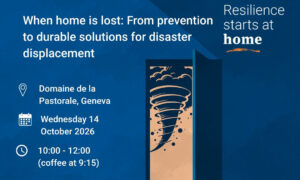
This event will bring together risk practitioners, researchers, journalists and media organizations, regulators, international organizations and other actors from Geneva and beyond to consider risk communication as part of disaster risk governance and preparedness, including information access, strategic communication, media preparedness and resilience, telecommunications systems, behavioural science, cultural knowledge and inclusive participation. - When Home is Lost: From Prevention to Durable Solutions for Disaster Displacement | Organized by UNDRR, IDMC, IOM, Platform on Disaster Displacement | 14 October 2026, 10:00 – 12:00 CEST | Domaine La Pastorale & Online, Zoom
Building on the GP2025 outcomes on disaster displacement, participants will discuss how various approaches and solutions from risk-informed development, resilient housing and infrastructure, social protection, livelihood restoration, anticipatory action, planned relocation, and community-led recovery can help people remain safely in their homes where possible, and rebuild resilient futures when displacement cannot be avoided. - Resilient housing in a changing risk landscape – A Geneva roundtable for International Day for Disaster Risk Reduction 2026 | Organized by UNDRR, UN-Habitat, Global Cities Hub – Geneva, UNDP and UNECE | 14 October 2026, 14:30 – 16:30 CEST | Domaine La Pastorale
This roundtable brings together mayors, urban planners, policymakers, financial institutions, and resilience experts to examine how housing affordability, availability and changing risk landscapes shape vulnerability in cities, and how housing resilience can strengthen broader urban resilience outcomes. The discussion will identify actionable pathways for embedding resilience into housing systems, urban planning and investment decisions – bridging policy and practice across formal and informal settlements.
Read more at:
- Press briefing, info su Nepal
- Nepal’s decade of disasters highlights the urgent need for climate finance | WEF | 7 October 2026
Celebrating E-Waste Day | Fast Tech: Don’t Bin It, Bring It!
International E-Waste Day, observed annually on 14 October since its launch by the Waste Electrical and Electronic Equipment Forum (WEEE Forum) in 2018, provides an opportunity to raise awareness of the growing impacts of electronic waste and the importance of advancing circularity across the electronics value chain. As digitalization accelerates and consumption of electronic products continues to rise, the day highlights the need to reduce waste, extend product lifespans, and strengthen systems for repair, reuse and recycling.
For its ninth edition, International E-Waste Day 2026 focuses on Fast Tech: the growing stream of small, low-cost electronic products that have become ubiquitous in daily life. These include earphones, charging cables, USB adapters, LED lights, mini-fans, disposable vapes, toys and other gadgets that are often purchased impulsively and discarded just as quickly. Drawing a parallel with fast fashion, the campaign highlights how a culture of convenience and disposability is generating an ever-increasing volume of e-waste, much of which is neither collected nor recycled properly. Unlike large household appliances, which consumers generally recognize as requiring specific end-of-life management, Fast Tech products often escape attention. A broken pair of earbuds may be thrown into a household bin, while outdated chargers and cables accumulate in drawers, forgotten. Yet these products contain valuable materials and potentially hazardous substances that require proper collection and treatment. To address this growing challenge, the WEEE Forum encourages consumers, businesses and policymakers to:
- Recognize: every small device with a plug, cable or a battery, no matter how little or inexpensive, is e-waste at the end of its life and requires proper treatment. Do not chuck it in the general bin.
- Return: bring fast tech items to official collection points, in-store take-back locations, or dedicated e-waste drop-off sites. In the EU, online retailers are legally obliged to accept small, discarded electronics free of charge.
- Demand compliance: consumers and regulators alike should ensure that online platforms selling electronics are registered as producers and contribute to funded recycling systems. Non-compliance undermines the circular economy for all.
To celebrate the day, the Basel, Rotterdam and Stockholm Conventions will hold an online event “E-waste Refurbishment, Repair and Repurpose: Towards Zero Waste Goals to Protect the Environment and Human Health ” presenting concrete cases with the advantages and the challenges encountered in the refurbishment and repair of computing equipment in countries of different regions. → Register to join online on 14 October 2026 from 13:00 to 14:30 CEST.
The Science of Hope: 2026 Living Planet Report
For three decades, WWF’s Living Planet Report has tracked the state of the natural world. The latest edition, released last week, reveals the scale of nature’s decline – a stark 73% decline in the average size of monitored wildlife populations over a 52-year period – but it also highlights something equally important: it is possible for nature to recover when we act together. In 2026, the Living Planet Report shows that the recovery of species like tigers and tuna is possible. It also demonstrates that by using the same principles we can transform our food, energy and finance systems – we just need governments and businesses to act. We have the power to decide nature’s future. By acting now, we can accelerate the change needed to build a more resilient, nature-positive world. Read more at:
- Living Planet Report 2026 | WWF | 8 October 2026
- WWF Living Planet Report: Amid an average 73% decline in wildlife population sizes, scientists reveal grounds for hope | WWF | 7 October 2026
- The Living Planet Report 2026: The Science of Hope | Trailer | WWF International
- A 73% average decline in wildlife populations: an overview of the 2026 Living Planet Index report | Our World in Data | 8 October 2026
A Collective Win for Human Rights, Justice and International Law
Congratulations to Navi Pillay on this well-deserved recognition of her lifelong commitment to justice, human rights, and the rule of international law!
Her Nobel Peace Prize award has generated a remarkable wave of positive reactions across the international community, with many seeing it as a timely affirmation of the importance of international legal institutions and accountability. The Norwegian Nobel Committee praised her role in strengthening the international legal order and promoting accountability for war crimes, crimes against humanity and genocide. António Guterres, UN Secretary-General, hailed her as “a champion of international law and human rights” and a “steadfast, independent voice of justice.” Amnesty International, through its Secretary General Agnès Callamard, described the award as recognition that international justice is the cornerstone of lasting peace. Volker Türk, United Nations High Commissioner for Human Rights, called the prize “a proud moment for the global human rights movement,” stating that it reaffirms that “human rights, the rule of law, justice and accountability are fundamental to everything,” and describing Pillay as someone who “embodies international law.” He further characterized the award as a “collective win for human rights” and for all those seeking justice and accountability worldwide. The recognition has been widely welcomed by those who see strong international law as essential not only for peace and human rights, but also for addressing global challenges that require collective action and respect for international norms, including environmental protection and intergenerational justice. Read more at:
- Former UN human rights chief Navi Pillay awarded Nobel Peace Prize | UN News | 9 October 2026
Geneva and A412 | A Test Case for Transboundary Environmental Governance
As Geneva continues to engage with major regional and global sustainability challenges, cross-border mobility and environmental governance remain at the forefront of public debate. One of the most closely watched developments is the A412 motorway project between Machilly and Thonon-les-Bains in neighbouring Haute-Savoie. Construction works began in September 2026, while the project has generated significant controversy due to its potential environmental impacts and its implications for transport patterns across the Greater Geneva region. In the latest development, the City of Geneva, together with other neighbouring Swiss municipalities – Choulex, Presinge, Gy, Puplinge, Vandoeuvres and Lancy – has initiated urgent legal proceedings seeking the suspension of works pending judicial review of the project’s environmental authorization. The case has also drawn attention to the importance of the Espoo Convention and the Aarhus Convention, two landmark environmental agreements administered by the UNECE in Geneva. While the Espoo Convention provides the framework for assessing and consulting on projects with transboundary environmental impacts, the Aarhus Convention guarantees public access to environmental information, participation in decision-making and access to justice. The legal actions undertaken by the City of Geneva, neighbouring municipalities and civil society organizations illustrate how these international principles continue to shape environmental governance and public participation beyond national borders. Read more at:
- Autoroute Machilly-Thonon (A412) : la Ville de Genève demande l’arrêt immédiat des travaux | Ville de Genève | 6 October 2026
- Raphaël Baltassat, l’éleveur haut-savoyard qui se dresse contre l’autoroute A412 | Le Temps | 6 October 2026
- Respect de la Convention d’Espoo et arrêt immédiat des travaux destructeurs de l’A412 en Haute-Savoie | Bulletin officiel, Le Parlement suisse | 28 September 2026
- Autoroute A412 du Chablais : deux recours alors que les travaux commencent | Nos Alpes | 22 September 2026
- A412 : les recours juridiques déposés par une large coalition d’acteurs | France Nature Environment | 17 September 2026
- Autoroute Machilly–Thonon (A412) : la Ville de Genève renforce son action juridique et environnementale | Ville de Genève | 22 April 2026
More Happening Abroad
- Space Sustainability Forum 2026 | Co‑organized by the International Telecommunication Union (ITU) and the Communications, Space & Technology Commission (CST) of Saudi Arabia, the 3rd edition of the Space Sustainability Forum will be held as part of the 2026 Global Space Connectivity & Sustainability Events from 12 to 14 October 2026 in Riyadh, Kingdom of Saudi Arabia. This flagship three‑day initiative brings together Connecting the World from the Skies and the ITU Space Sustainability Forum under the theme “Connected Earth, Sustainable Space.” This year’s edition reflects the growing interdependence between satellite connectivity and the sustainable use of space. By bringing these two communities together, the event aims to foster more integrated dialogue across policy, industry and academia at a time of rapid transformation in the space sector. With rapid advancements in the space sector, this event is a must‑attend for policymakers, industry leaders, regulators and space experts committed to the sustainable and responsible use of space.
- GEF FARM Forum | The Global Environment Facility FARM Forum, held under the theme FARM: The Transition Financing Resilient Food Systems Beyond Pesticides, Plastics & Pollution, will take place from 13 to 16 October 2026 in Bangkok, Thailand. The inaugural GEF FARM Forum will bring together governments, financial institutions, agrifood companies, investors, researchers and implementation partners to turn global commitments into action across value chains and reduce agrifood systems’ reliance on harmful pesticides and agricultural plastics.
Enjoying a Green Autumn in Geneva
With school holidays starting this upcoming weekend in Geneva and neighbouring French regions, autumn offers a welcome opportunity for families, friends and visitors to explore the many activities taking place across the region. This season brings a rich variety of experiences, from cultural festivals and thought-provoking exhibitions to outdoor walks, forums and community events, while also providing opportunities to connect with nature and enjoy the beauty of the changing landscape. Suggestions for Green Autumn activities taking place this week include:
- Ciné-débat “Le Léman, une agonie surveillée”, retour sur l’époque où le Léman mourait et où la baignade était interdite | 14 October 2026 | Cinéma le France, Thonon
Revisit a time when Lake Geneva was so polluted by phosphate discharges that swimming was banned. This screening of a 1979 investigative documentary will look back at the lake’s eutrophication crisis and the efforts that helped restore its waters. The film will be followed by a discussion with journalists, scientists and environmental advocates, exploring what this story can teach us about protecting the lake from today’s threats. - Atelier mobile de réparation de vélo Unicycle Au CMU | 14 October 2026 | Association d’étudiant-es à vélo | CMU
Need to get your bike back in good working order? Come to Unicycle’s mobile repair workshop at the CMU and have your bike repaired for free, with replacement parts available at supplier price. If you cannot make it on 14 October, Unicycle will also be at Science II on 21 October and Uni Dufour on 28 October. - Mode durable : de la fibre à la seconde vie |15 October 2026 | APRÈS-Ge | L’ESPACE
Discover how Geneva-based initiatives are rethinking the way we produce, wear and reuse clothes. From repair, reuse and upcycling to second-hand fashion, the evening will feature demonstrations, local initiatives, encounters and a sustainable fashion show showcasing pieces made from existing materials. A round table will also explore whether upcycling can become a viable and long-term economic model, and under what conditions. The evening will conclude with an aperitif, offering an opportunity to meet the participants and continue the discussion around sustainable fashion. - Regards croisés sur l’évolution des espaces publics – De Rigot aux Pâquis: quand la ville se met au vert | 16 October 2026 | Cité Seniors | Rendez-vous à l’angle chemin Eugène-Rigot / Avenue de la Paix
Celebrating Cité Seniors’ 20th anniversary, this guided walk explores the transformation of Geneva’s public spaces between Rigot and the Pâquis. Discover how the city is adapting a dense and largely mineral neighbourhood by giving greater space to trees, vegetation and areas of coolness. The programme, themed “Back to the Future”, also includes conferences, exhibitions, visits, performances and opportunities for discussion on the evolution of Geneva’s urban spaces. - Leurs cultures, nos racines – portraits de femmes en terre genevoise | Until 16 October 2026 | Promenade de l’Observatoire Saint-Antoine
This exhibition highlights the women who contribute to Geneva’s agricultural heritage, from farmers and winegrowers to livestock breeders and horticultural workers. Through a series of portraits by photographer Bertrand Carlier, discover their stories, professions and essential role in shaping the present and future of local agriculture. The exhibition also celebrates the International Year of the Woman Farmer 2026. - WonderDays Nature & Company: Atelier Mobilisation Adaptation | 16 October 2026 | AdACC | Restaurant du Jardin Botanique Amarante
Wonder Way invites businesses to explore how climate change adaptation can be integrated into their organisations. Through a collaborative workshop combining scientific insights, role-play and peer exchange, participants will examine physical climate risks and practical ways to place adaptation at the heart of corporate decision-making. The workshop will also explore the role of nature in adaptation. - Lecture du paysage et histoire du Léman en balade au bord du lac | 17 October 2026 | ASL | Baby Plage
As part of the “Léman être vivant” exhibition, the Hydromondes collective invites you to discover Lake Geneva, its history, how it functions and the threats it faces through a guided walk along its shores. This interactive outdoor activity encourages participants to share their knowledge and reflections on the lake and its preservation, while exploring the ecosystems and living species found around the site. A unique opportunity to better understand the lake and its biodiversity right on your doorstep. - L’Afrique au coeur de l’assiette – une journée festive autour de notre souveraineté alimentaire! | 17 October 2026 | Plateforme Souveraineté Alimentaire (PSA) | Ferme de Budé
Join the African community at the Ferme de Budé in Geneva to celebrate World Food Day and discover food traditions and initiatives from Africa and beyond. The event will feature cooking workshops, interactive activities, a farm visit and a round table on “From Here to Africa: Different Perspectives on Food Sovereignty”. Visitors can also enjoy African cuisine, exhibitions and projects focused on food sovereignty and cooperation in Africa, while children can take part in dedicated activities and visit the farm. - La Migration des Oiseaux en Direct | Until 17 October 2026 | Muséum d’histoire naturelle Col de Jaman
Want to observe bird migration from a beautiful setting? This activity is for you! Accompanied by a biologist from the Muséum Genève, you will head to the Col de Jaman, one of Europe’s largest bird-ringing sites, to observe migratory birds up close. You will also be able to visit the capture facilities and discover bird ringing, a technique used to better understand the complex phenomenon of migration. What usually remains hidden will be brought to life before your eyes! - Promenade botanique à Carouge | 18 October 2026 | Fondation de la Maison Rousseau et de la Littérature | Place de l’Octroi
During this botanical walk in Carouge, explore the plants and landscapes of Lancy on a botanical walk inspired by Jean-Jacques Rousseau. Accompanied by a botanist and a Rousseau specialist, participants will learn to recognise local species and discover their stories, while developing a closer connection with the natural world. - Graines en fête! | 18 October 2026 | Jardin Botanique de Genève
Come and celebrate the 25th anniversary of the Botanical Garden of Geneva’s seed bank and discover its role in preserving plant diversity. Explore the extraordinary variety of seeds and learn how this living vault protects the seeds of more than 700 native plant species. Throughout this festive day, children and adults can take part in fun activities and challenges to discover the surprising strategies seeds use to disperse and identify different seeds through touch. - Exhibition – LÉMAN ÊTRE VIVANT | Until 18 October 2026 | ASL | Espace Léman
See Lake Geneva from a completely different perspective through this immersive exhibition combining photography, films, sculptures, sound installations, and storytelling. Created by the Hydromondes collective, LÉMAN ÊTRE VIVANT invites visitors to think of the lake as a living ecosystem, connected to its rivers, forests, glaciers, wildlife, and communities. A programme of workshops and family activities complements the exhibition throughout the summer. - Atelier découverte de la nature pour enfant | Until 12 December 2026 | Swiss Food Academy | Espace de quartier Le99 aux Charmilles, Plainpalais et Eaux-Vives
This autumn, children can discover the chestnut through a fun and sensory workshop! They will explore, taste and learn about this seasonal Swiss favourite while taking part in a gardening activity and enjoying a comforting chestnut tasting. - Apéro nutri carougeois: Les bactéries qui nous veulent du bien | 14 October 2026 | Ville de Carouge | Salle des Auréas, Carouge
The Apéro Nutri Carougeois invites you to discover the benefits of bacteria through lacto-fermentation, a natural and traditional method of food preservation. This workshop is an opportunity to explore healthy and environmentally friendly food practices while learning how to reduce food waste, all in a warm and welcoming atmosphere. - Academic Bike Challenge | Until 31 October 2026| Various Locations, Cafétéria d’Uni Dufour
Take part in the Academic Bicycle Challenge throughout October and join cyclists from universities around the world! Form a team with your colleagues and cycle as much as possible, whether commuting to UNIGE or riding in your free time. Since 2018, UNIGE has taken part in this international challenge, promoting cycling, cleaner air, lower CO₂ emissions and a healthier lifestyle. At the end of the month, discover the results and see how UNIGE ranks among other universities, teams and individual cyclists. - Hortus Botanicus Helveticus: Together for 30 years | Until 29 November 2026 | Jardin Botanique de Genève
Marking the 30th anniversary of Hortus Botanicus Helveticus, this outdoor exhibition celebrates the work of Switzerland’s 30 botanical gardens. As you walk through the Jardin Botanique de Genève, discover 30 illustrated displays, each featuring a representative plant species and highlighting the important role these gardens play in protecting biodiversity and preserving plant life for future generations. - Create Your Own Rousseau-Style Herbarium | Until 23 December 2026 | Jardin Botanique de Genève
Discover the art of herbarium making in this hands-on workshop inspired by Jean-Jacques Rousseau. Using dried flowers, plants, and traditional paper, participants can create their own herbarium sheet while learning about plant identification and the scientific techniques behind this botanical practice. The activity is free and suitable for visitors aged four and above.
What (Else) to Read or to Watch Next?
- Mercury has long sickened and killed. Could the tide finally be turning? | UNEP | 8 October 2026
Mercury continues to pop up in everything from cosmetics to fluorescent lights and is widely used in small-scale gold mining. But that is changing thanks to a landmark international agreement: the Minamata Convention on Mercury. The pact, which celebrates its 13th year on October 10, has placed controls on the supply, trade and use of mercury, helping to protect people and the planet from its harmful effects. More than 153 nations are now party to the agreement, which its backers say represents an important example of international cooperation amid rising international tensions. - What to Expect at the UN Biodiversity Conference (CBD COP 17) | IISD | 7 October 2026
Four years after countries adopted the Kunming-Montreal Global Biodiversity Framework (KMGBF), governments are heading to the 17th meeting of the Conference of the Parties (COP 17) to the Convention on Biological Diversity (CBD). IISD’s Earth Negotiations Bulletin’s lead, Elsa Tsioumani, explains what to watch for in Yerevan as the focus shifts from global commitments to delivery. - 233 arrested in environmental crime crackdown in Latin America and Caribbean | INTERPOL | 7 October 2026
An international operation coordinated by INTERPOL has dismantled environmental crime networks across nine countries in Latin America and the Caribbean, leading to 233 arrests, the recovery of more than 1,000 animals and the identification of 60,000 hectares of illegally cleared forest. Operation Madre Tierra VIII (1 June to 31 July) involved Colombia, Costa Rica, the Dominican Republic, El Salvador, Guatemala, Honduras, Mexico, Nicaragua and Panama. Investigators found that illegal timber and wildlife trafficking networks were operating on an industrial scale along the corridor connecting Central and South America. - How melting glaciers are redrawing Switzerland’s maps | Swissinfo | 6 October 2026
Thousands of aerial photographs are currently arriving at the Federal Office of Topography (swisstopo) in Wabern, near Bern. The images were captured by swisstopo’s aerial survey service, which this year focused on the Alps in cantons Valais and Vaud. Every year, the federal government flies over roughly a third of Switzerland to document changes in the landscape. - Air conditioning may cool the room, but it also heats the world – here are five more sustainable ways to bring down temperatures | UNEP | 6 October 2026
The world is heating up, but our cities are heating faster. But there are alternatives: passive and low-energy cooling techniques can keep rooms comfortable when temperatures peak. When strategically combined these methods can cool a building by 6-9°C, reducing our reliance on air conditioning or eliminating it altogether – though the most effective combinations will change for different climates around the world. - Cosmopolis – La Genève de l’environnement | Léman Bleu | 5 October 2026
CO2 and greenhouse gas emissions resulting from human activities are causing global warming on a scale and at a rate never seen before. They also affect biodiversity, both directly and indirectly, particularly through deforestation and the destruction of natural habitats. The loss of biodiversity, in turn, exacerbates the climate crisis—and vice versa—since natural carbon sinks—that is, soils, forests, and oceans—are saturated and can no longer absorb the excess carbon dioxide produced by humans. It is a vicious cycle, yet giving in to fatalism is out of the question. Fatalism leads to inaction, and that is a luxury humanity cannot afford. We must act now. So how are the international community and the private sector addressing this urgency? Among UN agencies, activist NGOs, and multinationals in the midst of transition, how is the international community in Geneva orchestrating the global climate response? - Global Framework on Chemicals Fund approves nine new projects across 13 countries | UNEP | 5 October 2026
The Global Framework on Chemicals Fund has announced nine new national, regional and cross-regional projects supporting 13 countries through a second round of funding. This brings the fund’s overall reach to 23 countries across its first two funding rounds. The new projects will provide US$5.4 million in targeted support to help countries and stakeholders translate the Global Framework on Chemicals into practical action.
- Building Bridges chairman Patrick Odier: ‘Sustainability issues have become over-politicised’ | Geneva Solutions | 5 October 2026
As Geneva’s annual sustainable finance summit prepares to open its doors on Tuesday, its co-founder, Swiss banker Patrick Odier, argues that sustainability must remain a long-term priority despite global conflicts, energy and security threats diverting political attention.
- The trillion-dollar opportunity: An open letter from businesses and financial institutions to governments on incentive reform | Business for Nature
Ahead of Biodiversity COP17, more than 130 businesses and financial institutions have signed an open letter, calling on governments to reform incentives. Together, they urge governments to launch cross-ministerial and multi-stakeholder national processes within the next 12 months to develop incentive reform plans.
Events
See all
Body Meeting
17th meeting of the Basel Convention Implementation and Compliance Committee (ICC-17)
12 – 16 Oct 2026
International Environment House I | Room 3
BRS
Body Meeting
60th meeting of the WHO Expert Committee on Specifications for Pharmaceutical Preparations
12 – 16 Oct 2026
WHO Headquarters
WHO
Body Meeting
12th session of the Open-ended Intergovernmental Working Group on transnational corporations and other business enterprises with respect to human rights
12 – 16 Oct 2026
Palais des Nations | Room XII
HRC

Body Meeting
16th Meeting of the InforMEA Steering Committee
12 – 14 Oct 2026
International Environment House
InforMEA

Conference
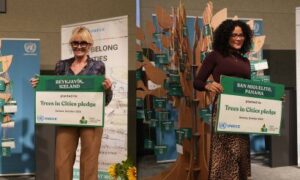
Plant your Pledge: Trees in Cities at the Forum of Mayors | 2026 Forum of Mayors
12 – 13 Oct 2026
WIPO
Conference
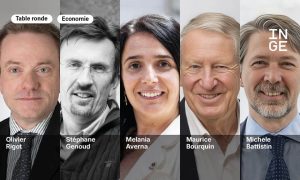
Table ronde « Le nucléaire, une technologie d’avenir ? »
12 Oct 2026 | 18:30
Les Salons
INGE

Virtual
Nature as Urban Infrastructure: Local Solutions to Heat, Flooding and Fires | Forum of Mayors 2026 Side Event
13 Oct 2026 | 08:10 – 09:45
WIPO | Room B
Global Cities Hub - Geneva, UNECE, UNEP, UNDRR
Body Meeting
95th session of the Working Party on Pollution and Energy | Transport
14 – 16 Oct 2026
Palais des Nations | Room III
UNECE

Body Meeting
87th session of the Committee on Housing, Urban Development and Land Management
14 – 16 Oct 2026
Palais des Nations | Room CC
UNECE

Consultation
2nd Dialogue, From Resolution to Action: Advancing Circularity and Material Efficiency Across Minerals and Metals Value Chains
14 Oct 2026 | 09:00 – 10:30
WIPO | Room NB.0 197 & Online
UNEP

Conference
From Knowledge to Action: Communication for a Safer World
14 Oct 2026 | 09:30 – 17:00
IFRC Headquarters | Auditorium B & Online
UNDRR, UNESCO, IFRC, Switzerland
Conference
When Home is Lost: From Prevention to Durable Solutions for Disaster Displacement
14 Oct 2026 | 10:00 – 12:00
Domaine de la Pastorale & Online, Zoom
UNDRR, IDMC, IOM, Platform on Disaster Displacement
Conference
Rethinking UN Financing in the UN80 Context: A Spotlight on Pollution
14 Oct 2026 | 12:30 – 14:00
International Environment House I | Room 1 & Online | Webex
BRS, UNU-CPR, GEN
Virtual
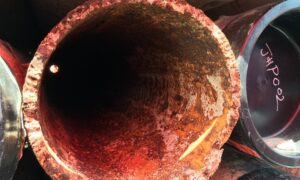
Mercury from Contaminated Steel in the Oil and Gas Industry: Challenges with Analysis, Waste Treatment, Disposal and Recycling | Hg in Steel – Learning from Global Approaches
14 Oct 2026 | 13:00 – 15:00
Online | Teams
UNEP Global Mercury Partnership
Virtual
From COP17 to COP18 and beyond: Finding Common Ground on Drought
14 Oct 2026 | 13:00
Online | Zoom
IDMP
Conference
E-waste Refurbishment, Repair and Repurpose: Towards Zero Waste Goals to Protect the Environment and Human Health – Celebrations for International E-waste Day 2026
14 Oct 2026 | 13:00 – 14:30
Online | Zoom
BRS
Conference
Resilient housing in a changing risk landscape – A Geneva roundtable for International Day for Disaster Risk Reduction 2026
14 Oct 2026 | 14:30 – 16:30
Domaine de la Pastorale
UNDRR, UN-Habitat, Global Cities Hub - Geneva, UNDP, UNECE

Virtual
Global Roundtable | Legal and Regulatory Frameworks for Stockholm Convention Implementation
14 Oct 2026 | 15:00 – 16:30
Online | Zoom
UNEP, GEF, GGKP

Conference
How Well Are National Climate Plans Protecting Health? Launching the GCHA Healthy NDC Scorecards
14 Oct 2026 | 18:30 – 20:00
Maison de la Paix | Auditorium A2
GCHA, IHEID, Geneva Global Health Platform, GEN, Climate Solutions for Health Lab, Wellcome Trust, Clean Air Fund
Conference
TESS Annual Conference on Trade, Climate, and Sustainable Development (TCSD) 2026
15 – 16 Oct 2026
Villa Barton
TESS
Conference
Policy Brief on Global Water Governance by the Special Rapporteur on the human rights to safe drinking water and sanitation
15 – 16 Oct 2026
Palais des Nations | Room XI
Special Procedures of the UN Human Rights Council

Conference
Facing Extreme Heat in Europe: Reviewing Summer 2026 – Preparing for Summer 2027
15 Oct 2026 | 09:30 – 16:30
Domaine La Pastorale
UNDRR, Switzerland
Virtual
Programme of Work and Budget for 2026–2027 & Status of Contributions (Parties only) | Minamata Online
15 Oct 2026 | 13:00 – 14:00
Online | Webex
Minamata Convention
Virtual
Online Symposium | Driving Climate Commitments toward a Just Transition
15 Oct 2026 | 13:00 – 17:00
Online
GCHRAGD
Virtual
From Evidence to Investment: The Systemic Challenges Facing Nature-based Infrastructure
15 Oct 2026 | 15:00 – 16:00
Online | Zoom
IISD
Body Meeting
Meeting of the UNECE Team of Specialists on Monitoring Sustainable Forest Management
16 Oct 2026 | 09:00 – 12:00
Online
UNECE
Jobs
See all
Professional
Programme Officer – Environment Programme, with a focus on conservation in Brazil and neighbouring countries
12 Oct 2026
Oak Foundation




Updates
See all

14 Feb 2026
The Growing Environmental Risks of E-Waste


29 Sep 2026
Cities, the Environment and the Role of Geneva
