Update
One Health and the Role of Geneva

The COVID-19 pandemic has reminded us of the deep connections between health and the environment. Adopting a One Health approach is critical not only to prevent outbreaks in zoonotic diseases, but also other urgent environmental issues including food safety and antimicrobial resistance. This page aims at listing the latest information, research, data and/or press releases issued by our partners in Geneva and other institutions around the world.
One Health Approach
One Health is an approach in which multiple sectors work together to achieve better public health outcomes (WHO, 2017). It is rooted in the recognition that human health and animal health are interdependent and bound to the health of the ecosystems in which they exist (WOAH, n.d.). The complex nature of the interactions between people, animals and plants renders this collaborative, multisectoral and transdisciplinary approach critical to addressing future health risks and challenges.
The One Health High Level Expert Panel (OHHLE) – the advisory panel convened by World Health Organization (WHO), Food and Agriculture Organization (FAO), World Organization for Animal Health (WOAH, formely known as OIE) and United Nations Environment Programme (UNEP) – has elaborated a new operational definition of One Health.
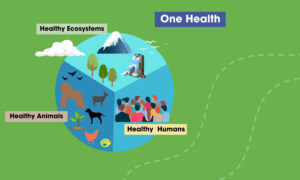
One Health is an integrated, unifying approach that aims to sustainably balance and optimize the health of people, animals and ecosystems. It recognizes the health of humans, domestic and wild animals, plants, and the wider environment (including ecosystems) are closely linked and inter-dependent.
The approach mobilizes multiple sectors, disciplines and communities at varying levels of society to work together to foster well-being and tackle threats to health and ecosystems, while addressing the collective need for clean water, energy and air, safe and nutritious food, taking action on climate change, and contributing to sustainable development.
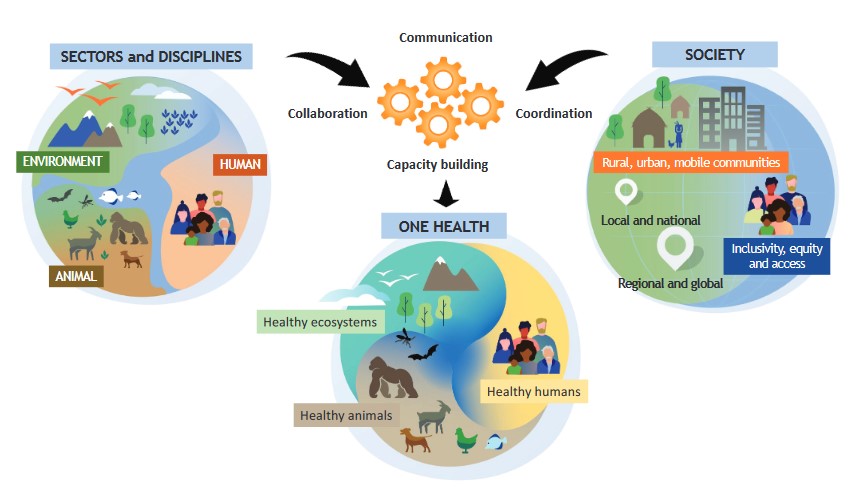
Illustration of the One Health approach by the OHHLEP
The collaborative work of the Food and Agriculture Organization of the United Nations (FAO), the United Nations Environment Programme (UNEP), the World Health Organization (WHO) and the World Organisation for Animal Health (WOAH – founded as OIE) to address risks at the human-animal-ecosystems interface was formally laid down in 2010 in the FAO/OIE/WHO Tripartite Concept Note and is being increasingly recognized by the global community, with the name and the structuring of the Secretariat officially becoming the “Quadripartite” when UNEP signed a Memorandum of Understanding for collaborative One Health work at the 28th Tripartite Executive Annual Meeting.
The Quadripartite works to mainstream One Health to improve prevention, predicting, detection, and responding to global health threats and promote sustainable development. At their first annual meeting as a quadripartite in March 2023, the partners launched a call to action for enhancing collaboration and cross-sector commitments to address global health emergencies. Priority actions all countries should undertake, include:
- Prioritize One Health in the international political agenda, increase understanding and advocate for the adoption and promotion of the enhanced intersectoral health governance;
- Strengthen national One Health policies, strategies and plans;
- Accelerate the implementation of One Health plans;
- Build intersectoral One Health workforces;
- Strengthen and sustain prevention of pandemics and health threats at sourc;
- Encourage and strengthen One Health scientific knowledge and evidence creation and exchange; and
- Increase investment and financing of One Health strategies and plans.
To fulfil its coordination and promotion role, the Quadripartite announced a One Health Joint Action Plan implementation guide released in 2023.
Other institutions also provide useful resources to understand the One Health approach and its value for improving health.
- WHO: One Health | One Health in the WHO European Region | Newsletter
- FAO: One Health | Strategic Action Plan (2011)
- WOAH: One Health
- What is One Health | One Health Commission
- One Health | Swiss Tropical and Public Health Institute
- One Health | Biovision
- Quadripartite One Health Intelligence Scoping Study | Quadripartitie Alliance on One Health | November 2023
- WHO urges investing in “One Health” actions for better health of the people and the planet | 3 November 2023
- The Quadripartite Alliance and One Health | Inger Andersen | 27 March 2023
- Achieving health for all requires action on the economic and commercial determinants of health | Tedros Adhanom Ghebreyesus | The Lancet | 23 March 2023
- The Lancet Series on One Health and Global Health Security | The Lancet | 19 January 2023
- One Health for the Future: Three Pathways Against Tomorrow’s Crises | Foraus | August 2022
- Health in the Global Environmental Agenda: A policy guide | IISD | 20 January 2022
- Safeguarding Animal, Human and Ecosystem Health: One Health at the World Bank | The World Bank | 9 July 2020
- ‘One Health’- A Multi-dimensional Approach to Health | Public Health Notes | 23 November 2019
- Integrated approaches to health – A handbook for the evaluation of One Health | Simon Rüegg et al. | 2018
International Cooperation
Collaboration is a central component of the One Health approach as it transcends thematic boundaries and calls for comprehensive responses on health issues. International institutions, in International Geneva and beyond, have established collaborative programs to achieve the common goal of protecting health. This section provides information on these efforts.
One Health at the UN Environment Assembly
The deep connections between ecosystem health and human health were on the agenda of the second segment of the fifth UN Environment Assembly (UNEA-5.2), held in February 2022 in Nairobi. The concluding Ministerial Declaration recognized the risk for future pandemics and other health risks if humanity doesn’t overhaul its patterns of interaction with nature by adopting a holistic approach such as One Health. In this context, a resolution on animal welfare calls on Member States to protect animals, protecting their habitats and meeting their welfare requirements (UNEP/EA5/L10/REV.1). Another resolution on biodiversity and health recognizes the importance of the One Health approach to address the impacts of environmental crises on global health (UNEP/EA5/L11/REV.1). It further calls on Member States to promote the sustainable use, conservation and restoration of biodiversity with a view to preventing current and future health risks, including disease outbreaks with epidemic and pandemic potential.
One Health Summit
The One Health Summit was hosted by the World Health Organization (WHO) and the Government of France under the French G7 Presidency from 5 to 7 April 2026 in Lyon, France. It concluded with commitments to turn the One Health approach into real-world action. As underscored by the World Health Day Campaign 2026, improving our understanding of the animal–human–environment connection is essential to prevent future pandemics and hinges on collaboration, coordination, communication and capacity-building. Recognizing this interconnectedness, the Summit highlighted how coordinated efforts strengthen international dialogue and mobilize public and private partners for the common goal of One Health. It concluded with renewed efforts from governments and agencies to improve the global health architecture and to advance the integration of the One Health approach across climate action.
Pandemic Treaty and One Health
The Intergovernmental Negotiating Body, established by the World Health Organization in 2021, after more than three years of intensive negotiations, reached a significant milestone on 20 May 2025 when the World Health Assembly formally adopted by consensus the world’s first Pandemic Agreement. This landmark decision culminates more than three years of intensive negotiations launched by governments in response to the devastating impacts of the COVID-19 pandemic, and driven by the goal of making the world safer from – and more equitable in response to – future pandemics. → Read the WHO press release.
- Progress on draft pandemic agreement important step – Türk | OHCHR | 17 April 2025
- WHO Member States conclude negotiations and make significant progress on draft pandemic agreement | WHO | 16 April 2025
- Nations clinch pandemic treaty in sign that ‘multilateralism is alive and well’ | Geneva Solutions | 16 April 2025
- Countries Say YES to Pandemic Agreement | Health Policy Watch | 16 April 2025
- Countries finalize historic pandemic agreement after three years of negotiations | UN News | 16 April 2025
- First global pandemic treaty agreed — without the US | Nature | 16 April 2025
- States agree on landmark pandemic treaty with key implications for LRGs | Global Cities Hub | 16 April 2025
World Health Day
2026 Celebration
7 April is World Health Day, a global health awareness day that draws attention to a health topic of concern to the world. Celebrated every year, it also marks the anniversary of the founding of the World Health Organization in 1948. In 2026, the theme for World Health Day is “Together for health. Stand with science“.
Under the theme “Together for health. Stand with science”, this year’s observance launches a year‑long campaign celebrating the power of scientific collaboration to protect the health of people, animals, plants, and the planet. The campaign spotlights both scientific achievements and the multilateral cooperation needed to turn evidence into action – through a strong focus on the One Health approach.
Anchoring the 2026 campaign are two major global moments: the International One Health Summit (7 April), hosted by WHO and the Government of France under the French G7 Presidency, and the inaugural Global Forum of WHO Collaborating Centres (7–9 April), gathering nearly 800 scientific institutions from over 80 countries. Together, these events form the largest scientific network ever convened around a United Nations agency, underscoring how science‑driven partnerships can build a healthier, safer future for all.
The campaign invites people everywhere to participate – by celebrating scientific achievements, engaging with evidence, sharing personal stories of how science improves lives, and joining the global conversation through #StandWithScience and #WorldHealthDay.
One Health Day
While not an official UN observance, 3 November is celebrated by many as One Health Day. The global campaign is co-coordinated by the One Health Commission, the One Health Initiative Autonomous pro bono Team and the One Health Platform Foundation with the aim of bringing global attention to the need for One Health collaborations.
Zoonoses and Emerging Diseases
Zoonoses – diseases or infections that are naturally transmissible from vertebrate animals to humans (WHO, 2020) – are one of the health risks where the deep interconnections of human, animal and environmental health are most visible. Around 60% of existing human infectious diseases are zoonotic and 75% of emerging infectious diseases (including Ebola, HIV, influenza, COVID-19) have an animal origin (WOAH, n.d.). Controlling zoonotic pathogens at their animal source is the most effective and economic way of protecting people (WOAH, n.d.).
Food Safety
Food is another crucial theme to which the One Health approach can bring meaningful contributions. While food quality is a crucial component of human health, food production is highly reliable on animal and plant health. Moreover, many important zoonoses relate in some way to animals in the food production chain. Food is indeed an important vehicle for zoonotic pathogens, creating a deep bond between animal health on human health. The One Health approach is thus important for ensuring food safety. This section provides relevant resources in that area.
Antimicrobial Resistance
Antimicrobial resistance (AMR) occurs when microorganisms such as bacteria, viruses, fungi and parasites change in ways that render the medications used to cure the infections they cause ineffective (WHO, 2017). AMR is a global health concern as AMR infections cause 700’000 deaths each year and may become the leading cause of deaths globally by 2050 (UK O’Neill’s Commission, 2016). Although AMR occurs naturally, it is facilitated by the misuse and overuse of antibiotics in human health, food-animal production and agriculture, along with poor management of waste from households, farms, factories and healthcare settings (UNEP, n.d.). AMR depends greatly on the interaction between humans, animals and the environment, hence, adopting a One Health approach is critical for developing appropriate responses. This section presents the latest progress on addressing AMR through a One Health approach.
The 78th session of the World Health Assembly introduced a Global action plan (GAP) on antimicrobial resistance (AMR), for discussion at next year’s World Health Assembly (WHA79) in 2026. A78/8: Antimicrobial resistance – Report by the Director-General
The updated plan will ensure the latest guidance is available to help countries accelerate implementation. It will reflect a multisectoral One Health approach, which aims to sustainably balance and optimize the health of people, animals and ecosystems. Looking ahead, other WHO priorities include supporting countries to achieve efficiencies by integrating AMR interventions in health sector planning and financing, and enhancing coordination and governance of the AMR response at all levels, including with the Quadripartite.
World Antimicrobial Awareness Week
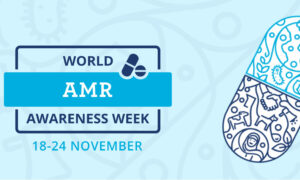
World Antimicrobial Awareness Week (WAAW) is celebrated from 18-24 November every year. This year’s theme, Act Now: Protect Our Present, Secure Our Future, underscores the urgent need to take bold, united action to address AMR. AMR is already harming our health, food systems, environment and economies. It’s not a future challenge. It is happening now. Drug-resistant infections are increasing, yet awareness, investment and action are still falling short.
Biodiversity and Conservation
All human health ultimately depends on ecosystem services that are made possible by biodiversity and the products derived from them. Indeed, functioning ecosystems provide us with food and fresh water, aids in regulating climate, floods and disease, and provides recreational benefits (CBD, 2020). Investigating the complex interlinkages between biodiversity, ecosystem services and human health is thus essential to comprehensively address risks to human health. This section provides information on the application of the One Health approach in the field of biodiversity and conservation.
Climate Change
Global warming poses a growing threat to human health, as it impacts many vital elements of our lives such as air quality, access to drinking water, food security and the safety of our homes. Between 2030 and 2050, climate change is expected to cause approximately 250 000 additional deaths per year, from malnutrition, malaria, diarrhea and heat stress (WHO, 2018). Raising temperatures linked to climate change also contribute to animal migrations and offer favorable conditions for disease emergence and spread. Climate mitigation and adaptation is thus essential to decreasing health risks for both our generation and future generations.
At the 78th Session of the World Health Assembly, held in May 2025 in Geneva, the first-ever Global action plan on climate change and health for 2025–2028 was adopted. The plan marks an important step forward in global health and climate policy. The Global Action Plan aims to provide a strategic framework to guide Member States, the WHO Secretariat and other stakeholders in developing climate-resilient, low-carbon health systems; enhancing surveillance and early warning systems; protecting vulnerable populations; and integrating health into climate policy and financing mechanisms.
The Role of Geneva
Organizations are listed in alphabetical order.
Food and Agriculture Organization Geneva Office | FAO
FAO promotes a One Health approach as part of the agrifood system transformation for the health of people, animals, plants and the environment. Ensuring a One Health approach is essential for progress to anticipate, prevent, detect and control diseases that spread between animals and humans, tackle AMR, ensure food safety, prevent environment-related human and animal health threats, as well as combatting many other challenges. A One Health approach is also critical for achieving the Sustainable Development Goals (SDGs).
FAO works with partners to promote health systemically, in particular, the Quadripartite which includes FAO, UNEP, WHO and WOAH. FAO focuses on eliminating hunger, promoting food security, food safety and healthy diets, preventing and controlling transboundary diseases, zoonoses and AMR, to protect the livelihoods of farmers from the impacts of plant and animal diseases, and to increase the sustainability and resilience of agrifood systems, with One Health benefits. FAO’s Joint Centre for Zoonotic Diseases and Antimicrobial Resistance coordinates One Health across different FAO divisions to mainstream One Health in FAO activities.
foraus
foraus is the Swiss participatory think tank on foreign policy. foraus conducted the “One Health” for the future project from November 2021 to December 2022, exploring zoonoses, antimicrobial resistance (AMR), and food safety and security threats, three major public health challenges which “One Health” aims at preventing and addressing. The project resulted into recommendations for necessary policy steps to be taken at national and international levels together with practitioners and experts from the field and a policy brief.
Health Diplomacy Alliance
The Health Diplomacy Alliance aims at advance health initiatives through diplomatic channels and foster collaborations and cooperation among local, national, and international stakeholders to address complex health challenges while emphasizing inclusivity, equity, and sustainable solutions.
Rosa-Luxemburg-Stiftung Geneva Office
The Rosa-Luxemburg-Stiftung Geneva Office works on social rights, socio-ecological transformation and the international organization of workers through conferences, seminars, workshops publications, studies or reports. This include work on the One Health Approach, envisaged by RLS as “an open and inclusive process, outside of usual thinking patterns and existing multilateral processes.” Relevant publications include: “One Health for the Future: Three Pathways Against Tomorrow’s Crises” (2022) in collaboration with Foraus.
United Nations Environment Programme | UNEP
The United Nations Environment Programme (UNEP) joined the One Health Quadripartite in 2022 as most of its work already mainstreamed the One Health principles through the coherent implementation of the environmental dimension of sustainable development within the UN system, and serving as an authoritative advocate for the global environment. Pursuing its mandate of preserving the health of the environment, UNEP contributes to fostering the health and well-being of humans, animals and plants. It’s Chemicals and Health is supporting the process.
World Bank Group Geneva Office
The World Bank Group, including its Geneva Office, considers the One Health Approach a viable method to pursue its objectives of poverty eradication and boosting shared prosperity. Together with WHO, the World Bank co-convenes the Global Preparedness Monitoring Board (GPMB), an independent monitoring and accountability body, created in response to recommendations by the UN Secretary General’s Global Health Crises Task Force in 2017. World Bank publications on One Health include: Putting Pandemics Behind Us: Investing in One Health to Reduce Risks of Emerging Infectious Diseases (2022); One health: operational framework for strengthening human, animal, and environmental public health systems at their interface (2018).
World Intellectual Property Office | WIPO
Wastewater is increasingly recognized as a critical pathway and vital interface for One Health in the fight against the spread of antimicrobial resistant microorganisms and genes. The WIPO GREEN database contains 1,500 wastewater treatment technologies that provide innovative detection and treatment technologies that can mitigate AMR risks, strengthen environmental surveillance, and support national and global efforts to operationalize the One Health approach.
World Health Organization | WHO
WHO integrates One Health across its units and offices, providing strategic advice relating to policy, and conducting training at the local, national and regional levels. WHO is a member of the One Health Quadripartite with FAO, WOAH and UNEP. Together, they have developed a One Health Joint Plan of Action that includes a set of activities that the 4 organizations can do together, including working with political leaders to establish the needed infrastructure and funding. WHO is the secretariat for the One Health High-Level Expert Panel (OHHLEP), which provides scientific advice to the Quadripartite partners on One Health priority setting, policies and strategies. This includes recommendations on good practice guidelines, a model One Health Surveillance System, a comprehensive list of upstream drivers of zoonotic disease spillover and recommendations to mitigate these risks.
Local Geneva & Switzerland
Federal Food Safety and Veterinary Office (FSVO)
In Switzerland, the “One Health” sub-organization, is led by the Federal Food Safety and Veterinary Office (FSVO) steers and coordinates this interdisciplinary, multi-sectoral cooperation. It brings together all the relevant federal and cantonal offices and associations in the fields of human medicine, veterinary medicine and natural, environmental and food sciences. The One Health sub-organization aims to work together to create added value in terms of human and animal health, and to have a positive effect on the environment. The Swiss Federal Office of Public Health (FOPH), Federal Food Safety and Veterinary Office (FSVO), Federal Office for Agriculture (FOAG) and Federal Office for the Environment (FOEN). together with the Armed Forces Veterinary Service and the cantonal enforcement agencies, set up in 2017 the One Health Interdisciplinary Platform to strengthen cooperation between public health, animal health, agriculture and the environment.
Academic Institutions
Geneva Graduate Institute (IHEID)
The Geneva Graduate Institute Global Health Centre is one of the research centres focusing on global health governance. As part of its research projects, the Governing Pandemics Initiative tracks efforts to address the gaps in the global system for governing preparedness for and responses to pandemics. The Global Health Centre’s Governing Pandemics initiative is tracking efforts to address the gaps in the global system for governing preparedness for and responses to pandemics. The Health Center hosts the Global Health Platform, which convenes stakeholders across the global health community in Geneva to collaborate, capture lessons, gain foresight from evidence and experience, to seek scalable solutions to complex global health challenges. The Platform organizes every year during the World Health Organization (WHO)’s World Health Assembly (WHA) hosts the Geneva Health Week, a series of side events and discussions around critical global health issues, raising awareness among member states attending WHA meetings. During the Geneva Health Week, the Platform provides important exposure for a wide range of global health actors, enhancing collaborations and partnerships for future discussions and events.
University of Geneva (UNIGE)
The interdisciplinary One Health Unit (OHU) of the University of Geneva addresses emerging issues in Global Health at the human-animal-ecosystem interface, including both health risks resulting from human-animal interactions such as zoonosis but also opportunities for health promotion associated to biodiversity conservation. This brings together theory and practice from a diversity of fields such as epidemiology of infectious diseases, veterinary public health, environmental health, zoology and disease ecology, urban ecology, conservation sciences, and citizen cyber-science. The OHU leads innovative teaching activities (e.g. MOOC, flipped‐classroom, distance education in Kenyan refugee camp) and interdisciplinary research (e.g. impact of snakebite on humans and animals in Cameroon and Nepal) in collaboration with local, national and international partners (University Hospitals of Geneva, Citizen Cyberlab, InZone, WHO, MSF, ITU, EPFL, Swiss TPH, Institut Pasteur, University of Montreal). The OHU promotes an integrated One Health approach and digital innovation to better understand and tackle global health challenges at the interface of human, animal and environmental health.
Swiss Tropical and Public Health Institute
The Swiss Tropical and Public Health Institute (Swiss TPH) is a world-leading institute in global health with a particular focus on low- and middle-income countries. Its One Health group develops theoretical and methodological foundations for integrated human and animal health approaches.
Learning
- Global Health at the Human-Animal-Ecosystem Interface | University of Geneva, Institute Pasteur, University of Montreal and Centre Virchow-Villermé/University Paris Descartes
- One Health: Connecting Humans, Animals and the Environment | Swiss Tropical and Public Health Institute & University of Basel
- Bats, Ducks, and Pandemics: An Introduction to One Health Policy | Princeton University
- Online training on navigating the Tripartite Zoonoses Guide (TZG) | FAO, OIE & WHO
- Brochures, Infographics and Educational Material | One Health Commission
GEN Events
Addressing Pharmaceuticals in the Environment through a Lifecycle Approach Event Series
Pharmaceuticals play a critical role in maintaining human and animal health, enhancing food production, and driving economic prosperity. However, their release into the environment—whether during manufacturing, use, or end of life — may pose significant risks. These include contributing to antimicrobial resistance, endocrine disruption, and toxic effects on ecosystems and public health.
The United Nations Environment Programme, in cooperation with the World Health Organization, the Geneva Environment Network, and other key partners, is organizing a series of events to raise awareness and share best practices, challenges and opportunities to address this pressing issue. The virtual events bring together experts, decision makers and other relevant stakeholders from around the world to discuss innovative practices throughout pharmaceutical lifecycle and across key sectors such as pharmaceutical manufacturing, healthcare facilities, agriculture, food production, and municipalities/households, shedding light on the benefits of action as well as existing tools.
The series of events was launched at the 2025 Meetings of the Conference of the Parties to the Basel, Rotterdam and Stockholm Conventions with the side event on “One Health Approach to Addressing Pharmaceuticals in the Environment Across Key Sectors”.
UNEP would like to acknowledge the financial contribution from the GEF and the Government of Sweden.









Nothing will happen without communities: The role of NGOs in strengthening environmental health
Geneva Health Forum 2022 | 4 May 2022

Nature-based Solutions and Health
Geneva Nature-based Solutions Dialogues | 26 April 2021
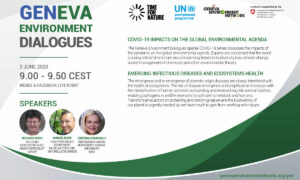
Emerging Infectious Diseases and Ecosystems Health
GENeva Environment Dialogues | 3 June 2022